You’ve put real money into your RV, and now you want it to feel like more than a box on wheels. The problem is that most decorating advice treats all RVs the same, which is like handing the same furniture plan to a studio apartment and a split-level house.
A Class A, Class C, fifth wheel, and travel trailer each have completely different bones, and what works brilliantly in one can feel cramped or mismatched in another.
Before you buy a single throw pillow or hang a piece of wall art, you need to understand what you’re actually working with structurally.
These RV decorating ideas will save you from expensive mistakes and a rig that never quite feels right.
Decorating a Class A Motorhome for a Residential Feel
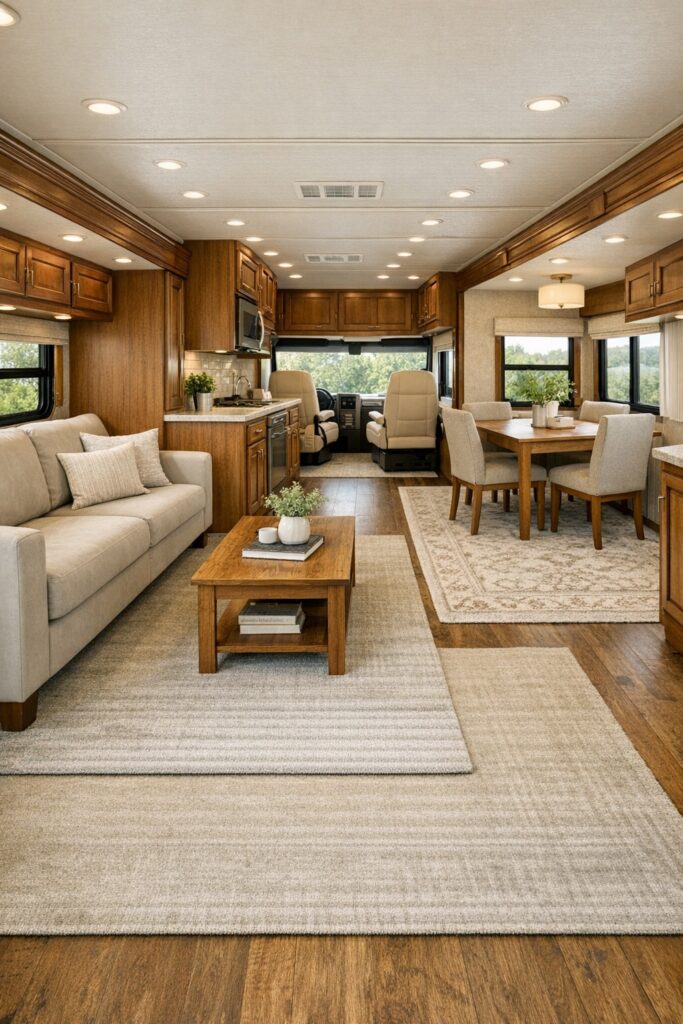
Class A motorhomes give you the most floor space to play with, but that open layout can just as easily feel like a long, undifferentiated hallway if you don’t approach it with intention.
The good news is that a few well-placed design choices go a long way toward making a Class A feel genuinely residential rather than like a vehicle you happen to sleep in.
Strategic zoning and upgraded finishes are where most of the heavy lifting happens, and neither requires a full renovation budget. Understanding how those two things work together is where to start.
Using larger rugs and defined living zones
Large area rugs are the most effective tool a Class A owner has, and most people underestimate them completely. Dropped in the right spots, they carve out a dining zone, a lounge area, and a bedroom that each feel deliberate rather than accidental.
That zoning technique is what separates a rig that feels like one long corridor from one that feels like a home with actual rooms. Size matters here, so go bigger than feels comfortable on paper, because a rug that’s too small just floats in the space and defeats the whole purpose.
Upgrading lighting and hardware for luxury appeal
Factory RV lighting and hardware exist to hit a price point, not to make you feel good about where you’re living. Swapping in dimmable LED fixtures, pendant lights, or recessed options transforms how a space reads at every hour of the day.
From there, replace plastic switch plates with metal versions and upgrade cabinet pulls to brushed nickel or matte black finishes. Those changes cost relatively little but they’re what separates a rig that looks like it rolled off a lot from one that looks like someone actually thought it through.
| READ THIS: The Ultimate Guide to RV Decorating Ideas (Inside, Outside & Every Style in Between). |
Class C RV Decorating Ideas for Compact Layouts
Class C rigs are clever machines, but their layouts work against you in ways that aren’t obvious until you’re actually living in one. The combination of narrow walkways and that jutting over-cab section creates design challenges you won’t find in any other RV type.
The answer isn’t to decorate less but to decorate smarter, choosing pieces that earn their place and never get in the way. Getting that balance right makes a compact Class C feel intentional rather than cramped.
Styling the over-cab sleeping area
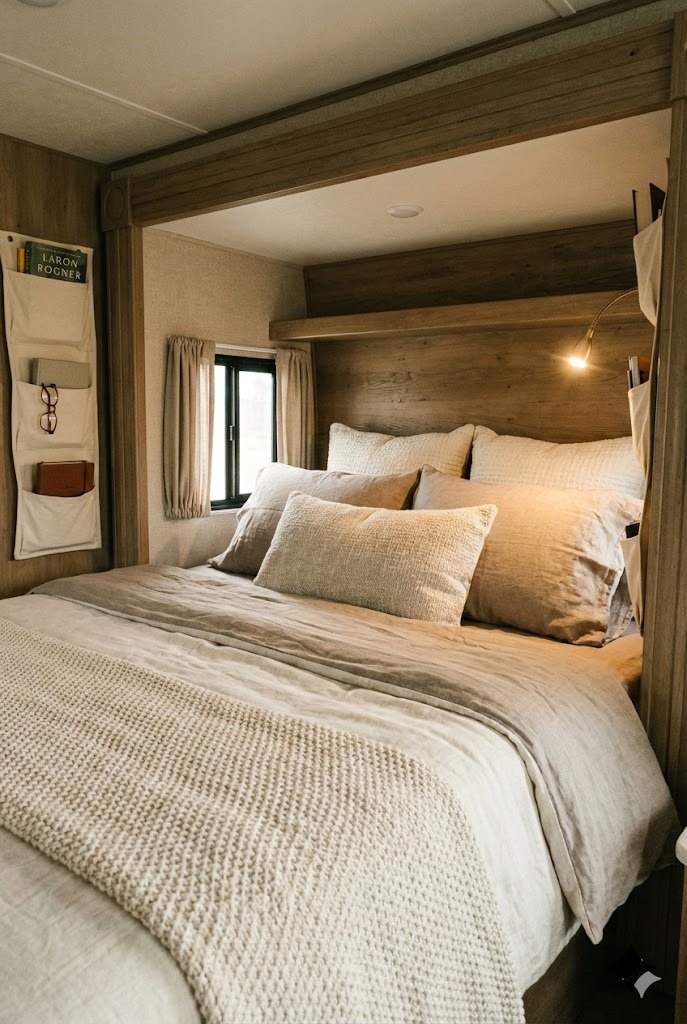
The over-cab area in a Class C is almost always wasted, stuffed with gear nobody can reach and ignored decoratively. Treat it as an actual sleeping space by fitting it with coordinating sheets, adding a gooseneck reading light, and lining the walls with fabric storage pockets that keep small items from migrating everywhere.
A little attention up there makes the whole front of the rig feel pulled together rather than like an afterthought. It’s one of the highest-impact, lowest-cost changes you can make in a Class C.
Keeping decor streamlined for narrow walkways
Narrow walkways demand a level of editing that most people aren’t used to applying to their living spaces. Any protrusion, whether it’s a bulky wall hanging, a protruding shelf, or a floor decoration, becomes a shin hazard by nightfall and a frustration every single day.
Flat-mounted art, recessed shelving, and slim-profile accessories aren’t compromise choices in a Class C; they’re the right choices. Think of the walkway as a design constraint that forces you toward cleaner, smarter solutions rather than a limitation you’re settling for.
SEE THIS: Small RV Decorating Ideas That Make Tight Layouts Feel Bigger.
Fifth Wheel Decorating Ideas for Zoned Living
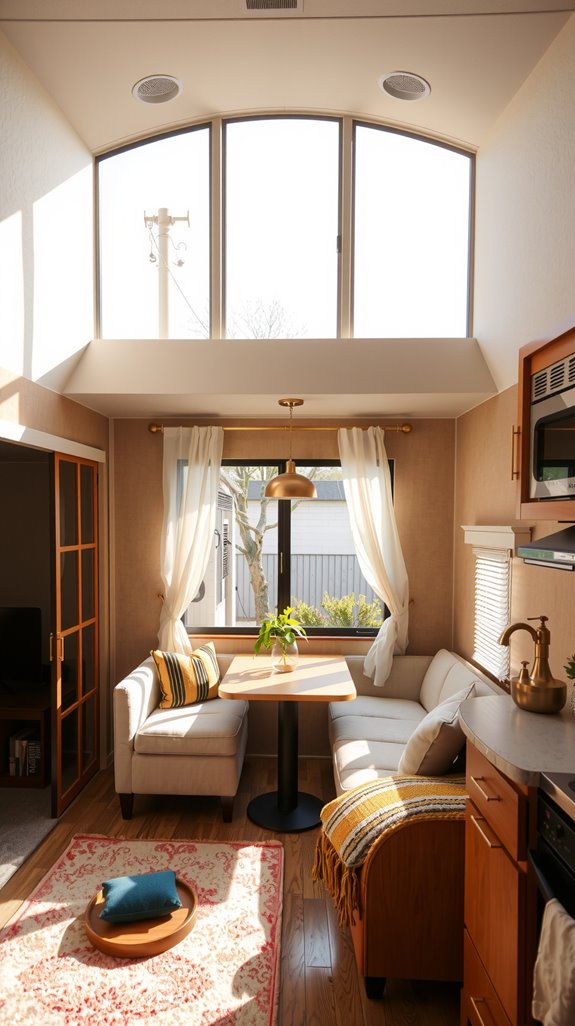
Fifth wheels come with a structural head start that no other RV type has: the split-level layout already creates natural separation between living and sleeping spaces before you’ve done a thing. That built-in zoning is genuinely useful, but it only works if you lean into it deliberately rather than letting the two levels drift apart visually.
The challenge is making distinct zones feel cohesive rather than like two unrelated rooms that happen to share a hitch. Get that balance right, and a fifth wheel can feel more like a real home than almost any other rig on the road.
Designing separate living and sleeping areas
Use the fifth wheel’s natural division as your foundation and build on it with intention. Different rugs in each zone, varied lighting temperatures between levels, and a curtain or room divider where you want genuine privacy all reinforce the separation that’s already there structurally.
The key is making each zone feel complete on its own without losing the sense that they belong to the same space. Define the boundaries clearly, and the whole rig becomes easier to live in and easier to look at.
Creating a cohesive palette across split levels
Two distinct zones can easily start feeling like two unrelated rooms, which kills any sense that the rig was designed rather than assembled. A consistent hardware finish, repeated fabric patterns, or a shared wood tone moving through both levels is what prevents that disconnected feeling.
You don’t need the upper and lower areas to look identical, but they should clearly be having the same conversation. Pull one or two design elements through both spaces and the whole interior reads as one thought-out decision rather than a series of separate ones.
SEE THIS: Boho, Rustic, Modern & Western RV Decorating Styles.
Travel Trailer and Small Camper Styling Tips
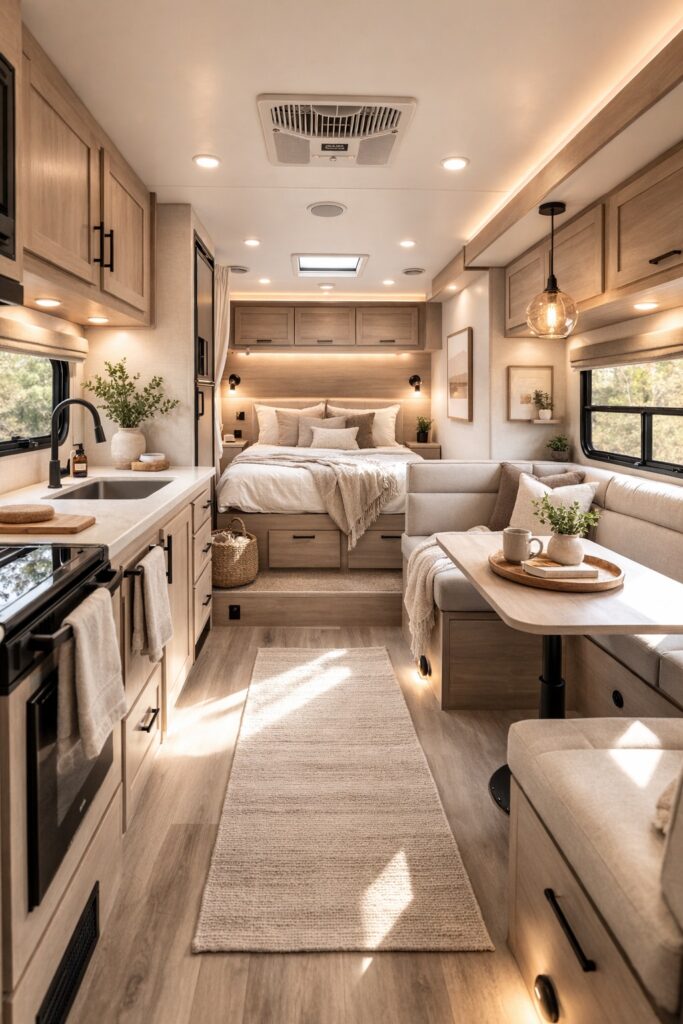
Working in a travel trailer or small camper means accepting from the start that every square inch is a negotiation. There’s no room for decorating that only does one thing, and there’s no room for surfaces loaded with objects that don’t genuinely matter.
The rigs that feel good to live in are the ones where every item was chosen with both function and appearance in mind. Get that discipline locked in early and the small footprint stops feeling like a constraint.
Decorating tiny layouts without visual clutter
A tight space fractured by competing colors and surfaces loaded with accessories feels chaotic in a way a larger rig can absorb but a small camper simply cannot. Stick to two or three colors throughout and treat your palette as a quiet background rather than the main event.
Keep surfaces edited down to pieces that genuinely matter to you, because in a compact layout, clutter isn’t just an aesthetic problem but a livability one. The restraint you apply here is what makes the space feel curated rather than crowded.
Using multi-functional decor pieces
In a travel trailer, your decor and your storage are the same conversation, and the sooner you accept that, the better your rig will feel.
Ottomans with hidden compartments, decorative baskets that actually hold supplies, and mirrors that open up sightlines while doing something practical aren’t stylistic compromises but smart decisions dressed up nicely.
Wall art that conceals a fold-down table or Murphy bed takes that thinking even further, giving you square footage you didn’t know you had. Every piece should be able to answer the question of what it’s actually doing there beyond just looking good.
SEE THIS: RV Bathroom Decorating Ideas That Maximize Style & Space.
Matching Decor to RV Structure and Storage
No matter how solid your design plan looks on paper, the structural realities of your specific rig will override it the moment you start hanging things and moving furniture.
Slide-outs, ceiling clearances, and built-in cabinetry are fixed variables that shape everything around them, and ignoring them leads to costly mistakes and real frustration.
The rigs that look and feel the best are always the ones where the owner decorated with the structure rather than around it. Taking the time to understand those constraints before you buy anything is the difference between a plan that works and one that doesn’t.
Working with slide-outs and ceiling height
Measure before you mount anything near a slide-out seam, because wall art or shelving installed too close will get destroyed the first time the slide moves. Low-profile light fixtures matter more than most people expect, especially in zones where a standard pendant would bottom out against your head or get clipped by the ceiling.
Think through how your furniture placement changes when slides extend versus when they retract, and choose pieces that work in both configurations without requiring constant adjustment. A little planning upfront saves you from reorganizing the entire interior every time you set up camp.
Adapting decor based on built-in cabinetry
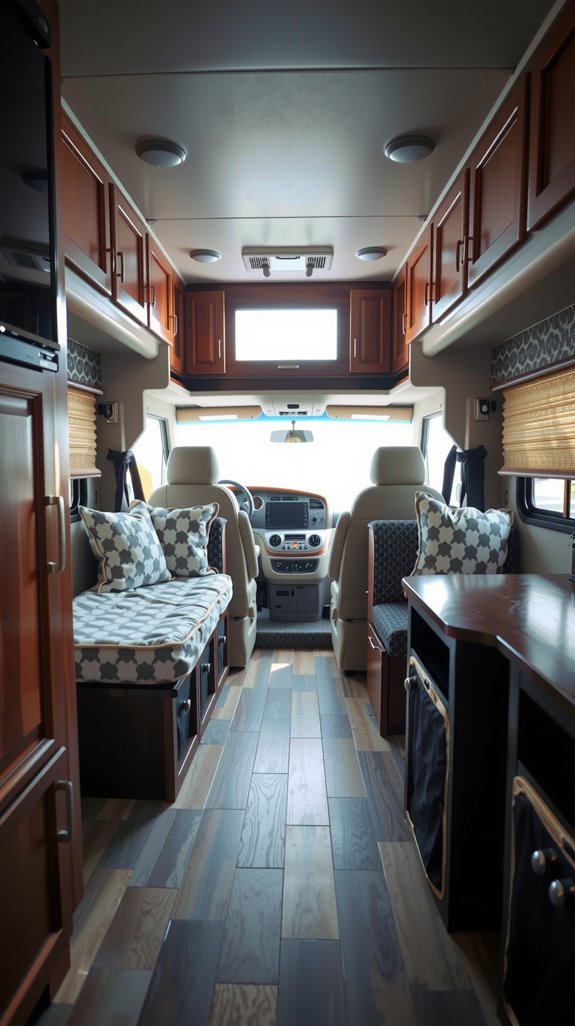
Built-in cabinetry is one of the most overlooked structural factors in RV decorating, and it shapes every textile, color, and accessory choice you make. Dark wood cabinets pull light from a space aggressively, and they need lighter wall colors and fabrics to keep the interior from feeling like a cave.
Lighter cabinets give you more flexibility, but they still demand coordination rather than improvisation. Work with what’s bolted in and treat the existing finishes as your starting point, because replacement cabinetry almost never ends up in the actual budget.