You picked a small living room right when POP ceilings, thats plaster of paris false ceilings, quietly became the smartest fix for low-height apartments.
A 9-foot ceiling doesn’t leave much room for drama, but the right design adds depth without stealing your headspace.
Twelve specific layouts work especially well for rooms under 150 square feet, and a few of them will genuinely surprise you.
Why POP Ceilings Suit Low-Height Apartment Living Rooms
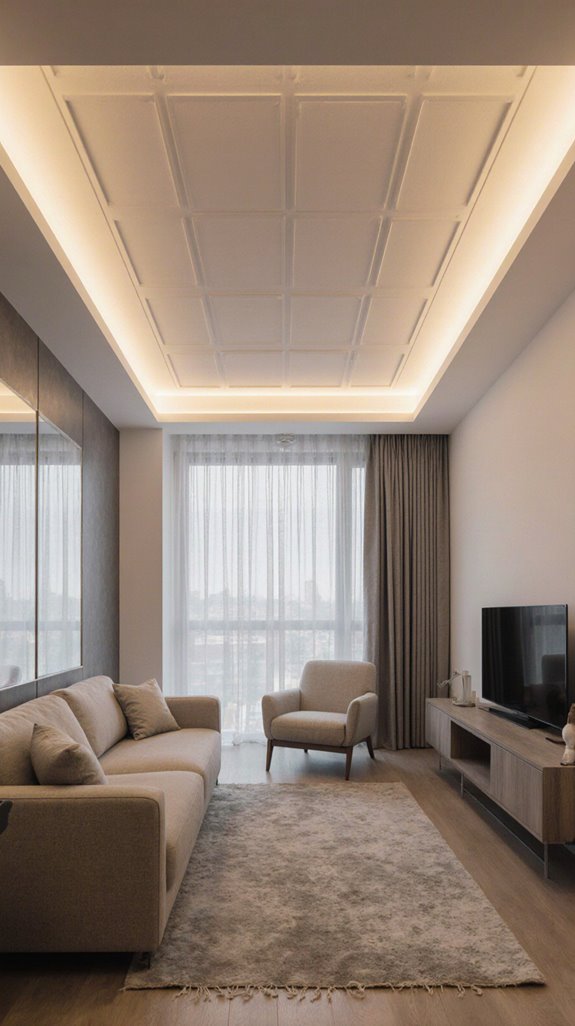
Low ceilings in compact apartments, typically found in units between 25 and 40 square meters, don’t have to feel like a lid pressing down on you.
POP, or Plaster of Paris, lets you add shallow trays, slim coves, and perimeter borders that pull your eye upward instead of sideways. A 2,3 inch drop conceals wiring and junction boxes without stealing headroom.
Light-colored POP finishes reflect more light than standard putty coats, making the room read taller. Pair that with vertical strip lighting or full-height curtains and you’ve quietly tricked the room into feeling bigger than its slab height suggests. Choosing upholstery that matches your wall color allows furniture to blend in, keeping the overall space feeling open and uncluttered.
POP Ceiling Cost for Small Living Rooms in 2026?
How much does a POP false ceiling actually cost for a small living room in 2026?
Expect $0.84–$1.57 per sq. ft. for basic to mid-range designs in Indian metros. A 10×12 ft living room, or 120 sq. ft., typically runs $126–$164 before GST.
Add 18% GST and that number climbs fast. Livspace quotes $1.00–$1.10 per sq. ft. as their base, but your final invoice rarely matches the brochure.
Labor alone eats 30–50% of the total. Multi-layer designs or LED coves push costs toward $2.62–$3.15 per sq. ft., so keep the design simple if your budget isn’t.
Getting multiple contractor quotes before committing is one of the most reliable ways to avoid overpaying in a market where pricing varies widely by city and experience level.
Peripheral Tray Ceiling for 10 X 12 Ft Compact Apartments
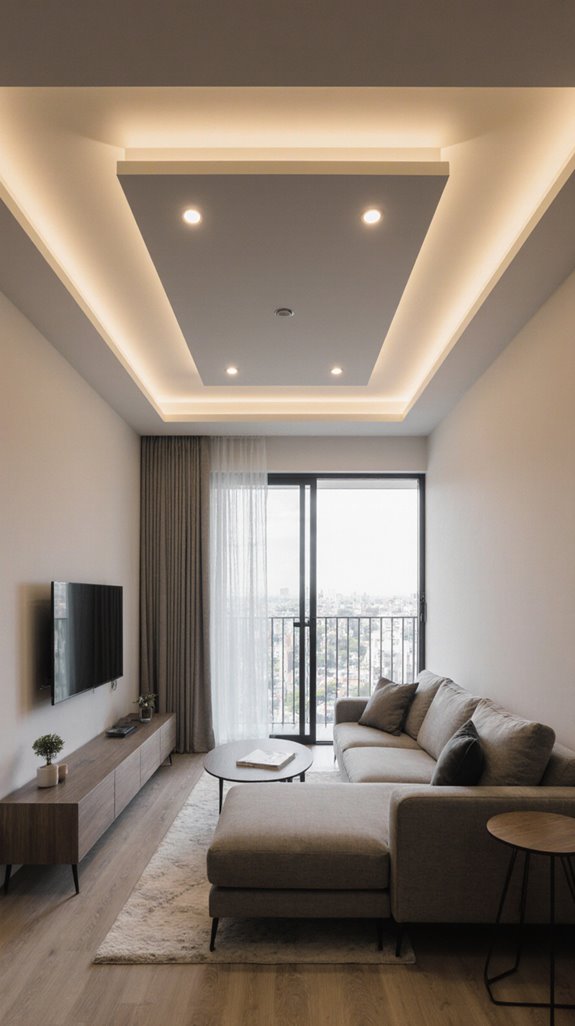
Once you’ve sorted your budget around $0.84–$1.57 per sq. ft., the next question is which design actually makes a 10 x 12 ft room feel bigger instead of smaller.
A peripheral tray ceiling keeps the flat center at full height while a 12, 24 inch POP band runs around the perimeter, dropping just 4, 8 inches.
That band frames the room without eating your headroom.
Paint the center off-white and the band a warm grey and suddenly your ceiling looks taller.
Its a straightforward trick that works specifically because you’re not touching the middle. Running LED rope lighting along the inner edge of that perimeter band draws the eye outward and adds a soft glow that makes the room feel wider than it actually is.
Cove Ceiling With LED Strip Lighting for Small Living Rooms
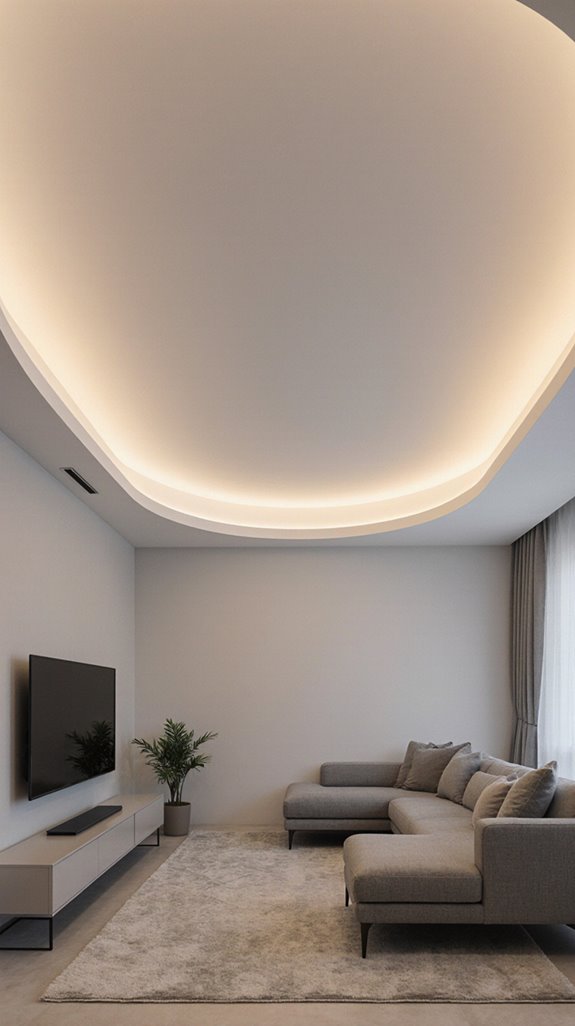
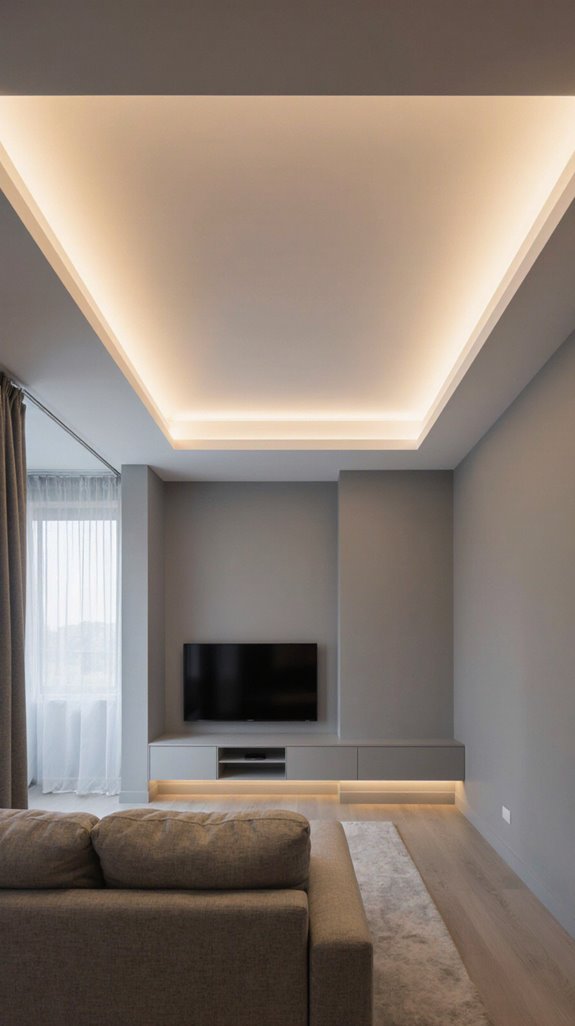
A cove ceiling hides LED strips in a recessed ledge at the wall, ceiling junction, bouncing light upward so your ceiling glows instead of your eyes squinting at a bare bulb.
Set the lip 200 mm below your slab and keep the pocket 60, 80 mm deep, with strips sitting 30, 45 mm back from the edge to avoid visible diodes.
Use 24 V constant voltage strips at 8, 10 W/m, a CRI of 90 or higher, and 2700, 3000 K for that warm hotel feel.
A properly sized driver follows a simple rule: total wattage multiplied by 1.25, and you’re going to want to size it carefully because undersized drivers are one of the most common mistakes people make when they are installing their lighting system. For longer coves, power-feed both ends to maintain even brightness across the full run.
Floating Panel POP Design That Adds Depth to Tight Spaces
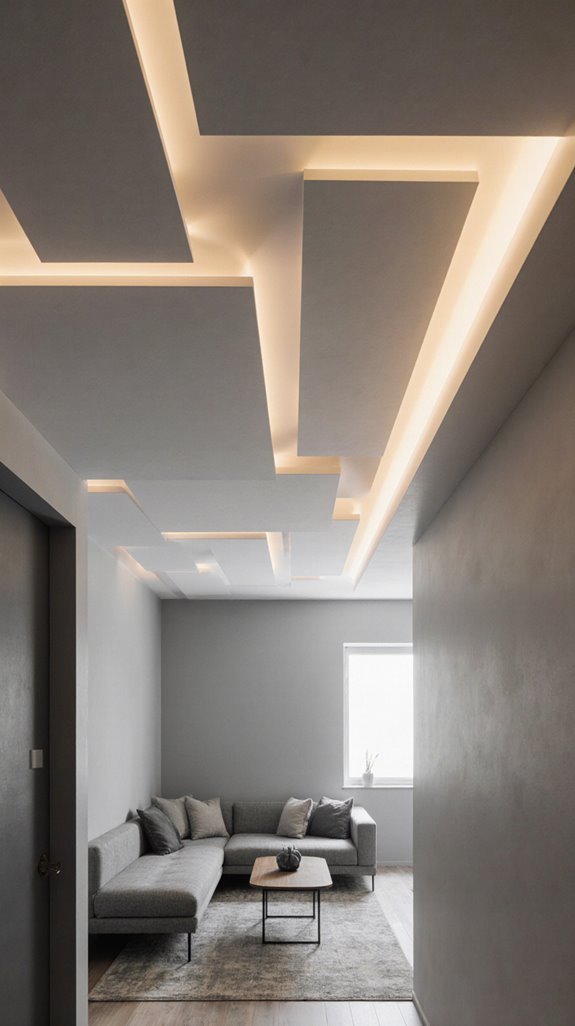
Unlike a full dropped ceiling that boxes you in, a floating panel POP design is just a single suspended slab of plaster, or two or three if you’re feeling ambitious, hung below your main structural ceiling with a deliberate gap left around the edges.
Modern ceiling styles for new homeowners can greatly enhance the aesthetic of a space. Many opt for sleek designs that integrate lighting elements seamlessly, providing both functionality and visual appeal. Additionally, bold textures and colors can transform a room, making it uniquely personal and inviting.
Affordable ceiling upgrades for dads can enhance a room’s aesthetic without overwhelming the space. Many families are opting for these stylish alternatives to traditional ceilings. They provide an opportunity to express personal style while keeping renovation costs manageable.
That gap does real work. Tuck an LED strip inside it and you get a soft halo effect that visually lifts the panel. A 10–12 mm shadow gap emphasizes the panel’s proportions and naturally draws the eye upward, making the room feel taller than it actually is.
Keep the drop under 8, 10 inches, size the panel to 60, 70% of your room’s footprint, and a tight 10×12 ft living room suddenly reads taller, layered, and intentionally designed.
L-Shaped POP Channels for Open-Plan 1–2 BHK Living Rooms
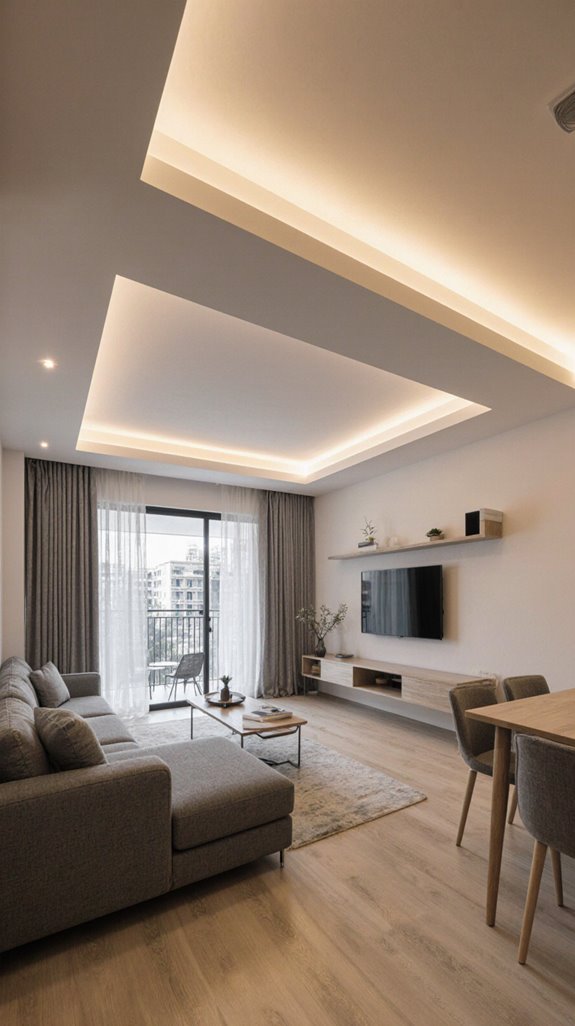
Floating panels work great when you’re dealing with a single defined zone, but the moment your living room bleeds into a dining area or study nook, welcome to the open-plan 1,2 BHK, you need something that can turn a corner.
L-shaped POP channels do exactly that. Run the long leg along your living area, then let it bend toward the dining or study zone.
Keep channels 2,4 inches deep in ceilings under 9 feet. Add LED strips, 2700K over the sofa, 3500K over the dining table, and you’ve quietly zoned the entire space without a single wall. Area rugs can further reinforce each zone below the ceiling channels, visually anchoring your seating and dining arrangements without adding any physical dividers.
Clean Straight-Line POP Designs for Minimalist Modern Apartments
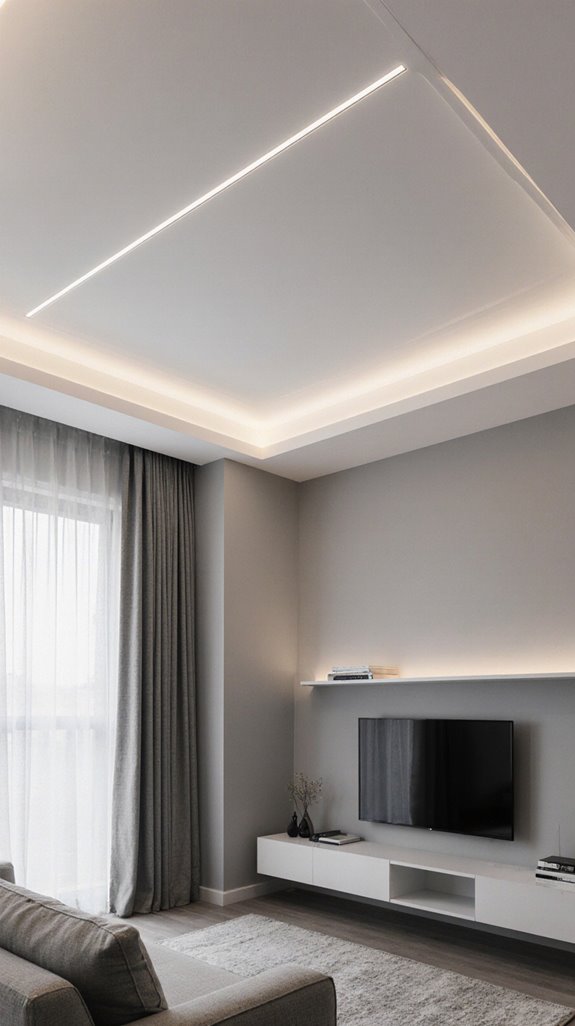
Most minimalist apartments don’t need drama on the ceiling, they need discipline. A single straight POP band, roughly 6,8 inches wide, running along your room’s longer wall does more work than a layered pattern ever could.
Keep the depth shallow, between 1.5 and 3 inches, so you’re not eating into your 9-foot headroom. Recess a 2700K LED strip inside the channel for soft, indirect light that doesn’t scream “budget renovation.”
Finish it in matte off-white, align it with your TV unit, and you’ve got a ceiling that looks intentional. Simple geometry done right, is genuinely hard to argue with.
Parallel Beam POP Design That Makes a Room Feel Longer
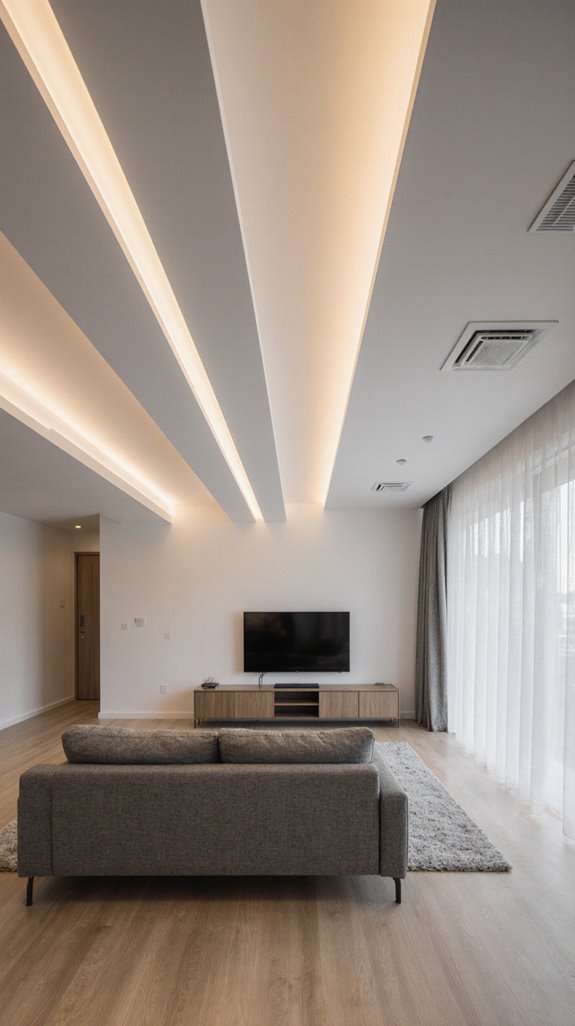
When a room’s ceiling stays plain, it just sits there doing nothing useful. Two or three shallow POP beams running lengthwise along your longer wall change that immediately. The eye follows the parallel lines toward the far end, and the room reads as longer than it actually is.
This works better in rectangular rooms than square ones. Keep beam depth under 4 inches to protect your headroom. Space the beams evenly, and add LED strip lighting along the edges.
Warm LEDs soften the lines, cool white sharpens them. Simple rhythm matters more than complexity here.
Soft Circular POP Pattern Over the Seating Zone
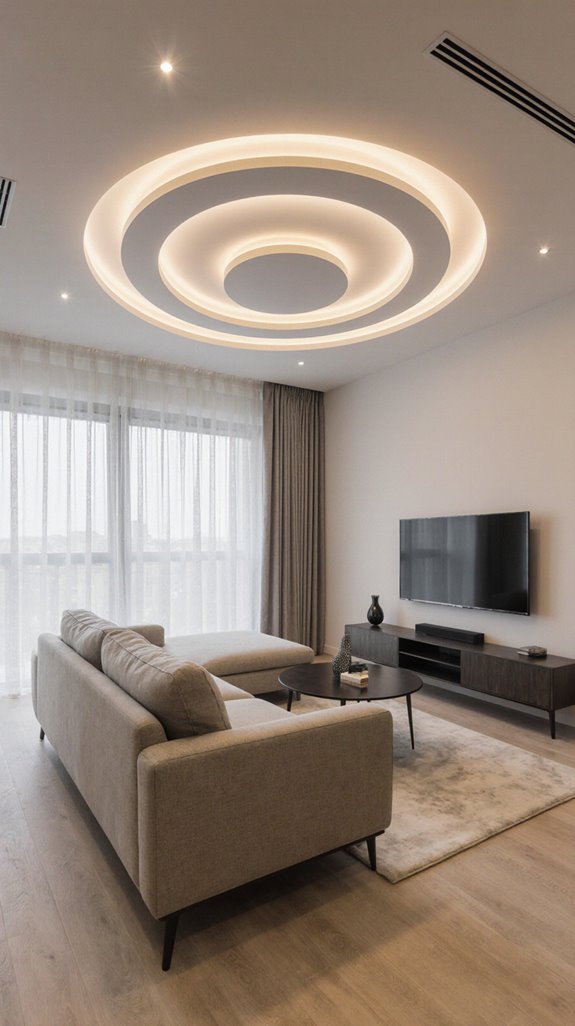
A circle on the ceiling does something a straight coffer can’t: it pulls the eye inward toward the seating zone instead of pushing it toward the walls. Rounded geometry keeps the ceiling reading as continuous, not chopped up.
Aim for a 1.8, 2.4 m diameter, centered between your sofa and TV wall. Keep the drop shallow, 25, 75 mm, so you’re not sacrificing headroom for aesthetics.
A shadow, gap ring, about 8, 15 mm wide, absorbs minor movement and hides future hairline cracks. Add a 3000K dimmable LED cove inside and you’ve built both a focal point and functional ambient light.
Shallow POP Coffers That Don’t Make Your Ceiling Feel Lower
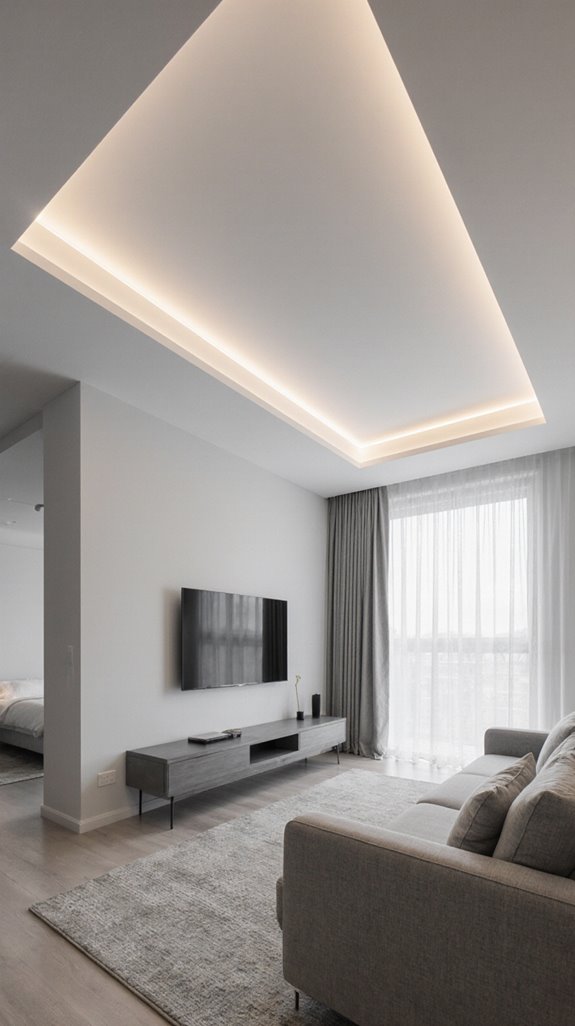
Shallow coffers look great until someone drops them 6 inches in a room with an 8-foot ceiling, and suddenly you’re living in a bunker. Keep your total drop between 3 and 5 inches.
Use beams that are 2 to 4 inches wide and keep each coffer panel between 3×3 and 4×4 feet. Paint the recessed panels lighter than the beams; white panels with slightly darker beams add perceived height.
Confine the coffer grid to the room’s center, leaving a flat 12-to-24-inch border along the walls. That margin alone makes the space feel noticeably less compressed.
POP False Ceiling With Gypsum Boards for Tighter Apartment Budgets
Most small living rooms in Indian apartments sit somewhere between 100 and 144 square feet, which puts your false ceiling budget in a pretty specific range.
POP alone runs $1.00–$1.10 per sq. ft. before 18% GST. Gypsum board sits slightly higher at $1.15–$1.31.
The smarter move is combining both. Use gypsum board for the main flat ceiling plane, then bring in POP only for borders and edges where detail actually matters.
You’re not covering everything with the expensive stuff. For a 12×12 room this hybrid approach can keep your starting cost near $210.
Recessed Spotlight Grid POP for Living Rooms With Limited Natural Light
When your living room gets little to no natural light, a recessed spotlight grid built into a POP ceiling is one of the more practical fixes you can make.
Space your spots about 4 feet apart on an 8-foot ceiling and position them 12, 18 inches from walls to wash vertical surfaces with light. That wall-washing trick makes tight rooms feel bigger.
Use 600, 900 lumen LEDs at 2700 – 3000K for warmth, and add a dimmer so TV nights don’t feel like interrogations.
A shallow 2, 4 inch POP drop keeps your headroom intact while hiding all the wiring cleanly.