Most people walk into an Airstream renovation thinking about what they can cram into 200 square feet. That’s exactly backwards. The renovators who nail it are thinking like yacht designers, obsessing over how space feels rather than how much of it exists. I’ve toured dozens of these aluminum capsules, and the difference between a claustrophobic tube and somewhere you’d actually want to spend three months isn’t about square footage at all.
It comes down to understanding sight lines, choosing materials that earn their weight allowance, and installing furniture that does three jobs instead of one. What follows are nineteen approaches I’ve seen work in the field, the kind of decisions that separate amateur hour from something you’d find in Dwell magazine.

Contents
- 1 Key Takeaways
- 2 Ocean-Inspired Color Palettes With Sea Glass Blues and Aquamarines
- 3 High-Gloss Cabinetry That Mimics Fluid Water Shapes
- 4 Warm Walnut Wood Tones Combined With Light Surfaces
- 5 Strategic Marble Accents for Luxury Without Weight Penalties
- 6 Ultraleather Upholstery for Durability and Sophistication
- 7 California Desert Aesthetics With Natural Warm Materials
- 8 Convertible Furniture Solutions for Dining and Sleeping
- 9 Under-Bed Storage With Hinged Mattress Platforms
- 10 Tropical South Beach Vibes With Bright Colors and Patterns
- 11 Reflective Surfaces Creating Spa-Like Ambience
- 12 Laminate Oak Flooring for Warmth and Durability
- 13 Neutral Palettes With Minimal Color Pops for Spaciousness
- 14 Envelope-Style Sconces and Low-Profile Fixtures
- 15 Custom Cabinetry Designed for Compact Living
- 16 Mixed Materials Balancing Wood Veneer and Modern Composites
- 17 Vintage Americana Style With Layered Thrifted Decor
- 18 Open Layouts Supporting Flexible Multi-Use Spaces
- 19 Warm Lighting With Aged Finishes to Soften White Interiors
- 20 Digital Design Tools for Maximizing Comfort and Style
- 21 Conclusion
Key Takeaways
- Whites and warm grays make small spaces breathe, creating the same visual trick high-end spas use to feel twice their actual size.
- Walnut paired with glossy surfaces catches light like water, delivering that yacht-interior sophistication without the yacht-interior price tag.
- Tables that become beds and counters that fold away turn your floor plan into something that changes throughout the day instead of staying static.
- Wall-mounted LED fixtures give you hotel-quality lighting without eating into your headroom or requiring you to duck every time you stand up.
- Vintage Americana or coastal themes work when you commit to them fully, using curated pieces that tell a story instead of random decorative filler.
Ocean-Inspired Color Palettes With Sea Glass Blues and Aquamarines

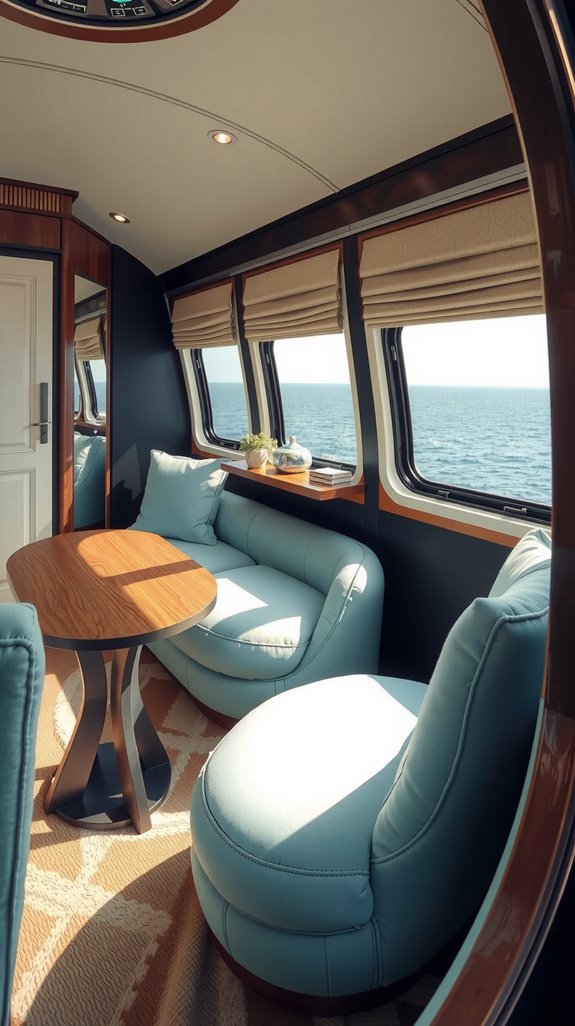
I’ve watched too many people paint their Airstream interiors navy blue and wonder why it feels like a cave. The trick with coastal colors is going pale, almost washed out, like actual sea glass you’d find tumbled on a beach.
Start with walls in that chalky off-white you see in Greek island architecture, then bring in seafoam and muted aquamarine through textiles where you can swap them out seasonally. The palette needs restraint because you’re working with roughly the same floor space as a modest walk-in closet, and saturated colors will shrink it fast.
High-Gloss Cabinetry That Mimics Fluid Water Shapes

Glossy cabinet fronts do two things at once: they bounce light around like mirrors and they make hard edges disappear when you curve them properly. I’m talking about thermofoil or automotive-grade finishes that look wet, paired with rounded cabinet faces instead of the standard RV rectangles.
The reflection tricks your eye into reading the space as larger, especially if you position these cabinets across from windows where they’ll catch changing daylight. This isn’t about being flashy; it’s about borrowing a technique from high-end galley kitchens where every surface has to work overtime.
Warm Walnut Wood Tones Combined With Light Surfaces
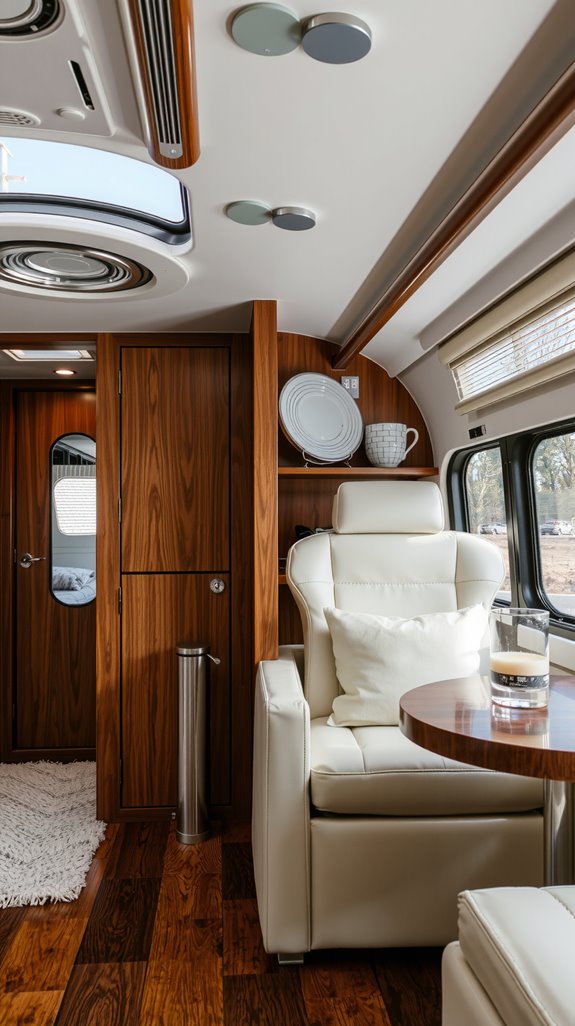
Walnut shows up in luxury Airstreams constantly, and there’s a reason beyond it looking expensive. The wood reads as warm without going orange, and when you set it against bleached oak or pale gray composite, you get contrast that defines different zones in an open floor plan.
I’ve seen this pairing make a 27-footer feel like it has actual rooms instead of just one long hallway. The mistake people make is using too much walnut, which muddies everything, when really you want just enough to anchor the lighter materials doing most of the visual heavy lifting.
Strategic Marble Accents for Luxury Without Weight Penalties
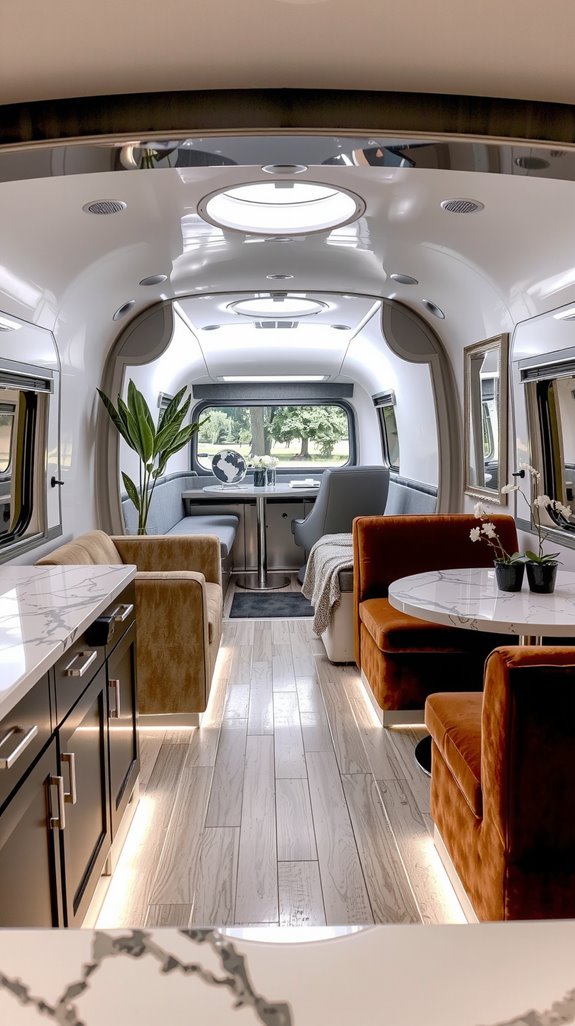
Real marble in a travel trailer makes about as much sense as a glass coffee table, so the industry has gotten creative with alternatives. Epoxy-coated MDF can mimic Carrara so well you’d need to tap it to tell the difference, and it weighs a fraction of actual stone.
I’m particularly sold on Corian for counters because it handles road vibration without cracking and you can get it in patterns that read as natural stone from three feet away. Save your weight budget for things that matter, like water capacity or solar panels, not for countertops that’ll look identical to lightweight alternatives once you’ve lived with them a week.
Ultraleather Upholstery for Durability and Sophistication

Genuine leather in an RV is a maintenance nightmare that’ll crack within two summers of temperature swings. Ultraleather, which is actually a polyurethane product, outlasts real hide by years while feeling nearly identical under your legs. The material can handle bleach cleanup when you track in trail mud, it doesn’t absorb odors, and it stays cooler in direct sun than anything else I’ve tested.
Most importantly, it looks deliberate and high-end in a way that standard RV upholstery fabrics simply don’t, giving you that boutique hotel vibe without requiring kid gloves.
California Desert Aesthetics With Natural Warm Materials

Desert modern works in Airstreams because both celebrate raw materials and clean lines. Think terrazzo composite floors, rammed earth-inspired wall treatments, and lots of sand and butterscotch tones that shift with the light.
The goal is to make the interior feel connected to wherever you’re parked, so when you’re camped in Joshua Tree, the design language continues from outside to inside. I’d add texture through woven textiles and reclaimed wood accents, anything that gives your hand something interesting to touch and breaks up the smoothness of aluminum and composite surfaces.
Convertible Furniture Solutions for Dining and Sleeping
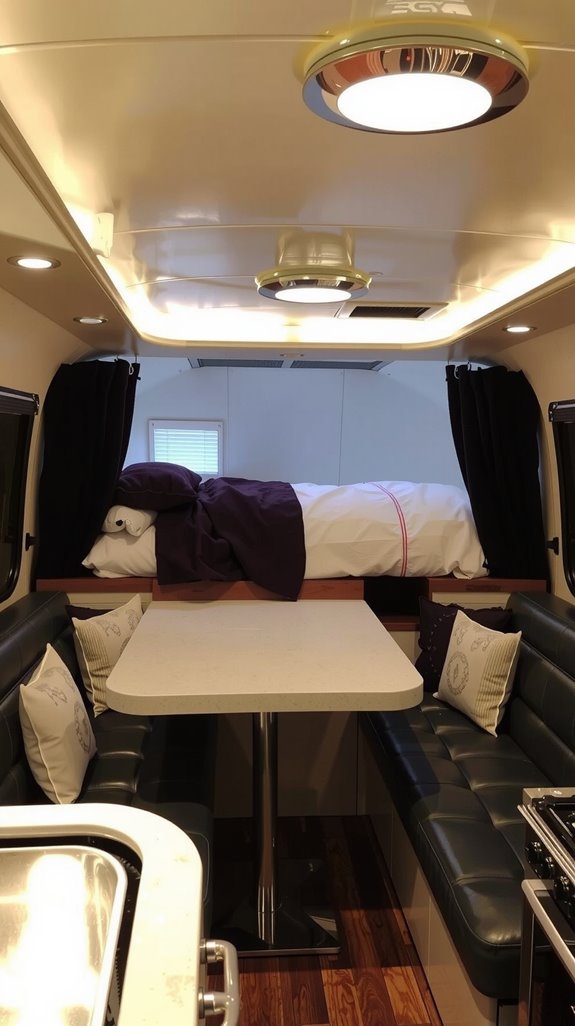
Fixed furniture in a tiny space is a rookie mistake. Your dinette should drop into a bed platform, your desk should fold against the wall, and your counter space should slide out from under something else. The Basecamp models do this with a table that releases via a button and transforms in about thirty seconds, using the same legs repositioned to support a sleeping surface.
Custom builders are going further with solutions like countertops that cantilever out during meal prep and tuck away completely when you need to move through the space. Every piece should justify its footprint by serving at least two distinct functions.
Under-Bed Storage With Hinged Mattress Platforms
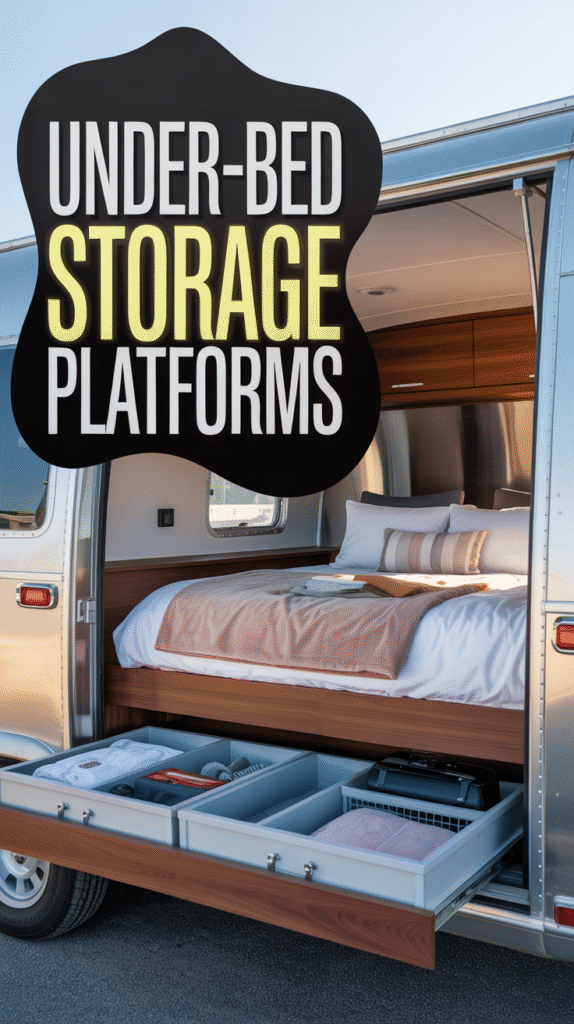
Lifting your mattress to access storage underneath sounds basic until you realize most people install it wrong and end up with wobbly hinges that fail after six months. Piano hinges along the entire length distribute weight properly, and adding soft-close hardware means you won’t slam your fingers when the platform drops.
This is where you’ll store bulky items like winter sleeping bags and camp chairs that don’t fit in overhead cabinets. Done right, the bed looks built-in and immovable, but you’ve actually got 15 cubic feet of hidden storage that doesn’t require you to unpack your entire rig to reach.
Tropical South Beach Vibes With Bright Colors and Patterns

Going full tropical is a commitment that only works if you push it far enough. I’m talking saturated coral upholstery, palm leaf peel-and-stick wallpaper on one accent wall, and brass fixtures that reference old Miami hotels. The risk is looking like a tiki bar exploded, so you need discipline: bright colors belong on changeable elements like cushions and bedding, while permanent fixtures stay neutral.
Large windows become critical here because the palette needs serious natural light to avoid feeling like a nightclub at noon. When executed properly, though, you’ve got an interior that feels vacation-ready even when you’re parked in a Walmart lot.
Reflective Surfaces Creating Spa-Like Ambience
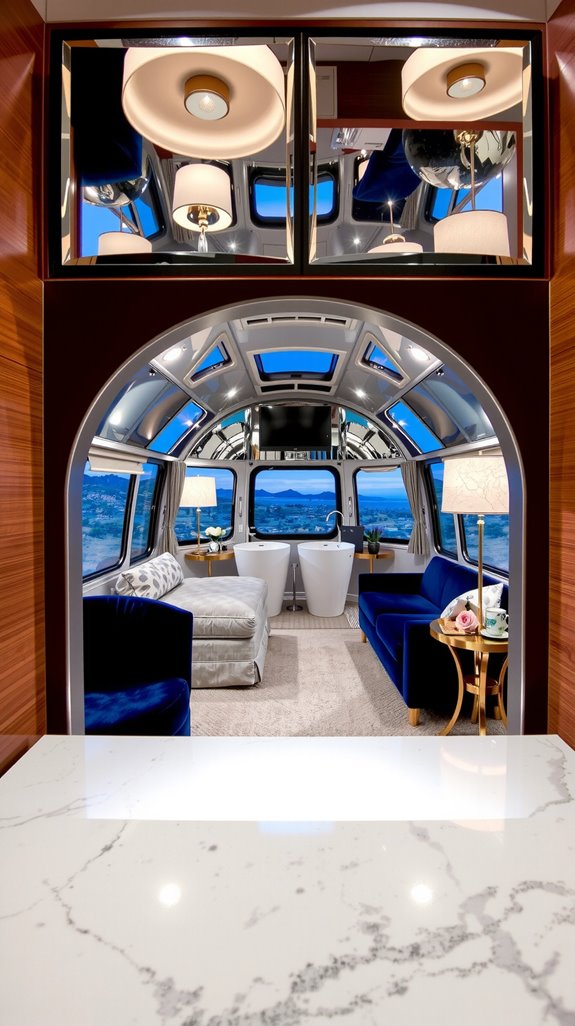
Airstream shells are already reflective, which gives you a head start on that spa aesthetic hotels charge $400 a night for. Double down with satin-finish cabinets, strategically placed mirrors, and Corian counters in pale patterns that catch light without glaring.
The key is controlling reflectivity so it’s soft and diffused, not bouncing around like a funhouse. Dimmable LEDs let you adjust throughout the day, bright for cooking and dim for winding down, while metallic fixtures in brushed nickel add just enough shine without overdoing it.
Laminate Oak Flooring for Warmth and Durability
Hardwood in a trailer is asking for buckling and gaps as humidity changes. Laminate designed for floating installation gives you the oak look with a wear layer that can handle grit from hiking boots and spills from camp coffee.
Look for AC4-rated products if you want this floor to survive five years of full-time use. The installation is forgiving enough for competent DIYers, clicking together over the existing subfloor without adhesive, which means you can replace individual planks if something gets damaged down the road.
Neutral Palettes With Minimal Color Pops for Spaciousness
Color restraint feels counterintuitive when you’re excited about personalizing your space, but it’s the fastest way to make 200 square feet feel like 400. Stick with whites, warm grays, and creamy beiges for anything permanent, then add personality through small doses of sage green or dusty blue in pillows and dish towels.
The monochromatic base lets your eye travel uninterrupted from one end of the interior to the other, creating the illusion of continuity. Too many colors fragment the space visually, making your brain register each color change as a boundary that shrinks the perceived area.
Envelope-Style Sconces and Low-Profile Fixtures
Overhead lighting in a space with 6’4″ ceilings is a head injury waiting to happen. Wall-mounted sconces that sit nearly flush solve this while providing better task lighting than a single ceiling fixture ever could. Look for frosted glass shades that diffuse the LED source and prevent harsh shadows, especially important when you’re trying to read or cook.
Most quality sconces now run on 12V DC systems, which means you can install them without an inverter running. Brushed nickel or matte black finishes tie into modern aesthetics without screaming “RV parts catalog.”
Custom Cabinetry Designed for Compact Living
Off-the-shelf RV cabinets are built to a price point, and it shows in the particleboard construction and loose-fitting doors. Custom work using hardwood or marine-grade plywood costs more upfront but eliminates the rattles and sag you’d otherwise fight for years.
I’m seeing more builders use aluminum-extruded frames, which are lighter and more rigid than traditional wood construction, crucial when your house is bouncing down washboard roads. Hidden compartments and adjustable shelving should be standard, not upgrades, because your storage needs will change as you figure out how you actually use the space.
Mixed Materials Balancing Wood Veneer and Modern Composites
An all-wood interior feels heavy and dated, while all-composite reads as cold and institutional. Combining walnut veneer cabinets with composite counters and waterproof flooring gives you visual warmth where you see it most, while keeping practical surfaces where you need them.
The transition between materials needs to look intentional, not like you ran out of budget halfway through. I’d use wood on upper cabinets and composite below, or wood on a feature wall with composite everywhere else, creating a clear hierarchy instead of random patchwork.
Vintage Americana Style With Layered Thrifted Decor
Pulling off vintage Americana without looking like a Cracker Barrel requires actual curation, not just buying whatever’s at the antique mall. I’m talking copper camp cookware that still functions, saddle leather straps repurposed as cabinet pulls, and military surplus pieces like canvas bags or enamelware that earn their space through utility.
Pair these with southwestern textiles and handmade ceramics from actual artisans, not mass-produced “artisan-style” imports. Every piece should have a story you can tell, which means shopping takes longer but results in an interior that feels collected over time rather than decorated over a weekend.
Open Layouts Supporting Flexible Multi-Use Spaces
Floor plans that dedicate specific areas to single functions waste space you can’t afford to waste. Twin beds instead of a permanent queen opens up the middle of your floor, creating a walkway that doubles as a yoga space or a place to spread out maps.
Convertible dinettes are standard now, but better layouts incorporate retractable dividers that can separate sleeping areas when you need privacy or disappear when you want sight lines from front to back. The goal is designing zones that shift throughout the day, a breakfast nook at 8 AM, an office at 10 AM, sleeping quarters by 9 PM, all in the same six linear feet.
Warm Lighting With Aged Finishes to Soften White Interiors
Cool white LEDs make aluminum interiors feel like operating rooms, which is why color temperature matters as much as fixture placement. Warm white (2700-3000K) bulbs create an ambiance that works with white walls instead of against them, and adding dimmers lets you adjust based on the time of day.
I’ve seen people use amber gel filters as a temporary fix, taping them over existing fixtures to shift the color without replacing bulbs. Aged brass or bronze fixture finishes help too, giving you that patina look that softens the whole lighting scheme and makes everything feel less sterile.
Digital Design Tools for Maximizing Comfort and Style
You don’t need to hire a designer anymore when AI tools can show you what different materials look like in your actual space. Upload photos of your current interior to something like Paintit.ai and preview cabinet colors or flooring options before buying a single board.
Vanspace 3D takes it further with furniture libraries, letting you drag and drop actual dimensions into a floor plan and walk through it virtually. These tools prevent expensive mistakes, like ordering a sofa that’s four inches too long or choosing a backsplash that clashes with your counters, problems you’d only discover after installation.
Conclusion
The gap between an Airstream that looks like a camping trailer and one that reads as a mobile boutique hotel isn’t about money spent. I’ve seen $15,000 renovations that feel cheaper than $5,000 builds because the expensive one lacked a coherent vision.
Committing to ocean palettes or desert modern or vintage Americana and following through on every detail matters more than your cabinet material budget.
Whether you’re drawn to minimal Scandinavian whites or maximalist tropical colors, the trick is understanding how sight lines, lighting, and convertible furniture create space where none technically exists. Get those fundamentals right, and you’ll have an interior that works as hard as you do, looking good in Instagram photos and actually functioning when you’re living in it full-time.