Most outdoor halloween ghost decorations look the same. A white sheet on a stick. A fabric figure zip-tied to a porch rail with no lighting, no context, no sense of scale.
People buy them because they’re cheap and easy, then wonder why nobody slows down to look. The problem isn’t the ghost. It’s that a static white shape in a yard reads exactly like what it is: a prop someone drove a stake through and forgot about.
Ghosts work when they move. Your brain is hardwired to track movement in peripheral vision, which is why a gently swaying ghost at the edge of a lit path will unsettle someone far more than an elaborate static display in full view.
The most effective ghost setups exploit that instinct. This list is built around that principle — every setup here earns its place by doing something a stationary yard ornament can’t.
If you’re starting from scratch, our first outdoor halloween guide covers the full zone-based approach before you start buying props. For a broader look at every outdoor prop category, the halloween decorations outdoor complete guide has it all in one place.
| QUICK SUMMARY:
Ghost decorations dominate outdoor halloween displays for one reason — they move, and movement at night triggers something primal in people passing by. This guide covers 17 ghost setups that actually deliver, from a six-minute DIY lawn ghost to the viral swinging ghost with a full materials list and step-by-step build. |
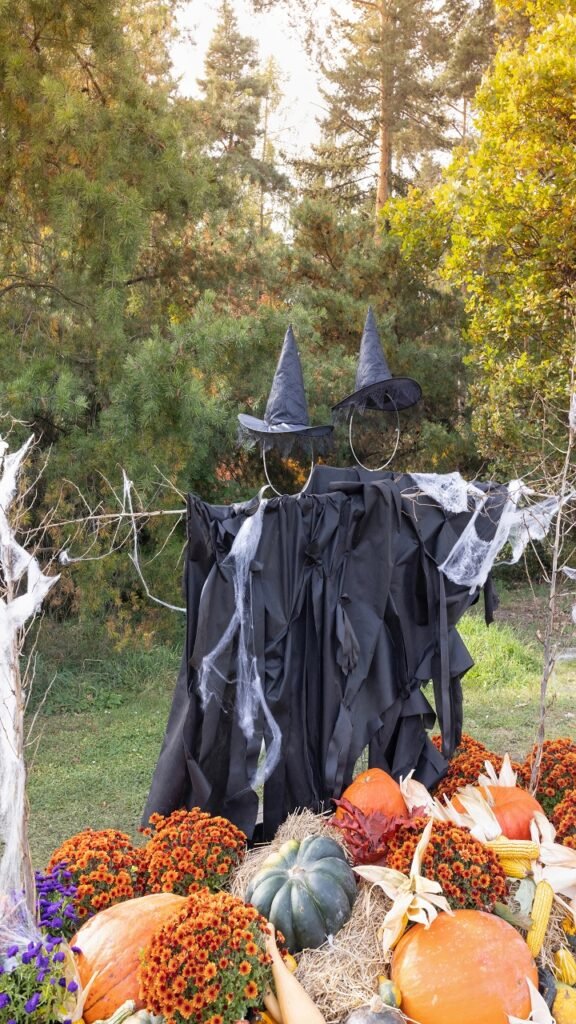
The Viral Swinging Ghost Earns Its Reputation — Here’s the Full Build
=$12 total 20 minutes
The swinging ghost has been circulating for a few years now, and it genuinely delivers.
Most tutorials leave out the one detail that makes it work: a ball-bearing swivel hook, not a standard S-hook. A fixed hook means your ghost hangs limp or spins once and stops.
A swivel means every breath of wind sends it into slow, continuous rotation — and that rotation is exactly what stops people on the sidewalk.
MATERIALS LIST
- 1 large white curtain panel or twin-size white sheet (~$6 at a thrift store)
- Fishing line, 20 lb test
- Ball-bearing swivel hook (fishing section at Walmart, under $3)
- Small bunch of crumpled newspaper or a foam ball for the head
- Battery-powered LED fairy lights, warm white (~$8 on Amazon)
- Black permanent marker.
Step-by-step build:
- Bunch the top center of the fabric around the newspaper ball to form a round head. Tie tightly with fishing line just below the ball — leave 18 inches of line above for hanging.
- Draw a face on the head with the black marker. Keep it simple: two dark ovals for eyes. Elaborate faces read as cartoonish from a distance.
- Tuck the fairy lights inside the head ball before tying it off. Let the battery pack hang inside the fabric body where it won’t show.
- Attach the fishing line above the head to your swivel hook. Hang from a tree branch using a second length of fishing line. The ghost should hang at five to six feet off the ground, eye level for an adult approaching from the street.
- Pull the fabric into an irregular shape by tearing small slits in the lower edges. Symmetrical skirts look manufactured. Irregular edges catch air differently and create more movement.
SIMPLE-tip: The fairy lights inside the head create a soft internal glow that reads from 30 feet away at night. Without lighting, the ghost disappears into darkness after sunset — which defeats the entire purpose.
RELATED: 14 DIY Witch Decorations for Your Yard That Are Actually Impressive!
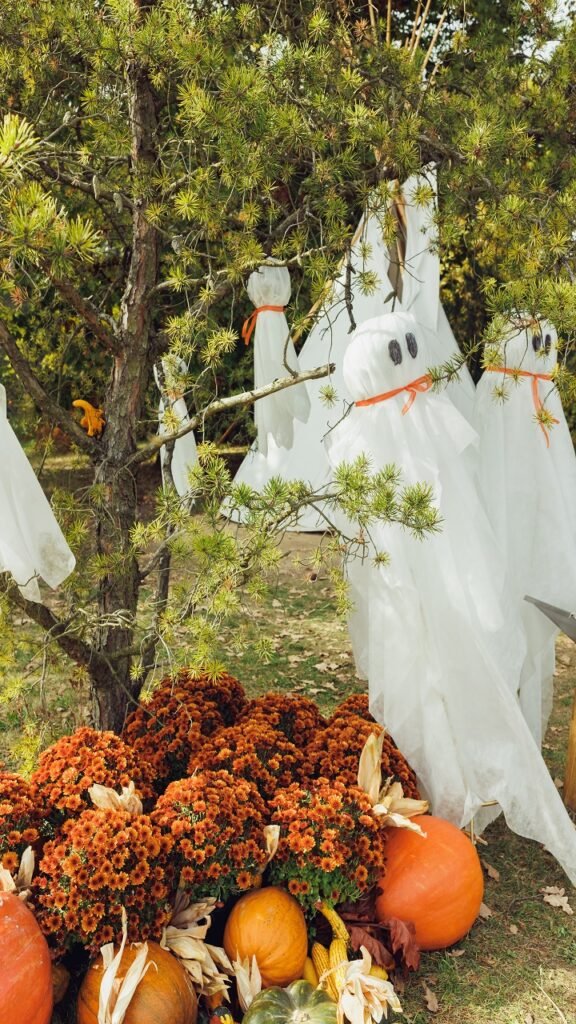
A Cluster of Ghost Lawn Stakes Reads Better Than One Large Prop
=$15 for two packs 10 minutes
The instinct is to buy one large ghost stake and drive it into the center of the lawn.
That instinct is wrong. A single ghost stake in open grass looks like a sign someone forgot to remove.
Grouping creates the visual effect that makes people stop. The suggestion of a crowd, of something gathering, of multiple presences rather than one obvious decoration.
Seven stakes clustered near the path entrance, staggered at irregular depths so some sit higher and some lower, create a scene.
Find affordable ghost stake sets at Amazon and split two packs between an uneven cluster rather than lining them up like airport runway lights.
Place a solar spotlight behind the cluster rather than in front. Backlighting throws shadows toward the viewer and adds about fifty percent more menace for zero extra dollars.
Ghost Porch Light Covers Turn a Three-Minute Install Into a Focal Point
=$8–$12 for a set of two 3 minutes
The mistake most people make with porch ghost decorations is adding props on top of the existing setup instead of working with what’s already there.
Your porch light is already the brightest point of your exterior at night. Cover it, and you’ve just converted existing architecture into a halloween decoration.
Fabric ghost covers slip over a standard porch light globe and transform it into a glowing face that greets every trick-or-treater at the door.
The light inside illuminates the face from behind, as the outdoor lighting principles covered here confirm, backlit translucent materials always read better after dark than front-lit solid ones.
Just confirm the cover material is rated for contact with a light bulb, or swap to an LED bulb first. Fabric sitting directly against an incandescent bulb is a fire risk.
RELATED: How to Set Up a Halloween Yard Graveyard From Scratch (The Full Tutorial)!
Stuffed Trash Bag Ghosts Solve the Scale Problem in Large Yards
=$2 per ghost 10 minutes
Sheet ghosts have a scale problem in large yards. A standard twin sheet hung from a tree branch looks appropriately ghostly from ten feet and disappears entirely from forty.
Large yards need large props, and a stuffed trash bag ghost solves that problem for about two dollars.
Fill a 33-gallon white contractor bag with crumpled newspaper until it holds a roughly spherical head about the size of a basketball.
Tie the filled portion off with twine, draw a face in black marker, then let the remaining bag material hang loose below as the body. Hang at eight to ten feet from a tree branch.
I tried this in my own front yard thinking it would look amateur — it was genuinely the piece that got the most comments from neighbors.
The oversized scale does something to the brain at night. It reads as wrong in a way that smaller props don’t, and that wrongness is the whole point.
Hanging Tree Ghosts Work Best When You Vary the Heights Deliberately
=$10–$20 for three ghosts 15 minutes
A single ghost hanging from a tree branch is decoration. Three ghosts at identical heights is a garland.
Three ghosts at radically different heights — one at eight feet, one at five, one at three — is a scene.
Height variation forces the eye to move between them, creating the illusion of depth that makes a yard feel inhabited rather than decorated.
Use clear fishing line rather than white string. White string reads as white string during the day and catches ambient light at night in a way that breaks the illusion.
Attach each ghost to a separate branch at a different height so they move independently, synchronized movement signals ‘decoration,’ independent movement signals something else entirely.
RELATED: 15 Outdoor Skeleton Decoration Ideas That Tell a Story (Not Just a Lone Bone)!
Ghost Luminaria Bags Line a Path Better Than Standard Pathway Lights
~$15 for a full path 20 minutes
Standard pathway lights are fine for navigation. Ghost luminaria bags do the same job and convert the walk to your door into an actual experience.
Cut ghost face shapes into the front of white paper lunch bags, drop a battery-powered LED tea light inside each one, and space them every three feet along both sides of your walkway.
The cutout faces glow orange or white from inside and cast shaped light patches on the ground between each bag. At night, the effect reads as a procession — like something is lining the path on purpose.
Paper bags are not weatherproof, so cover the opening loosely with clear plastic wrap if rain is likely. Bags cost about $4-$9 for 50 at any grocery store. Battery LED tea lights run about $8-$18 for a 24-pack.
The entire path costs under $15-$25.
Window Ghost Silhouettes Perform From the Street Without Any Yard Space
=$0 if you have black paper 5 minutes
Renters, apartment dwellers, or anyone with no yard should know this setup. A ghost silhouette cut from black craft paper and taped to the inside of a lit window reads clearly from the street as a shadow figure. No outdoor access required.
The window acts as a backlit frame, and the silhouette does all the work.
Cut a simple ghost outline from a single sheet of black poster board — round head, irregular trailing body. Tape it to the inside of a window facing the street, then leave the room light on behind it after dark.
Your brain interprets a dark shape against a lit window as something inside the room rather than a flat paper cutout.
That spatial confusion is genuinely unsettling for about three seconds, which is exactly how long a good halloween decoration needs to hold someone.
Grim Reaper Ghost Variants Add Height Without Adding Complexity
=$25–$45 10 minutes to position
A standard fabric ghost goes limp in still air and collapses in rain. A reaper ghost built over a rebar or PVC frame holds its shape in any conditions and reads at full height even at a distance.
This is the version worth buying rather than building — the framing work is fiddly and retail versions handle it well.
Look for versions with a wire-reinforced hood that keeps the cowl upright and a weighted base that resists wind. Freestanding outdoor reaper decorations at Amazon typically run $25 to $45 and hold up to a full October of outdoor exposure.
Place one at the end of a lit path rather than in open lawn, framing it between two points of reference gives it scale that open grass never does.
A Ghost Trio on the Porch Ceiling Turns Dead Space Into the Best View From the Street
=$20–$35 20 minutes
Most porches have an overhead area that goes completely unused for halloween.
Three hanging ghosts suspended from the porch ceiling at varying cord lengths; one long, one medium, one short. Fill that space and create the most photogenic view of your setup from the street.
The overhead hang puts them at exactly the height a person passes through, which is the most effective zone for any hanging prop.
Use adhesive ceiling hooks rated for outdoor use if you don’t want to drill. Three-pound rated hooks hold most fabric ghost props without issue.
Position the longest-hanging ghost at the center of the porch opening so it sits at roughly face height for someone walking up the steps. Add battery lights inside each ghost head and they become a ceiling installation that reads like a design choice rather than three props someone taped up in a hurry.
Ghost Wind Spinners Solve the Movement Problem Without Any Wind
=$15–$20 5 minutes
Most ghost props need actual wind to move, which makes them completely static on calm nights. The nights that tend to coincide with Halloween.
A ghost-shaped wind spinner solves this — the spinning mechanism requires almost no airflow to activate, so even the slight convection from your porch light gets it moving.
The rotation at night, backlit by a spotlight or porch fixture, reads as something hovering rather than spinning. Metallic ghost wind spinners run about $15 to $20 at most garden centers in October.
Mount them at the entrance to your display zone rather than the middle of it. They work best as a threshold marker, something people pass through rather than approach.
Ghost Porch Column Wraps Work on Any Porch That Has Columns
=$6 per column 15 minutes per column
Wrapping porch columns in white gauze from top to bottom is one of the highest-impact setups in outdoor halloween.
The column becomes the ghost rather than hosting a ghost prop attached to it — a more intentional reading that looks genuinely designed.
Wind orange LED string lights around the column first, then wrap the gauze loosely over the lights so the glow comes through the fabric.
This technique is the same principle that makes wrapped porch columns work so well for Christmas decor. Transforming architectural elements rather than decorating around them makes the whole porch read as a finished concept.
Two columns done this way plus one hanging focal ghost creates a complete porch setup with minimal spend. Gauze fabric runs about $3 a yard at any craft store.
Fog Machine Ghost Setups Reward the Extra Setup Time
=$30–$60 for a fog machine 30 minutes to position correctly
A fog machine alone is underwhelming.
A fog machine combined with a ghost prop at ground level, where the fog obscures the prop’s base — creates the specific visual that makes people genuinely pause.
The goal is a ghost that appears to float rather than stand, and low fog achieves that by hiding the stake or stand at ground level.
Position the fog machine output behind the ghost prop rather than beside it so the fog drifts forward and around the base. Run it on a smart plug timer set to cycle every four minutes. Constant fog depletes fluid fast and loses the dramatic reveal effect.
Our complete halloween outdoor guide covers fog machine placement in full: output aimed at the center of your display zone, never at the edges where fog immediately disperses.
Cheesecloth Ghosts Hung From Fence Lines Cover Ground Fast
=$10 for a 20-foot run 30 minutes
If you have a fence line along your property, cheesecloth ghosts are the fastest way to activate it.
Tear cheesecloth into roughly three-foot sections, knot each section around a small foam sphere, and tie each finished ghost to the fence at irregular intervals using fishing line.
Thirty minutes converts a bare fence into a haunted perimeter that reads as intentional from the street.
Vary the spacing so some ghosts cluster and some hang alone. Uneven distribution reads more naturally than even intervals — real events don’t space themselves uniformly, and neither should your props.
At $4 to $9 per bag of cheesecloth, you can cover a 20-foot fence run for about $10. Pull each piece apart more aggressively at the bottom edge so it catches air differently and moves independently of its neighbors.
Ghost Wreath on the Front Door Anchors the Entry Zone
=$12 10 minutes
A ghost wreath sounds gimmicky. Done well, it’s actually the cleanest entry-zone anchor in this entire list. No staking, no drilling, no extension cords, and it works at exactly eye level for every person who approaches the door.
The key is to build it as a silhouette rather than a literal ghost face. A white wreath base with simple dark eyes reads as a ghost at a glance and as elegant abstract decor on closer inspection.
Use a foam wreath ring as the base, wrap it in white ribbon or gauze, add two black felt ovals for eyes, and hang with an over-door wreath hook that leaves zero marks on the door frame.
Total cost: about $12. This is the version of DIY halloween ghost decoration that looks like you put real thought into it, because the restraint signals confidence.
Ghost String Lights Replace Standard String Lights Everywhere You’d Use Them
=$15 for 25 covers 10 minutes
Anywhere you’d run standard orange halloween string lights, consider ghost-shaped bulb covers instead.
These slip over standard C7 or C9 bulbs and convert a string light run into a line of small glowing ghost faces. At 20 feet the effect reads as a procession — dramatically more interesting than an undifferentiated line of colored bulbs.
They run about $15 for a set that covers 25 bulbs. Enough for a standard porch railing or fence run.
The outdoor staging approach that works for any exterior gathering applies here too: string lights as structural elements that define a space rather than just illuminate it. Ghost bulb covers turn a functional decision into a thematic one.
Ghost Projection Loops on Exterior Walls Cost Less Than They Look
=$30 for the projector 20 minutes to position
A window or wall projector running a ghost loop is one of the few outdoor halloween setups that genuinely surprises people who’ve seen everything.
The projection reads as movement behind glass or on a flat wall surface, which the brain processes as something internal rather than projected. A fundamentally different reading from any static prop.
Projectors rated for outdoor use now run as low as $30 on Amazon.
Position the projector at least 15 feet from the surface to get a large enough image to read from the street. Aim at a blank wall or large window rather than a textured surface. Texture breaks up the image and reduces the effect significantly.
One projector covers an entire exterior wall and replaces what would otherwise require a dozen individual props to fill the same visual footprint.
Lighted Floating Ghost Orbs Create Depth in Shrub Beds and Tree Lines
=$15–$25 for a set 10 minutes
Most yard decorations fight for attention at the property’s front edge.
Ghost orbs — white fabric spheres with battery LED lights inside, hung at varying depths among shrubs or along a tree line. Pull the eye back into the darker parts of the yard.
Depth is the design element most outdoor halloween displays completely ignore, and orbs are the simplest way to create it.
Hang them at different heights and depths rather than in a neat row. Some visible immediately, some partially obscured by branches. The partially hidden ones are actually more effective because your brain works harder to resolve what it’s seeing.
Find lighted ghost orb sets on Amazon in packs of four to six. The warm internal glow reads well against dark foliage in a way that a lit stake prop against open grass never quite does.
Start With the Swinging Ghost, Add Two More Setups, and Stop There
Seventeen ideas on one page can make outdoor halloween ghost decorating feel like a project that requires a weekend and a cargo van. It doesn’t.
The swinging ghost plus the luminaria path plus one porch column wrap covers every zone of a standard front yard and porch setup in under two hours for about $40-$75 total.
Pick three setups from this list that suit your space, execute them with proper lighting, and the display will look more considered than a yard stuffed with twice as many pieces ever could. The full outdoor halloween guide has the zone framework that helps you decide which three to prioritize.