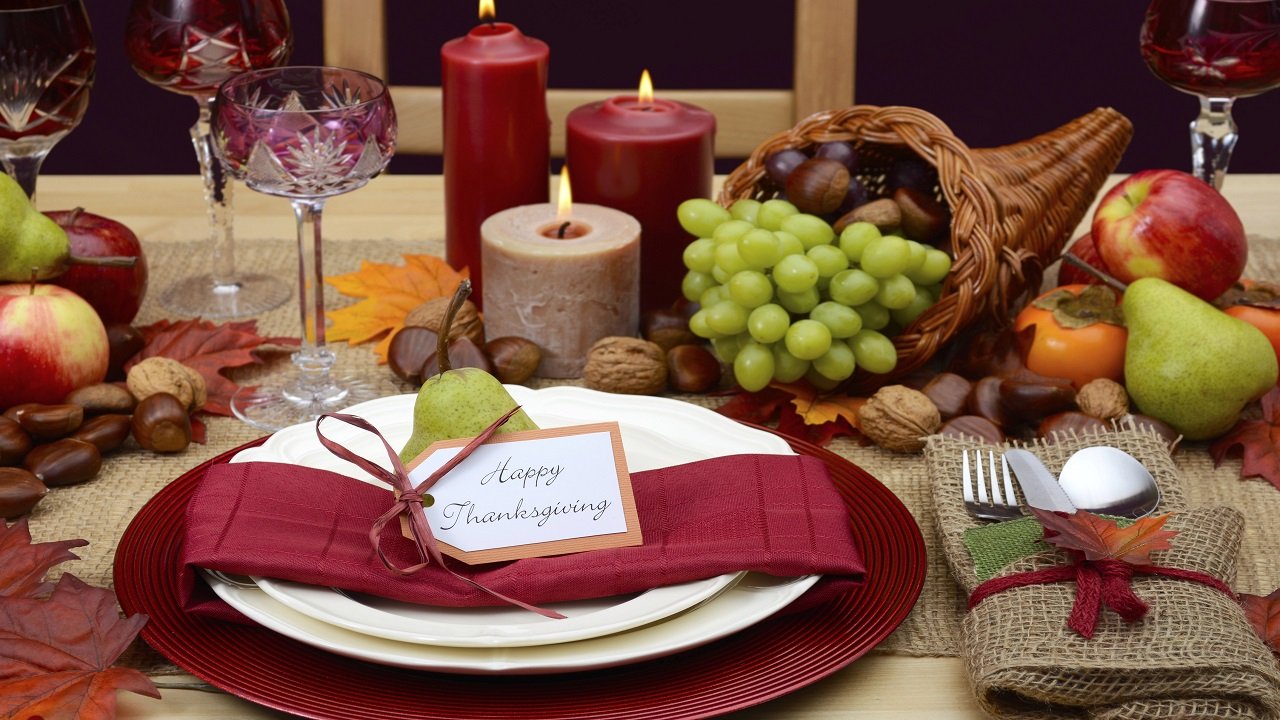
Most people set a Thanksgiving table the same way every year. They pull out the same orange candles, scatter a few fake leaves, and call it done. The table works. Nobody complains. But it also doesn’t feel like anything.
This guide is for the person who wants the table to actually feel like something. You don’t need a big budget or a farmhouse dining room. You need to make six decisions in the right order, then execute. That’s it.
Here’s everything, laid out straight.
What this guide covers: Every Thanksgiving tablescape decision from aesthetic to budget to table shape, in one place. Most useful if you’ve saved a dozen pins and still don’t know where to start. Skip to any section that matches where you’re stuck.
The 6 Decisions That Shape Your Whole Table
Decision 1: Pick Your Aesthetic First
Your aesthetic is the filter every other purchase runs through. Lock it in before you buy a single thing. The six most searched thanksgiving tablescape directions right now:
| Aesthetic | Defining Colors | Key Elements |
| Neutral & Natural | Cream, linen, warm white | Velvet pumpkins, eucalyptus, dried botanicals |
| Rustic Farmhouse | Brown, amber, plaid | Burlap, mason jars, wood slices |
| Glam & Elegant | Gold, burgundy, deep green | Taper candles, cheesecloth, moody florals |
| Traditional Harvest | Orange, rust, deep red | Cornucopia, wheat stems, jewel tones |
| Blue & Non-Traditional | Navy, sage, cream | Transferware, blue pumpkins, crisp linen |
| Boho | Terracotta, earth tones | Macramé, dried pampas, bud vases |
One honest note: neutral and natural photographs beautifully but requires real restraint.
Over-accessorize it and the whole thing tips into beige clutter. Rustic farmhouse is more forgiving for first-timers. There’s enough texture to hide imprecision.
For the rustic and neutral looks, amber glass votives and vessels do a lot of the heavy lifting on the centerpiece without spending much.
The boho direction follows the same layering logic as boho tent interiors. Start neutral, layer in texture, keep the palette talking to itself.
And if you’re going glam and want to carry that elegance beyond the table, elegant outdoor Christmas decorations in the same editorial direction transition easily into late-November hosting.
Decision 2: Know Your Table Shape Before You Shop
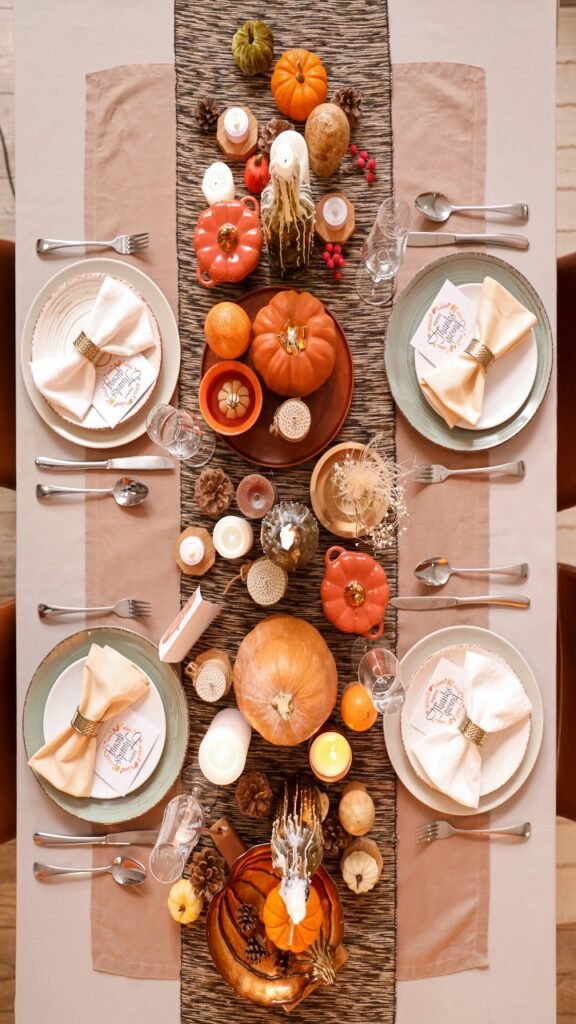
Your thanksgiving table setup lives or dies by scale. A centerpiece that works on a long farm table crowds a four-person round one. Five minutes with a tape measure prevents forty dollars of wrong.
- Round tables: One centerpiece, centered, no taller than 10 inches. A straight runner fights the shape — use a circular arrangement or skip the runner entirely.
- Rectangular (6–8 seats): One focal centerpiece plus a runner, at least 12 inches shorter than the table on each end.
- Long farm tables (10+ seats): Three centerpiece clusters — one larger anchor in the middle, two smaller ones flanking it. Odd numbers read as intentional.
- Small tables (2–4 seats): One hero element only. Negative space is doing real work on a small table. Let it.
Emily Post’s Thanksgiving table setting guide covers place setting spacing for every table size — worth a look before you finalize the layout.
Decision 3: Set a Real Budget
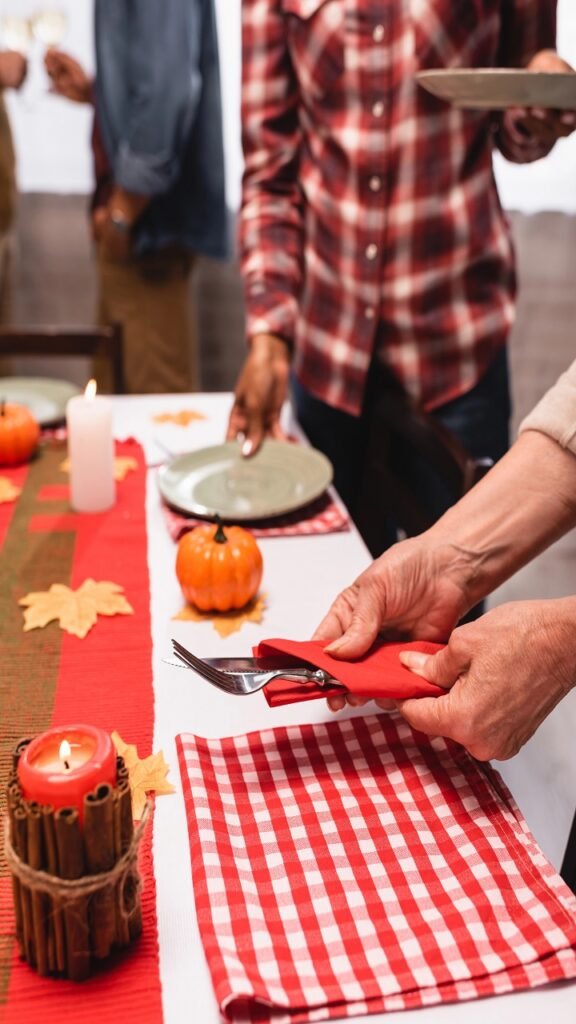
Good simple thanksgiving table decor holds up at almost any price point. The difference between a $25 table and a $150 one is restraint, not quantity.
| Budget | What You Can Achieve | Best Sources |
| Under $25 | One runner + two elements | Dollar Tree, Trader Joe’s, your backyard |
| $25–$75 | Full table — runner, centerpiece, candles | Target, Trader Joe’s, Dollar Tree combo |
| $75–$150 | Two investment pieces + natural filler | Etsy, Hobby Lobby, Target |
| $150+ | Fresh florals, linen runner, statement chargers | Local florist, Etsy, CB2 |
The rule at every budget: spend money on one thing that catches the eye, and fill everything else cheaply.
A $30 eucalyptus bundle from Trader Joe’s next to a $7 candle cluster reads better than $37 spread across twelve mediocre objects.
That same principle — one strong anchor, cheap fill — is how farmhouse interiors stay cohesive on a tight budget, and it translates directly to a harvest table on a tight holiday spend.
Decision 4: Pick a Lane — DIY or Buy
People get stuck in the middle. They start a project, run out of time, and land with a halfhearted mix that satisfies neither intention. Commit to one approach.
DIYing works. A pinecone candle ring, a pumpkin vase with grocery store flowers, a walnut-and-votive display. All of it costs almost nothing and takes two hours. Buying also works, as long as you shop with a list and stop when the list is done.
Crate & Barrel’s Thanksgiving table setting guide breaks down how to mix and match dinnerware without things looking chaotic. The worst outcome is a complicated table that’s also unfinished.
Decision 5: Design for the Actual People at the Table
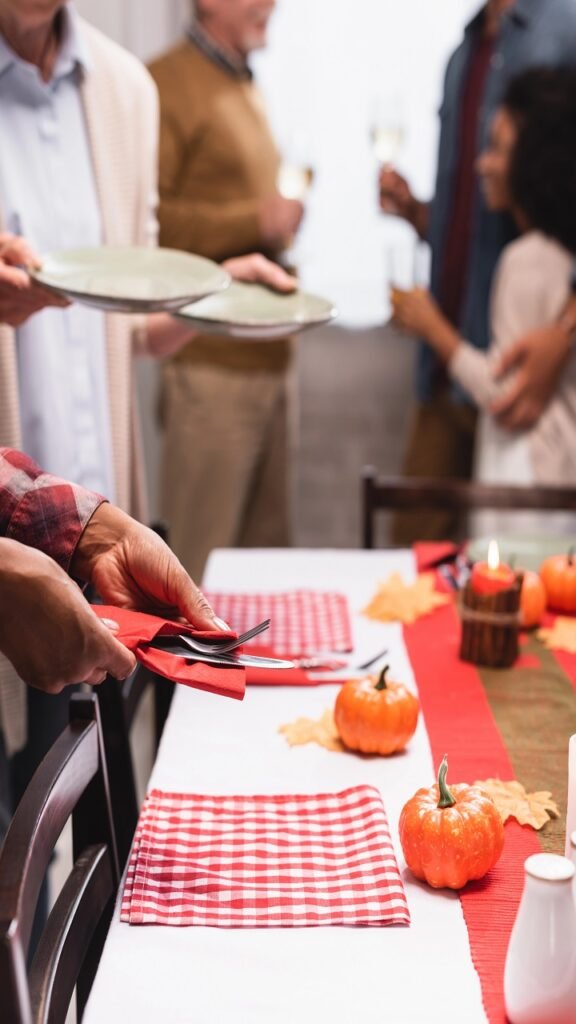
Your thanksgiving dinner table needs to work for the people eating at it, not just the photo taken before they arrive.
- Kids present: No taper candles at kid height. No breakable glass within arm’s reach. Butcher paper as a runner doubles as a tablecloth and an activity.
- Large crowds: Keep your centerpiece under 10 inches tall so guests can see each other. Long tables suffer most when decorations block sightlines end to end.
- Intimate 2–4 guests: More room to go taller and more dramatic — fewer people means less to obstruct.
- Friendsgiving (casual adults): Mismatched everything, a butcher paper runner with marker prompts, a grazing board as the centerpiece. The friendsgiving table decor aesthetic is intentionally unfussy — and easier to pull off than a polished formal look.
Decision 6: Decide If the Table Doubles as Your Buffet
If food is coming from the dining table, your centerpiece is not staying there during the meal.
Plan for it to move.
Set the thanksgiving table spread for photos, take them, then clear a third of the surface for dishes.
A good layout puts decorations at the ends and keeps the center open. Running a separate buffet?
That surface needs its own moment — labels, height variation, a small arrangement. The same zoning logic that makes a backyard BBQ setup feel organized applies here: zone your surfaces by function before you start decorating, and Thursday at 3 p.m. stops being a crisis.
These six decisions take 15 minutes. Getting them right means every shopping trip, every craft session, every last-minute Trader Joe’s run has a direction. Without them, you’re just collecting autumn objects and hoping they cohere.
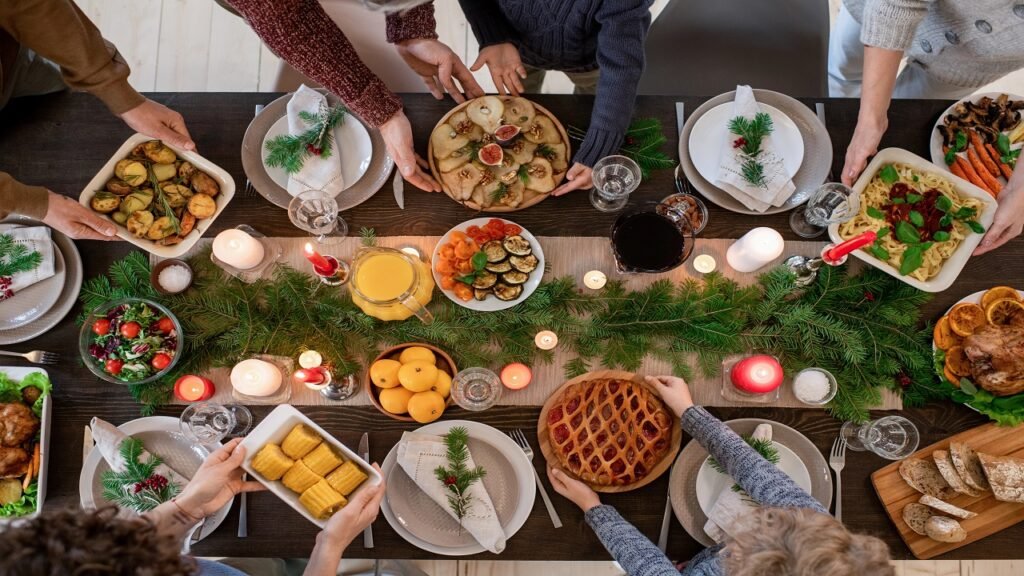
The Anatomy of a Thanksgiving Tablescape
Every thanksgiving tablescape is built in the same four layers. Get the order right and the table almost arranges itself.
Layer 1 — The Foundation
This is your tablecloth, runner, or bare wood. A linen tablecloth reads formal. A cheesecloth or gauze runner says relaxed and airy.
Kraft paper works for Friendsgiving and doubles as an activity for kids. Bare wood with scattered foliage is the fastest route to a rustic autumn table with no shopping required. Pick one, commit to it, and don’t layer conflicting textures on top.
Layer 2 — The Centerpiece
Place this first, before anything else. The rule: height above 12 inches blocks conversation across the table. Low clusters of velvet pumpkins, dried orange slices, and votives work at any table size. Taller arrangements.
Taper candles in a candelabra, wheat sheaf bundles. Belong on long tables only, where sightlines run lengthwise rather than across.
Amber glass votives and vessels earn their place in almost every aesthetic — they catch candlelight the way nothing else does, and they cost almost nothing to source secondhand.
Layer 3 — The Place Settings
Work from outside in: charger, dinner plate, napkin fold, flatware, glassware. Emily Post’s Thanksgiving table setting guide covers the formal and informal versions side by side.
One thing most people skip: leave 15 inches between place settings so guests aren’t bumping elbows all night.
Layer 4 — The Accent Layer
Scattered pumpkins, pinecones, leaves, tea lights. Add these last, after everything else is set. The mistake is treating this layer as the main event.
Its job is to fill gaps and add warmth, not to compete with the centerpiece. Three small elements, placed with intention, beats a dozen objects dumped across the cloth.
Then comes the step most people never take: edit.
Walk around the table and remove one thing. It almost always looks better. A thanksgiving table spread that breathes is more impressive than one that doesn’t have any space left.
Style Guide: 8 Thanksgiving Table Aesthetics
Your aesthetic determines your shopping list, your color palette, and which elements to skip.
Each of these eight thanksgiving tablescapes has a distinct logic. Match the one that fits your home and your tolerance for fussiness.
1. Neutral & Natural
Cream, linen, warm white. Velvet pumpkins, eucalyptus, dried botanicals. This is the most-pinned aesthetic for a reason.
It photographs cleanly and ages well through the meal. The trap is over-accessorizing. Two textures max: something soft (linen runner, cheesecloth) and something organic (eucalyptus, dried stems). Everything else is noise.
2. Rustic Farmhouse
Brown, amber, plaid. Mason jars, burlap, wood slices, amber glass candleholders. The most forgiving aesthetic to execute because texture carries the weight.
The farmhouse palette. Soft whites, warm greys, muted sage. It translates directly from the farmhouse interior logic that works in small spaces: one strong material repeated, filler kept cheap and natural.
3. Modern Minimal
Clean lines, single-color palette, one architectural centerpiece. A tall black taper in a brass holder. A cluster of white pumpkins on bare wood. This look fails when people add “just one more thing.” The restraint is the point.
4. Glam & Elegant
Gold flatware, moody florals, cheesecloth pooling at the table ends, deep burgundy or forest green.
Candles are non-negotiable here. The whole aesthetic depends on low, warm light. Taper candles at staggered heights carry more visual weight than any floral arrangement.
Ambient lighting layers work the same way in rooms: warmth comes from light direction, not quantity.
5. Traditional Harvest
Orange, rust, deep red, cornucopia, wheat stems. Classic and comfortable. The risk is tipping into generic fast. Fix it with one unexpected element — deep plum candles instead of orange, a linen runner instead of a printed tablecloth.
6. Blue & Non-Traditional
Navy, sage, cream. Transferware plates, blue pumpkins, crisp white napkins. The least expected thanksgiving table decor direction and currently the fastest-growing.
Blue pairs with harvest orange as a complementary contrast, or with cream for a cooler, more modern read.
7. Boho
Terracotta, dried pampas, bud vases, macramé table runner. Texture-layering is everything here. Rough weave against smooth linen, ceramic against wood.
Start with a neutral base, then layer pattern and material the way boho interiors build depth: keep the palette consistent, let the textures fight.
8. Friendsgiving Casual
Butcher paper runner, mismatched dishes, chalkboard labels on shared dishes, a grazing board as the centerpiece. This is the one aesthetic where imperfection is the point. Don’t try to make it look polished.
Table Shape Guide: What Works Where
Scale is the thing most thanksgiving table decor tutorials skip. A centerpiece that photographs well on someone else’s long farm table will look like a mistake on your small round one.
Match the decor to the geometry.
Round Tables
One centerpiece, centered, diameter no larger than one-third of the table surface. Height stays under 10 inches.
On a round table every guest is equidistant from the center, so a tall centerpiece blocks someone’s view from every angle. Skip the straight runner entirely.
A circular lay-flat of eucalyptus, dried orange slices, and votives works far better. Zone by function first, decorate second. Set your place settings, see what space remains, then fill it.
Rectangular Tables (6–8 Seats)
One centerpiece plus a runner. The runner should be at least 12 inches shorter than the table on each end. A runner that falls off the edge looks unintentional.
Center the focal element, then flank it with two smaller accent clusters: a pair of candles, two small pumpkins, a few sprigs of foliage. Symmetry reads as deliberate at this size.
Long Farm Tables (10+ Seats)
Three centerpiece clusters — one large anchor in the middle, two smaller ones at either end. Space them evenly.
Odd numbers always read as intentional. Run a garland or eucalyptus down the length between them rather than one continuous centerpiece, which becomes a wall guests can’t see past.
Candle heights should vary along the length: tall tapers in the middle, shorter votives near the ends.
Small Tables (2–4 Seats)
One hero element, full stop. A single low arrangement, a candlestick cluster, or three small pumpkins of varying sizes.
Negative space is your best tool on a small table. A 36-inch round table with one good centerpiece and clean place settings looks deliberate. The same table with six objects on it looks crowded and anxious.
Folding or Extra Tables
These feel temporary because the legs give them away. Fix it with a floor-length tablecloth. It hides the structure and makes the whole surface read as intentional.
Match your runner and centerpiece approach to whatever the main table is doing. Cohesion across both surfaces matters more than either table in isolation.
Budget Breakdowns: What You Can Actually Achieve
The thanksgiving table decor category is flooded with gorgeous inspiration that never tells you what anything costs. Here’s what each budget actually gets you.
Under $25
One runner, two elements, done. A roll of kraft paper as a runner costs under $5. Add a cluster of real mini pumpkins from Trader Joe’s ($6–8) and a pack of tea lights from Dollar Tree.
That’s a complete simple thanksgiving table decor setup. It won’t win a Pinterest award, but it looks intentional. The thrifting angle works here too.
Antique malls and estate sales yield amber glass bottles and votives for under $3 each, which immediately elevate a cheap table.
$25–$75
Now you can build a full table. Spend $20–25 on a linen or cheesecloth runner, $15 on fresh eucalyptus and mini pumpkins from Trader Joe’s, and $10–15 on taper candles and holders.
That’s a complete easy thanksgiving table decor setup. Runner, centerpiece, candlelight — for under $55. Resist the urge to spend what’s left on more objects.
$75–$150
Two investment pieces, everything else cheap. A good velvet pumpkin set from Etsy ($30–40). Or a linen table runner ($25–35) as the anchors, then fill with grocery store eucalyptus, dollar store candles, and foliage from your yard.
The investment pieces carry the whole table. Cheap fill that’s natural reads as intentional. Cheap fill that’s plastic reads as cheap. Elegant outdoor Christmas decor follows the same logic: quality in one category, restraint in all others.
$150+
Fresh florals and linen. A local florist’s seasonal arrangement ($60–80), a quality linen tablecloth ($40–50), statement chargers ($20–30 for a set of four).
This is the one budget level where you’re paying for things that genuinely can’t be replicated cheaply. Fresh flowers are fresh flowers. At every level, the principle holds: one thing that catches the eye, everything else kept quiet.
The “What You Actually Need to Buy” Breakdown
This is the section most thanksgiving table decor guides skip entirely. They show you the finished table.
They don’t tell you what’s on it. Here are three complete aesthetics, reverse-engineered down to the exact shopping list.
Neutral & Natural — estimated cost: $55–70
| Item | Where to Buy | Est. Cost |
| Cheesecloth table runner | Amazon | $8–12 |
| Eucalyptus bundle | Trader Joe’s | $4–6 |
| Velvet pumpkins set of 3 | Etsy | $22–28 |
| Taper candles (set of 12) | Target | $8–10 |
| Brass taper holders (pair) | Target or TJ Maxx | $10–14 |
| Dried orange slices | Amazon | $7–9 |
Lay the cheesecloth first, arrange the velvet pumpkins as the centerpiece anchor, tuck eucalyptus around them, and scatter the dried orange slices.
Candles go last, flanking the centerpiece. Total items on the table: six. That’s enough.
Rustic Farmhouse — estimated cost: $40–55
| Item | Where to Buy | Est. Cost |
| Plaid table runner | Hobby Lobby | $12–15 |
| Mini pumpkins (real, x6) | Trader Joe’s / grocery | $8–10 |
| Amber glass votives (x3) | Thrift store / Amazon | $6–10 |
| Tea lights (pack of 50) | Dollar Tree | $2–3 |
| Burlap ribbon for napkin ties | Hobby Lobby | $4–6 |
| Pinecones | Your yard | $0 |
The amber glass votive cluster does most of the work here. Real pumpkins grouped in odd numbers — three or five — beat any faux arrangement at this price point.
Glam & Elegant — estimated cost: $85–110
| Item | Where to Buy | Est. Cost |
| Linen table runner | Etsy | $25–35 |
| Taper candles, black or ivory (x12) | Target | $10–12 |
| Tall brass candlestick holders (x2) | H&M Home / TJ Maxx | $20–25 |
| Velvet ribbon for napkin rings | Hobby Lobby | $5–7 |
| Deep burgundy faux florals | Hobby Lobby (40% off) | $15–20 |
| Gold charger plates (set of 4) | Amazon | $18–22 |
The candles carry this entire look. Without tall tapers and good holders, glam thanksgiving table decor is just a regular table with dark linens.
The Kids’ Table
Most kids’ tables are an afterthought. A folding table pushed into a corner, a plastic tablecloth, some paper plates. The kids know. They always know.
The Butcher Paper Runner
This is the one non-negotiable. Roll it down the center of the table and put a cup of crayons at each place setting.
Kids draw, color, write what they’re grateful for, and leave the table proud of something they made. Clean-up is lifting the paper off the table.
It costs around $8 for a full roll that lasts multiple years.
Centerpiece Rules Change Here
No tapers. No open flames, full stop. No glass elements within arm’s reach. A cluster of real mini pumpkins, a battery-operated votive cluster.
Or a terracotta pot filled with dried botanicals — all of these survive the meal. Battery-operated LED votives are specifically worth it here: you get the candlelight effect with zero fire risk around unpredictable hands.
Craft-as-Decor
Turkey place card holders from pinecones and construction paper, leaf-print placemats, a paper chain gratitude garland strung around the table edge.
All of these take 20 minutes to make and mean the kids decorated their own table. That changes everything about how they treat it during the meal.
- 6 and under: handprint turkeys as placemats, sticker place cards, washable crayons only.
- 7 to 12: pinecone turkey crafts, gratitude chains, marker prompts on the butcher paper.
Total supply cost for the whole kids’ table setup: under $15.
Last-Minute Thanksgiving Table Decor (Under 30 Minutes)
The plan fell apart. It happens. Here’s what actually works when you have 30 minutes and whatever’s available.
The 5-Ingredient Emergency Table
- A runner — kraft paper, a linen cloth, even a clean dish towel laid flat
- Candles — any candles
- Pumpkins — real ones from the grocery store, three minimum
- One natural element: eucalyptus, a leafy branch from outside, rosemary stems from the kitchen
- Napkins folded into something that isn’t a flat rectangle
That’s the baseline. It looks like a choice, not a crisis.
What Trader Joe’s Has the Week of Thanksgiving
Mini pumpkins, eucalyptus bundles, sunflowers, taper candles, beeswax tapers, seasonal herbs like rosemary and sage.
A $25 Trader Joe’s pack (one eucalyptus bunch, a bag of mini pumpkins, and a pack of taper candles) produces a complete harvest table in under 20 minutes of setup.
The Pantry Raid
Dried pasta arranged in a clear vase with a candle beside it. A wooden cutting board as a tray, topped with three stacked books and a candle.
Clementines, apples, or pears grouped in a bowl at the center. Things you already own, arranged with intention, look like decor. Things you bought without a plan look like clutter.
One honest note: last-minute thanksgiving table decor is never going to look like the tables that took two weeks to plan.
Aim for cohesion, not perfection. Three candles, three pumpkins, one runner, clean tablecloth. Guests are there for the food and the people — the table is context, not the main event.
Frequently Asked Questions
What goes in the middle of a Thanksgiving table?
A low centerpiece — pumpkins, candles, foliage, or a combination of all three. Keep it under 10–12 inches tall so guests can see each other.
The most common mistake is going too tall. Your centerpiece is not the main attraction; the conversation is.
How do I decorate a long Thanksgiving table?
Three clusters, not one continuous arrangement. One larger anchor piece in the middle, two smaller ones at each end. Run a garland or eucalyptus between them.
Vary candle heights along the length. See the table shape guide above for the full breakdown.
What colors are traditional for Thanksgiving?
Orange, rust, deep red, gold, and brown are the historic palette. But tradition isn’t a rule. Blue thanksgiving table decor is the fastest-growing non-traditional direction right now.
Sage green, burgundy, and cream all photograph beautifully and feel fresh without being jarring.
How early should I set up my Thanksgiving table?
The foundation layer; tablecloth, runner, place settings can go down the day before. Add fresh botanicals, real pumpkins, and candles the morning of.
Anything fresh wilts overnight in a heated house, so timing the organic elements matters.
Can I use Christmas decor for Thanksgiving?
Some of it, yes. Brass candlestick holders, linen runners, glass votives, and neutral ceramic pieces all transition cleanly between holidays.
Anything overtly red-and-green, or with snowflakes and pine trees, skips past Thanksgiving entirely and feels premature.
The elegant outdoor Christmas decorations that use metallics and greenery without explicit Christmas motifs are the easiest to borrow for a late-November autumn table.
What’s the one thing that makes the biggest difference?
Candlelight. A table with candles and mediocre decor looks better than a table with great decor and overhead lighting.
Dim the room lights, light the tapers, and the whole thanksgiving tablescape reads three levels above what it actually is.
The warm light does the editing for you.
Now you have a plan. Pick your aesthetic, measure your table, set your budget, and commit to one direction. The table you set this November doesn’t need to look like anyone else’s. It just needs to look intentional. That’s the whole game.