Your caravan kitchen is probably the most under-optimized 6 square feet you own.
A few smart swaps, like a galley layout, fold-out worktables, and proper task lighting, can turn a cramped frustrating space into something that actually works.
These 14 ideas cover everything from repositioning heavy appliances near the axle for better weight distribution to adding a swing-out exterior pod for real outdoor cooking.
Stick around, because the first fix alone could change how you use the whole van.
Switch to a Galley Layout for Smarter Caravan Kitchen Cooking
If your caravan kitchen feels like you’re cooking in a phone booth, a galley layout is the fix.
It’s two parallel runs of cabinets and countertops forming a narrow corridor, borrowed straight from ship design. That origin story matters because boats don’t waste space, and neither does this layout.
You get continuous storage runs, longer work surfaces per linear metre, and every appliance within arm’s reach. No slide-outs, no complicated structures.
Your sink, cooktop, and prep area line up in a straight workflow that keeps you moving efficiently instead of spinning around like a confused compass, and there’s no better option for a compact space.
Base cabinets paired with overhead storage options make sure every inch of the layout pulls its weight without cluttering your workflow.
Rethink Your Work Triangle to Cut Kitchen Steps
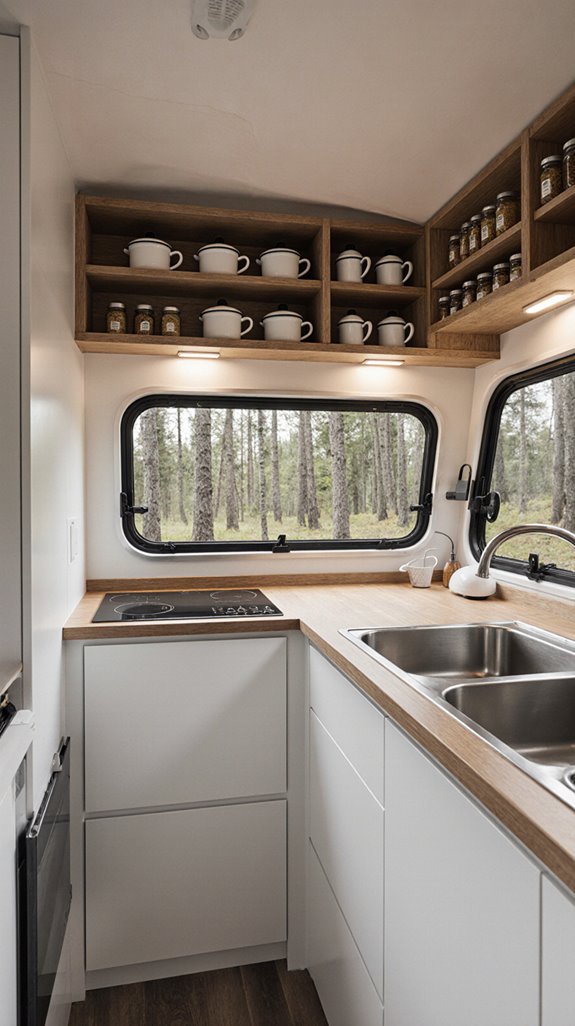
The work triangle, sink, cooktop, and fridge arranged so no single leg exceeds 9 feet, was designed for full-sized kitchens, not a caravan where three steps covers the whole room.
Forget the geometry. Think zones instead: prep, cooking, cleanup, and storage clustered so you pivot rather than walk.
Place your fridge near the entrance to keep snack-grabbers out of your cooking path. Tuck the sink between the hob and prep counter so rinsing never means backtracking.
Keep every main task within one or two steps and you’ve already cut most of the unnecessary movement out of your cooking routine. Aim for 40 inches minimum between countertops so you can move freely and open appliances without blocking your own path.
Swap Fixed Dinette Seating for a Pull-Out Kitchen Module
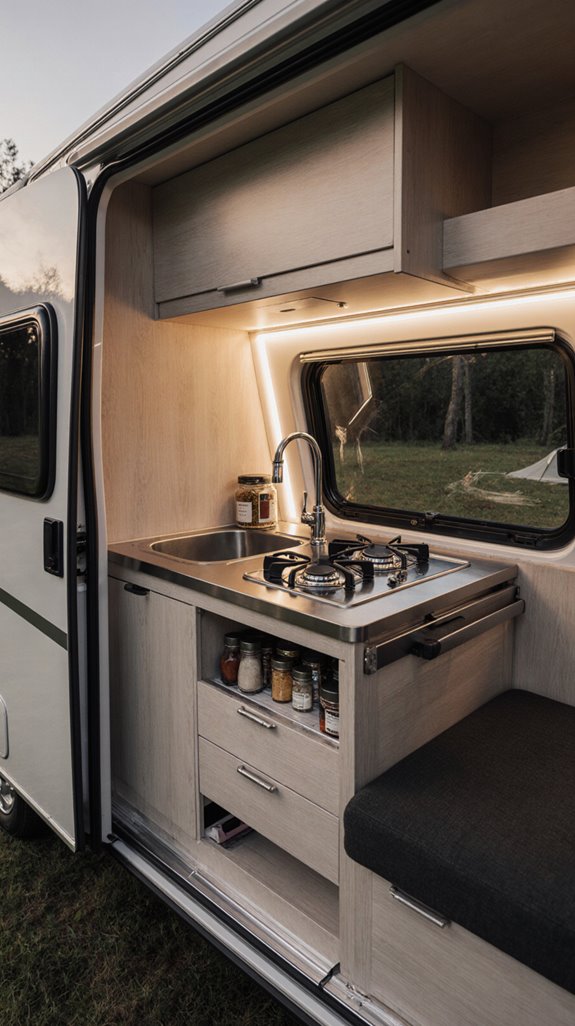
Ripping out that fixed dinette and replacing it with a pull-out kitchen module is one of the few caravan mods that actually earns back floor space instead of just shuffling it around.
Done right, it frees 15-30% more floor area for circulation and storage.
You’re building the module from lightweight plywood or aluminum, then mounting it on heavy-duty drawer slides rated around 200-250 lb.
The slide-out positions your stove, sink, and prep surface in a linear sequence outdoors, cutting heat and odors inside.
Fold-down side tables can expand your prep surface by up to 60%. Regular maintenance keeps everything running smoothly, so make sure to lubricate the slide-out mechanism every six months to prevent wear and ensure consistent performance.
Move Heavy Appliances Low and Close to the Axle
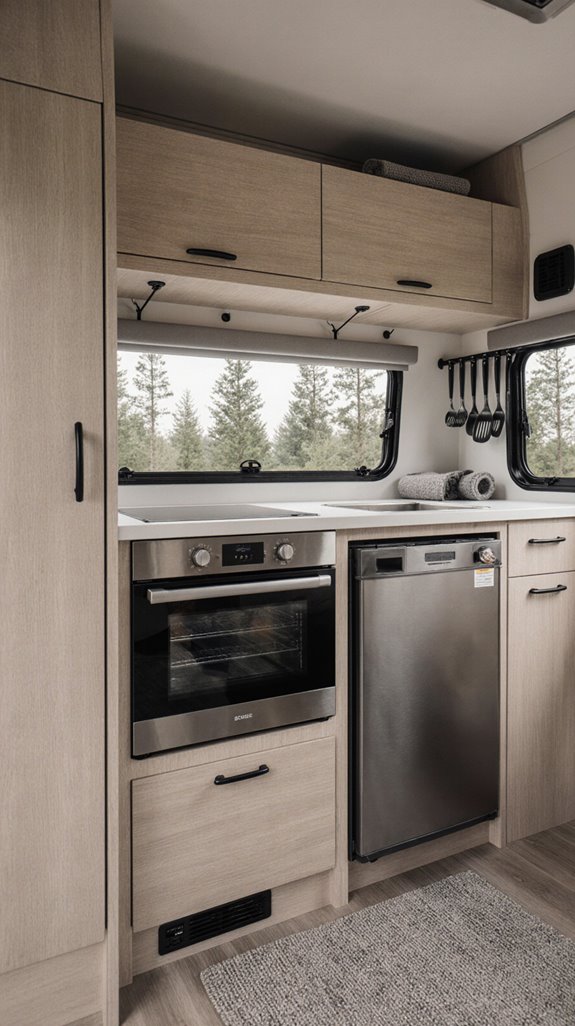
Moving 3 heavy appliances, your fridge, oven, and battery bank, low and close to the axle is the single most effective weight management change you can make to a caravan.
Gravity doesn’t negotiate. Keeping mass low cuts body roll and reduces sway when a passing semi tries to ruin your afternoon.
Mount these items within 300 – 400mm of the axle line, and you’ll hit the recommended 7,10% tow ball weight almost automatically.
Your chassis takes less bending stress on corrugations, cabinet fixings last longer, and your tow vehicle’s rear suspension stops working overtime.
Fewer problems, same kitchen. When repositioning these appliances, use straps and moving blankets to prevent vibration damage during transport and protect internal components from shifting.
Add a Swing-Out Exterior Pod to Cook Outside the Van
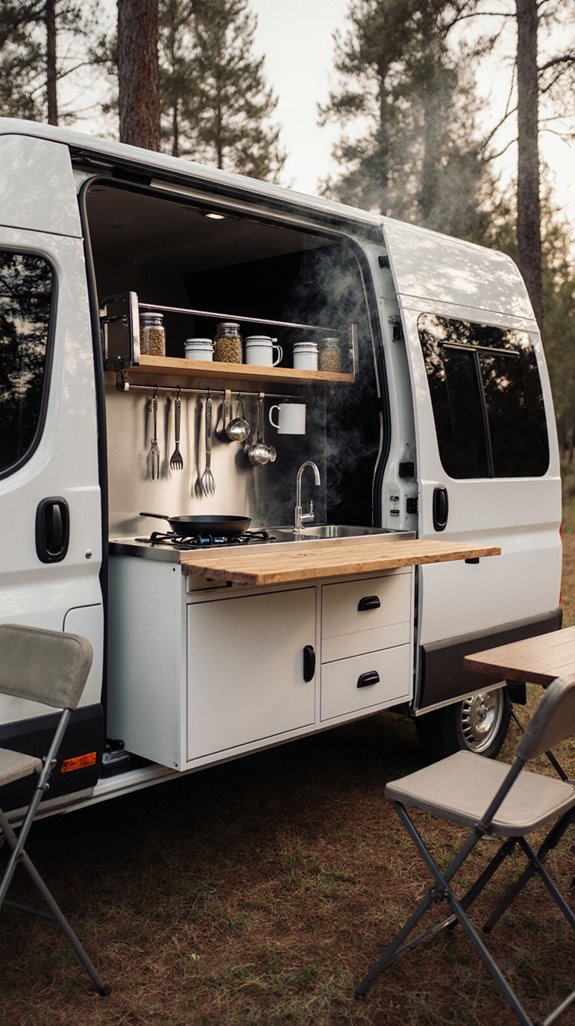
A swing-out exterior pod turns your caravan’s rear or side door into a full working kitchen that deploys in about 60 seconds.
Swing-away tire carrier hinges rated 200,500 lbs support the frame, which is typically 1.5″, 2″ square steel or aluminum tubing.
Bolt mounting points into existing door reinforcement ribs, not thin sheet metal, or you’ll regret it on corrugated roads.
Lock the pod open with detent pins and add a gas strut to stabilize your cooking surface.
Use marine-grade plywood or aluminum composite panels, stainless hardware, and automotive bulb seals to keep weather and dust out between stops.
Fit Deep Drawers With Full-Extension Runners Under Every Bench
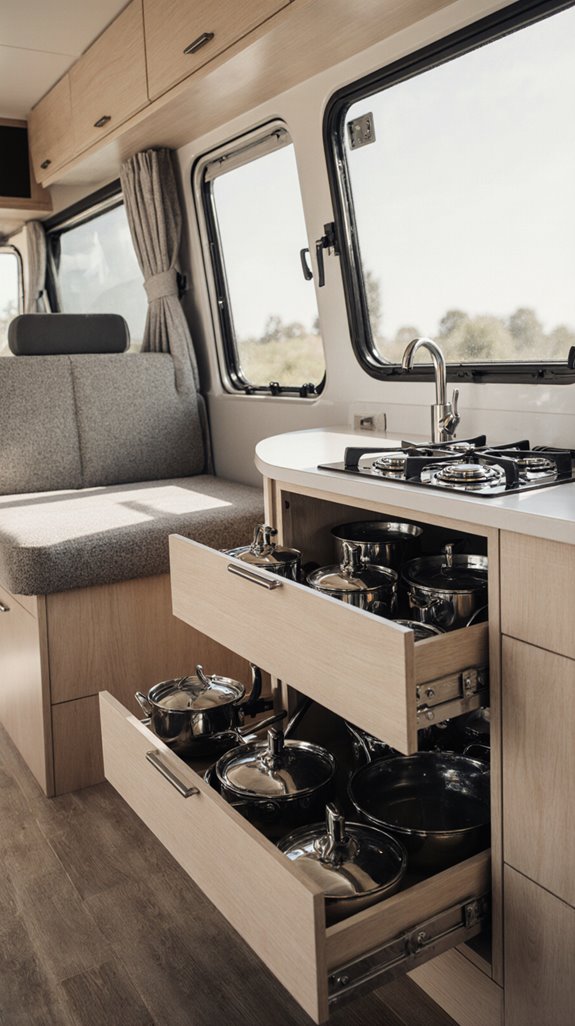
Every bench in your caravan is sitting on a hollow box, and that box is wasted space until you fit deep drawers with full-extension runners.
Size your drawers 400, 600 mm deep and match them to full-extension slides, runners that travel the full length of the drawer, giving you 100% access to the back.
Ball-bearing slides rated 35, 45 kg handle cookware easily; go heavier if you’re storing cast iron.
Build your drawer box from 12 mm birch ply, not particleboard, which vibrates apart on corrugated roads.
Soft-close mechanisms stop the 2 a.m. slam that wakes the entire campsite. Side-mount slides require 1/2 inch clearance on each side of the drawer box, so factor that into your bench opening measurements before you cut anything.
Use Vertical Space in Your Caravan Kitchen With Mesh Pockets and Shelves
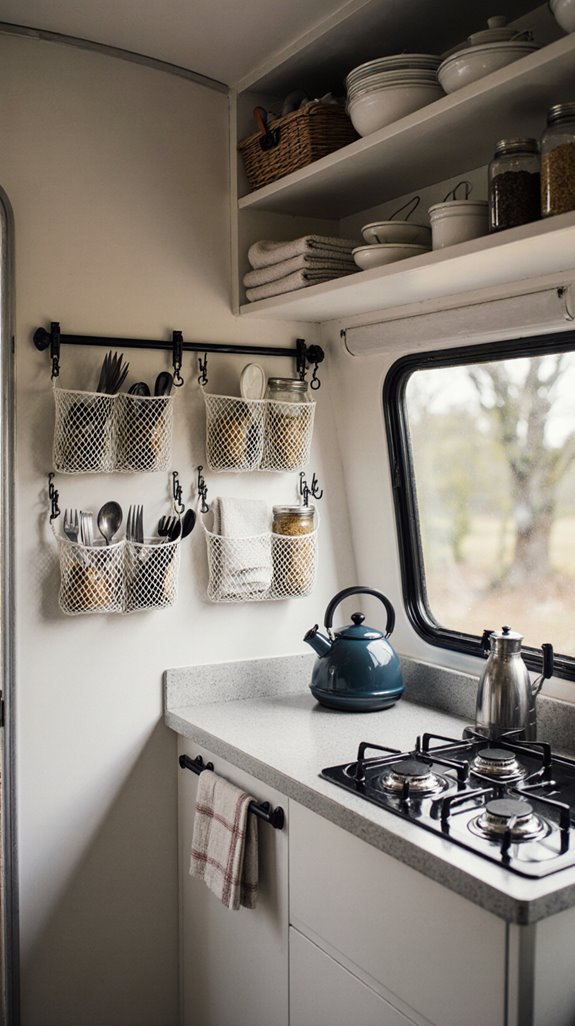
Once your under-bench drawers are sorted, look up, because that’s where most caravan kitchens waste their best real estate.
Mesh wall pockets convert blank vertical surfaces into storage for utensils, snacks, and small tools without touching your benchtop. Mount them with Command-style adhesive pads on laminate or fibreglass walls and you won’t lose resale value by drilling.
Add slimline shelves above the bench for spices and mugs, then hang mesh pockets underneath for chopping boards and foil rolls.
Suspend a 3-tier mesh hanging shelf in your awning for fruit and bread, keeping both pests and clutter off your camp table. Wall pockets are especially practical in the bathroom, where organised toiletries are kept upright and within reach without cluttering any surface.
Add Toe-Kick Drawers and Pull-Out Pantries for Dry Food Storage
That 100,115 mm gap running along the base of your caravan cabinets is doing absolutely nothing right now, and that’s a waste.
Slide in a toe-kick drawer, a shallow, low-profile drawer built into that recessed plinth space, and you’ve instantly recovered usable storage.
Across a typical caravan galley, you’ll often find 1-2 metres of toe-kick running along base cabinets, which converts into several tens of liters of extra space.
Use push-to-open hardware so nothing protrudes into your aisle.
Store flat dry goods there: tortilla packs, vacuum-sealed meats, silicone mats, and freeze-dried backup meals travel well in that space.
Upgrade to a 12V Compressor Fridge for Better Cooling
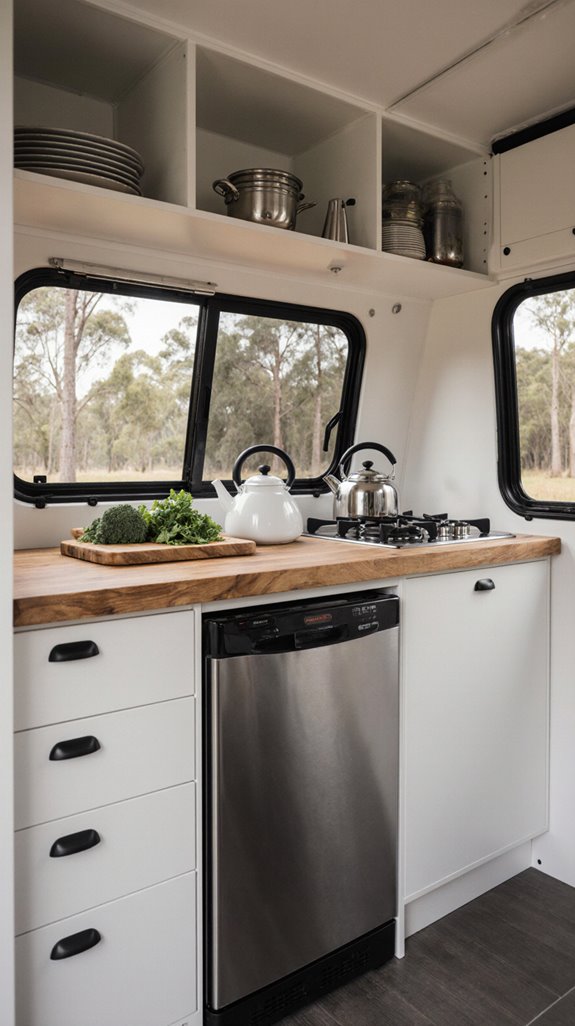
Squeezing storage out of your toe-kick space is smart work, but cold storage is where most caravan kitchens actually fall apart.
Your old absorption fridge runs on gas, 12V, or 230V, but it cools through a slow chemical process that struggles in summer heat.
A 12V compressor fridge uses refrigerant cycling to actively remove heat, cooling faster and holding temperature better when its 40 degrees outside.
It draws roughly one-third the power of an absorption unit.
Paired with a decent battery and solar setup, some users run theirs four days without recharging.
That’s a real upgrade, not a marketing claim.
Choose Between Induction and Gas for Your Caravan Kitchen
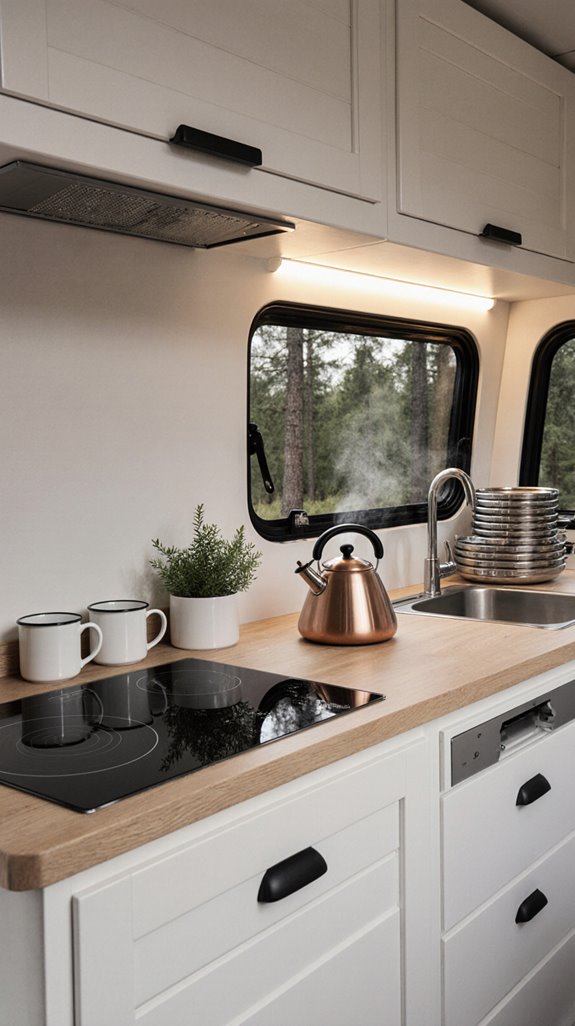
Choosing between induction and gas comes down to how you power your caravan and how far off-grid you actually go.
Induction runs 80,90% efficient, boils water twice as fast as gas, but pulls 1,500,2,000W per burner, so your inverter and battery bank need to handle that load.
Gas stores serious energy in a compact LPG cylinder, works with any cookware including rounded-bottom woks, and needs zero electrical infrastructure.
Induction wins on safety and cleanup since the glass surface stays cool and wipes down in seconds.
Gas wins on remote self-sufficiency, making it the better choice for those who venture far from powered sites.
Match the cooking method to your actual setup.
Replace Old Laminate With a Lightweight Butcher-Block Benchtop
Old laminate benchtops peel, stain, and generally look tired after a few years on the road.
So replacing them with a butcher-block-style top is one of the faster wins in a caravan kitchen makeover.
Skip true 1.5-inch hardwood; it runs 12 – 15 kg per linear metre and your cabinet fixings will hate you for it.
Instead, use 19 mm edge-glued pine panels or 18 mm birch plywood with false front edges mitered to 35,40 mm thick.
You get the chunky butcher-block look at roughly half the weight, and your hinges stay aligned over corrugated dirt roads.
Install a Fold-Out Worktable for Extra Outdoor Prep Space
When your caravan’s interior bench runs out of room mid-meal, a fold-out worktable mounted to the exterior wall buys you a genuine second prep zone without adding a square metre of footprint to your setup.
Mount the surface 850,950 mm off the ground to match standard bench height and save your back. Use marine-grade plywood or aluminum for the top; solid timber eats into your payload fast.
Fix brackets into metal wall framing, not just cladding, or you’ll pull the whole thing out under load. Heavy-duty steel brackets handle 50 kg easily, which covers a camp stove without drama.
Add LED Task Lighting to Your Caravan Kitchen Stove and Prep Area
A single overhead light does almost nothing useful in a caravan kitchen; it casts shadows exactly where you need to see, right over your cutting board and cooktop.
Fix that with 12V LED task strips or puck lights mounted under cabinets or near the stove’s front edge. They draw 3.6W each, run directly off your caravan’s fused distribution panel, and won’t flatten your battery.
Choose fixtures rated IP44 or higher and housed in metal, not plastic; heat and grease wreck plastic fast.
Stick to 3000K, 4000K color temperature so your food actually looks like food.
Don’t Skip These Ventilation and Safety Upgrades
Cooking in a caravan without proper ventilation isn’t just uncomfortable, it’s genuinely dangerous. Gas burners produce carbon monoxide and nitrogen dioxide, both invisible, both harmful in tight spaces.
A compact 12V roof fan, like the Maxxair 00-07500K, pulls steam and combustion gases out before they build up. Ducted range hoods work best for heavy cooking, while ductless models only recirculate air and skip removing moisture entirely.
Check gas connections monthly using soapy water. Bubbles mean leaks. Keep a fresh-air inlet near your cooker so the flame gets enough oxygen for clean, complete burning.