What this is: A guide to building an intentional recovery zone in your bedroom or apartment. The corner, chair, and
setup that genuinely decompress your brain instead of just giving it different stimulation. Covers gaming setups, reading nooks, music corners, and bean bag areas, with the crucial distinction between passive scrolling and actual rest.
Who benefits most: Men who crash on the bed after work and somehow feel more drained an hour later — not rested. Why it’s worth reading: Most man cave ideas content shows you what a recovery zone looks like. This one explains why yours isn’t working and how to fix it.
There’s a version of rest that most men get wrong, and it quietly explains why you can spend two hours “relaxing” and feel worse than when you started.
Scrolling a phone, watching random YouTube videos, and flipping through content without intention are not rest.
Neuroscientists call this passive digital consumption.
And passive digital consumption overstimulates reward circuits while preventing the default mode network from doing its actual recovery work.
Your brain needs specific conditions to genuinely decompress. Building a recovery zone that creates those conditions is the difference between an evening that restores you and one that just kills time.
What Separates a Real Recovery Zone From Just a Corner With a Chair
The standard man cave ideas content conflates decompression with entertainment. A gaming setup, a big screen, a sound system — all valid, all enjoyable, but enjoyment and recovery are not the same thing.
Games that require active decision making and fast responses keep your stress response elevated, not quieted. Watching content that triggers outrage, anxiety, or strong emotion does the same.
A genuine recovery zone gives your nervous system a job it can actually complete.
That job is low stakes sensory input with no urgent decisions required. A book. Music you already know. A game you play on autopilot.
The difference is cognitive load — your brain can process familiar, low stakes input while simultaneously running background maintenance it can’t access when you’re in active mode.
Sleep and genuine relaxation fall into the passive rest category, while light reading and casual music listening fall into active rest. Both restore. Endless scroll restores neither.
The Gaming Setup That Actually Recovers You
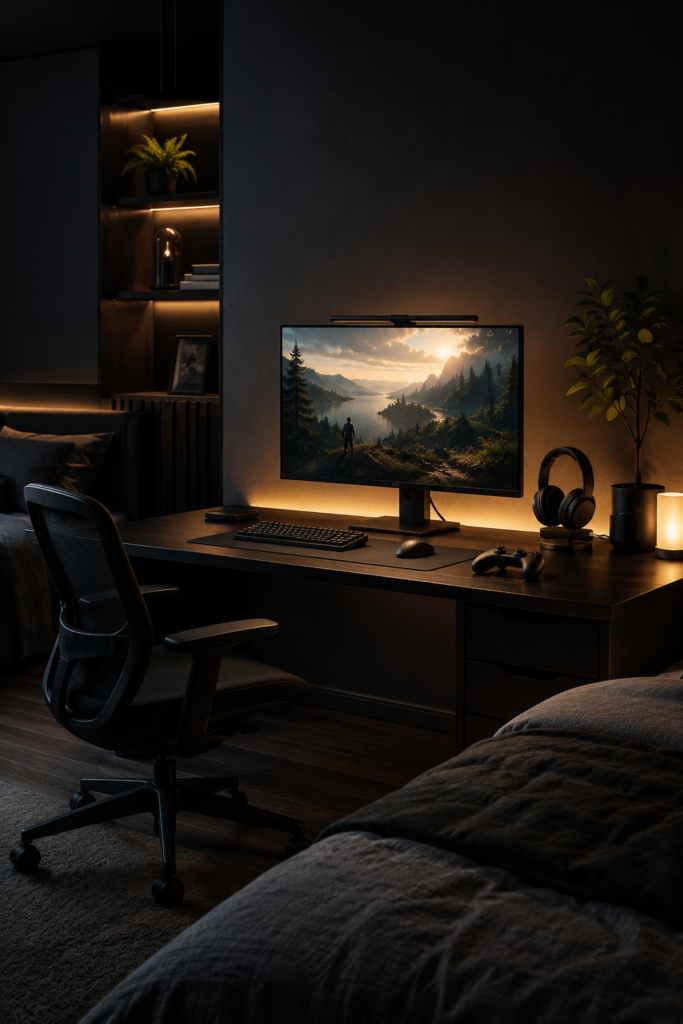
Gaming setups dominate the room ideas for men space for good reason. They’re among the most visually striking and personally expressive setups a man can build.
Positions four, eight, fifteen, and twenty two in the top performing content for this keyword are all gaming adjacent, and the engagement numbers back it up.
The problem isn’t the setup.
The problem is what gets played in it. Competitive multiplayer keeps cortisol elevated.
Ranked matches where losing costs something real are not decompression, they’re a second job with better graphics. Story mode games, open world exploration, and simulation titles are a different category entirely.
RELATED: Japanese Minimalism for Men: The Clean, Calm Room That’s Harder to Pull Off Than It Looks!
Proven research.
Brain imaging research confirms that the brain needs low urgency, absorbing activity to activate genuine restoration.
Researchers who study rest physiology distinguish between active and passive rest for exactly this reason. Single player narrative games land firmly in the restorative column. Ranked multiplayer does not.
Build the gaming setup you want. Stock it with games you play to unwind, not to win. The setup itself; dark walls, warm LED ambient lighting behind the monitor, a good chair, a controller that fits your hand — is the right call.
The playlist inside it is where most men make the mistake.
The Reading Nook: The Most Underrated Recovery Setup in Any Room
Reading outperforms most other activities as a recovery tool. A 2009 University of Sussex study found that six minutes of reading reduced stress levels by up to 68 percent!
More than listening to music, taking a walk, or making tea.
The cognitive mechanism is straightforward: reading absorbs attention gently, activates the default mode network through imagination, and requires no reactive decision making.
A proper chill vibe room reading nook needs three things and nothing more.
A chair or floor cushion that keeps your body comfortable for thirty to sixty minutes, not a dining chair, and not the bed, where the association with sleep makes concentration difficult.
A warm task lamp positioned so the light falls on the page without hitting your eyes directly. A surface within arm’s reach for a drink, a bookmark, and nothing else. No phone on that surface.
The best reading nooks happen close to the floor, which is why floor cushions and low chairs consistently outperform traditional armchairs in rooms where the ceiling height is standard.
A floor cushion against the wall with a small wooden crate as a side table costs less than thirty dollars and creates a reading corner that pulls you in every time you walk past it. Add a blanket. Done.
The Vinyl and Music Corner
A music corner built around vinyl has a specific quality that streaming cannot replicate: it requires physical interaction.
Choosing an album, pulling it from the sleeve, cleaning the record, setting the needle. This sequence is a transition ritual that tells your brain something is changing.
Research on work rest transitions consistently shows that deliberate shutdown rituals improve psychological detachment from work stress more than passive drift into screen time.
Room ideas for men gaming content occasionally includes vinyl setups as accent pieces.
Treating the record player as the centerpiece rather than the decoration changes how the corner functions. Mount a small shelf for twelve to fifteen records you actually listen to. Place the turntable at sitting height beside a low chair.
Connect it to a compact powered speaker rather than a complex receiver setup — one cable, two connections, done.
The corner becomes a space where the act of choosing what to listen to is part of the decompression.
The Bean Bag Setup: Lower Than You Think, More Effective Than It Looks
A bean bag chair in a specific corner of the room is one of the highest performing visual formats in the man cave ideas space.
A bean bag setup with a floor lamp in a dark corner of a bedroom, and its engagement numbers are strong precisely because the setup reads as intentional rather than accidental.
The functional case for a bean bag in a recovery zone is posture.
Standard desk chairs keep your body in an alert posture, upright, forward facing, arms at typing height. A low bean bag chair drops your centre of gravity, reclines your posture, and physically signals to your body that nothing urgent is happening.
Combine a quality bean bag with a floor lamp at warm 2700K, a small side table, and either a book or a controller, and you have a recovery zone that costs under a 150$.
Placement matters as much as the chair itself.
Put it in a corner rather than in the open floor — the enclosed geometry on two sides creates a psychological sense of shelter that amplifies the calming effect.
Dark wall colours behind it reinforce the cocooning quality. The lamp is the only light source active in that corner. Everything else in the room drops away.
Building Your Recovery Zone: What to Choose and Why
The recovery zone setup that works is the one you actually use. Here’s a quick reference for choosing between the four formats:
| Recovery zone type | Best for | Key element | Avoid |
| Gaming corner | Active unwinding, immersive rest | Single player titles, warm ambient light | Ranked competitive play |
| Reading nook | Cognitive decompression, stress reduction | Floor cushion, warm lamp, no phone | Bed, dining chair |
| Vinyl and music corner | Transition rituals, sensory rest | Turntable, one compact speaker, record shelf | Streaming on a screen |
| Bean bag corner | Postural rest, low stakes sessions | Quality bag, floor lamp, enclosed corner | Open floor placement |
Every format above works. Mixing two of them in the same corner rarely works.
The zone loses its singular identity and becomes another cluttered corner that your brain files away as background noise. Pick one, commit to it, keep it clear of anything that doesn’t serve its purpose.
The Zone That Earns Its Square Footage
A recovery zone is not decorative.
Every element in it is doing a specific job, the lamp creates a warm envelope of light, the chair changes your body posture, the activity gives your brain low stakes absorption.
Room ideas for men gaming content shows these setups looking great in photos. I’d simply explained why they need to be designed for your nervous system first and your camera roll second.
Build it with that frame and the corner pays for itself in how you feel on the days you actually use it.