
What this is: A practical guide to building a functional gym corner inside a bedroom using a four by six foot patch of
floor, a doorframe pull up bar, resistance bands, a yoga mat, and optional folding equipment — no separate room required.
Who benefits most: Men who want to train at home but assume they don’t have the space.
Why it’s worth reading: The home gym ideas conversation almost always assumes you have a garage, a basement, or a spare room. Most men don’t. This guide works for the room you actually have.
Most home gym content starts with a dedicated room and works backward from there. That framing eliminates most men before they’ve even started.
The reality is that a gym corner built into a bedroom costs under a 150$, requires about twenty four square feet of floor, and delivers enough training volume to cover strength, mobility, and conditioning. All without touching the rest of the room.
The bridge between room design and fitness is the opportunity nobody has claimed.
Room design content ignores training. Fitness content ignores aesthetics. My simple ideas shared here occupies the space between them: a bedroom that looks like a bedroom first and functions as a gym second.
Why a Bedroom Gym Corner Works Better Than You Think
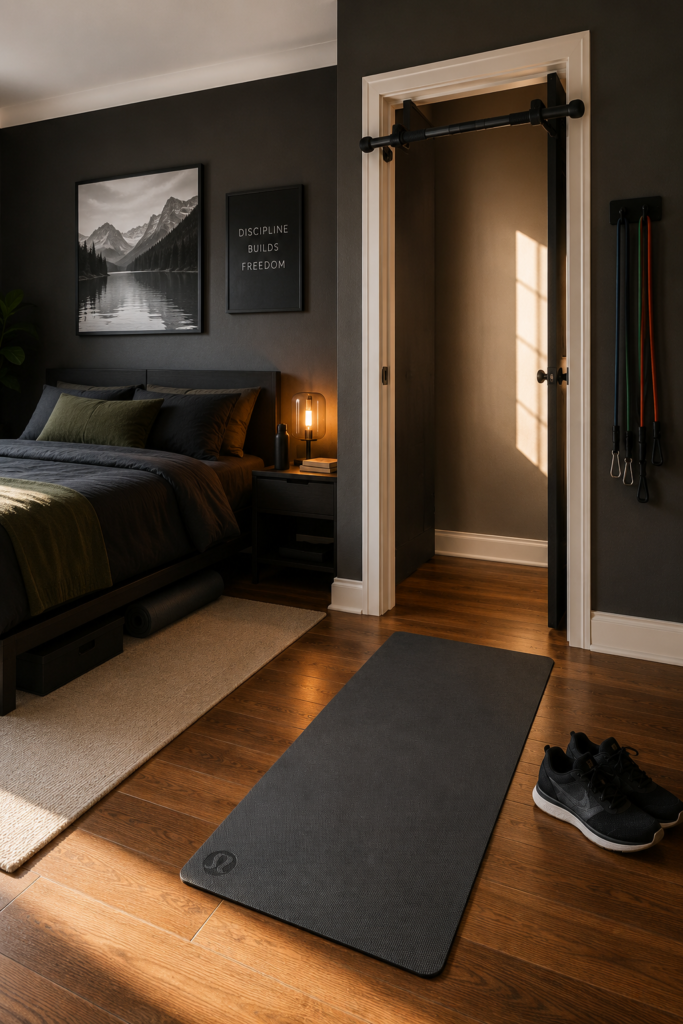
Space is the first objection and usually the weakest one. A yoga mat covers approximately two by six feet. Standing on it with arms extended takes approximately four by four feet of clearance.
A pull up bar mounted in a doorframe uses no floor space at all. Resistance bands stored on a single wall hook use no floor space either.
The gym corner in a bedroom works.
Yes, it works because fitness equipment is modular in a way that furniture is not.
A mat rolls up and slides under the bed. Bands unclip from a hook and fit in a drawer. A doorframe bar disassembles in thirty seconds.
Not one of these items competes with the room’s function when not in use. None of them compromise the aesthetic when they are.
Contrast this with the standard gym room approach, dedicated floor space, fixed equipment, a room committed to one purpose.
Research on home exercise consistency suggests that reducing friction between the intention to train and the act of training is one of the strongest predictors of routine consistency. A gym corner in the room where you wake up eliminates that friction almost entirely.
RELATED: The #1 Men’s Bedroom Aesthetic on Pinterest (and How to Do It Right)!
The Equipment: What You Need and What You Don’t
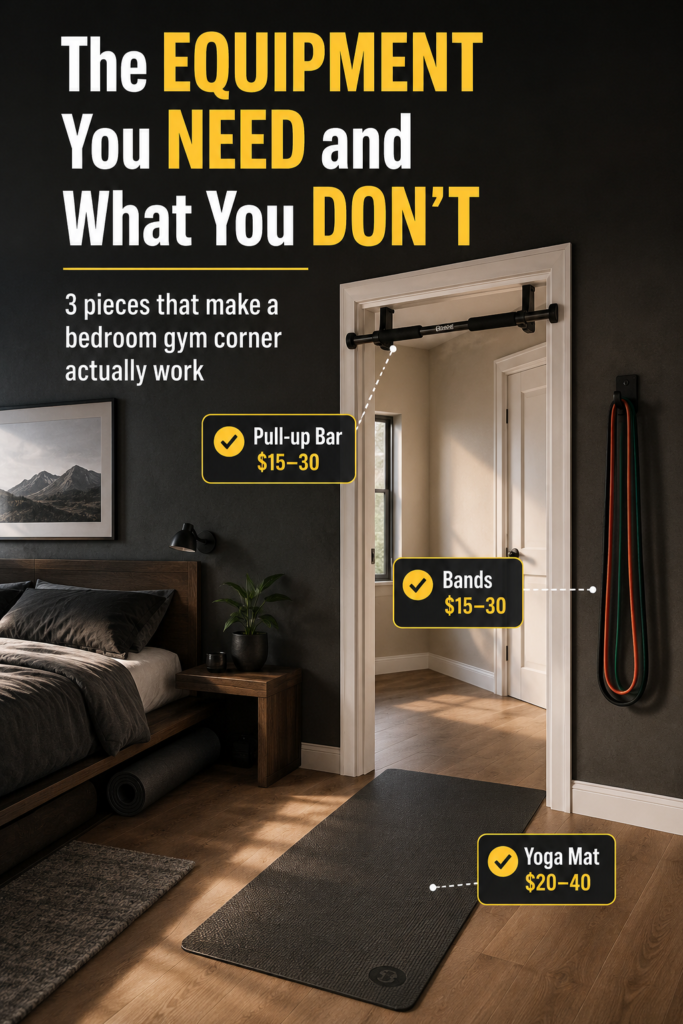
The floor is clear, the doorframe is available, and the wall has a hook. Here is what earns a place in the corner:
The doorframe pull up bar is the single highest value piece of equipment in this setup.
Mounting in any standard doorframe with no drilling required, it covers pulling patterns. Pull ups, chin ups, hanging leg raises, that resistance bands cannot replicate at the same intensity. Fitting one takes about two minutes. Cost: fifteen to thirty dollars.
Resistance bands cover the rest of the strength spectrum.
Mass General Brigham’s review of exercise band research confirms that resistance band training produces comparable strength gains to conventional weight training. As well improvements in muscle activation, cardiovascular health, and body composition.
A set of five bands with varying resistance levels covers chest press, rows, squats, curls, overhead press, and lateral raises. Cost: fifteen to thirty dollars. Storage: one wall hook, or a drawer.
RELATED: The Streetwear Room: Sneaker Displays, Brand Art, and Hypebeast Bedroom Design!
A quality yoga mat defines the movement zone visually and functionally.
Six millimetres of density is the minimum for floor work and mobility. The mat unrolls in three seconds and rolls back under the bed in five. Cost: twenty to forty dollars.
Optional additions for men who want to expand the corner without expanding the footprint:
- Adjustable dumbbells (replace an entire rack, store in a small footprint)
- A foldable bench (stores vertically against the wall, unlocks pressing movements)
- Gymnastic rings (hang from the pull up bar, add row and dip variations)
- A jump rope (zero storage footprint, high conditioning output)
| Equipment | Primary movements | Space required | Cost |
| Doorframe pull up bar | Pull ups, chin ups, hangs | Zero floor space | $15 to $30 |
| Resistance bands (5 pack) | Full body push and pull | One wall hook | $15 to $30 |
| Yoga mat | Floor work, mobility, squats | Rolls under bed | $20 to $40 |
| Adjustable dumbbells | Pressing, curls, rows | 1×1 foot footprint | $80 to $200 |
| Foldable bench | Pressing, step-ups | Stored vertical | $60 to $120 |
| Jump rope | Conditioning, warm-up | Zero floor space | $10 to $20 |
The Layout: Making a Four by Six Foot Corner Into a Full Gym
Position the mat in the corner of the room furthest from the bed. The mat becomes the gym’s floor plan, everything happens on or adjacent to it.
A matte black wall hook mounted directly above the mat holds the resistance bands. The doorframe pull up bar is in the nearest doorway, visible from the mat but not on it.
The corner placement is deliberate.
Two walls meeting creates a contained zone that reads as its own space within the room. The same enclosed geometry principle that makes a bean bag reading corner feel intentional rather than incidental.
Your brain treats the corner as a different location within the room, which creates a psychological cue for the mode shift from regular morning to training morning.
RELATED: Japanese Minimalism for Men: The Clean, Calm Room That’s Harder to Pull Off Than It Looks!
Keep the mat rolled when not in use.
The visual difference between a training corner with a rolled mat and one with a mat left out permanently is the difference between a gym corner and clutter.
Rolling the mat takes five seconds. Leaving it out makes the room feel permanently mid-workout. Roll it.
RELATED: The Refined Masculine Aesthetic Nobody Is Doing on Pinterest Yet!
What a Full Training Week Looks Like in This Corner
A common concern: can a corner gym cover enough training stimulus to be worth building?
Here is a complete weekly structure using only the doorframe bar and a set of resistance bands:
Day 1 — Push – Band chest press: 4 sets – Band overhead press: 3 sets – Band lateral raises: 3 sets – Band tricep pushdowns: 3 sets
Day 2 — Pull – Pull ups or band assisted pull ups: 4 sets – Band face pulls: 3 sets – Band bent over rows: 4 sets – Band bicep curls: 3 sets
Day 3 — Legs and core – Band squats: 4 sets – Band Romanian deadlifts: 4 sets – Hanging leg raises from pull up bar: 3 sets – Band lateral walks: 3 sets
Day 4 — Mobility and recovery – Full yoga mat mobility sequence: 20 to 30 minutes
This covers the primary movement patterns
Push, pull, hinge, squat, carry — across four sessions per week without touching a single piece of gym equipment that requires permanent floor space.
Cleveland Clinic’s review of resistance band training research notes that a 2019 study specifically found comparable strength gains to conventional gym equipment using this exact approach.
Keeping the Room Looking Like a Bedroom, Not a Gym
The aesthetic challenge of a bedroom gym corner is real and solvable. Every piece of equipment in this setup either stores invisibly or contributes to the room’s visual identity.
A set of resistance bands in black or charcoal hanging on a matte black hook looks like intentional wall decor from a distance.
A rolled dark grey mat leaning against the wall beside the dresser reads as a design object. The pull up bar in a doorframe is barely visible and quickly becomes unremarkable.
What breaks the bedroom aesthetic is disorganized equipment. A mat left half rolled, bands tangled on the hook, a bench sitting at an awkward angle in the middle of the room.
These signal that the space is contested between two purposes and neither one is winning. The solution is storage discipline, not less equipment.
Assign every piece a specific home.
Bands on the hook — always.
Mat rolled, always. Bar in the frame, always. Dumbbells on a small shelf or tucked beside the dresser, always.
Consistency in placement is what makes the corner look like a feature of the room rather than a collision between the gym and the bedroom.
The five-zone framework for men’s room design treats movement as one of the five core functions a bedroom should support alongside sleep, dress, work, and recovery.
A four by six foot corner is all it takes to activate that fifth zone — and a gym that’s already in the room you sleep in removes the last excuse for skipping it.