
What this is: A design guide for building a streetwear and sneaker influenced bedroom. Covering display systems,
brand art placement, how to make a curated collection look intentional rather than cluttered, and the specific mistakes that separate a genuine hypebeast room from one that just looks busy.
Who benefits most: Men with a real collection — sneakers, art figures, brand pieces — who want the room to reflect that identity without becoming a storage problem with good lighting.
Why it’s worth reading: The sneakerhead bedroom and hypebeast room ideas content online is mostly product galleries. This is the design framework behind the ones that actually look right.
The streetwear room is one of the highest engagement aesthetics in the men’s bedroom space right now. And the reason is obvious.
A wall of sneakers displayed correctly communicates taste, identity, and real investment in a way that generic dark bedroom content simply cannot match.
The problem is that most men approach it as a storage problem rather than a design problem. Collection stored. Room decorated. Gap between the two never bridged. Here is how to bridge it, and the best bachelor room decor.
The Sneaker Display Wall: Why It Works and How to Build One
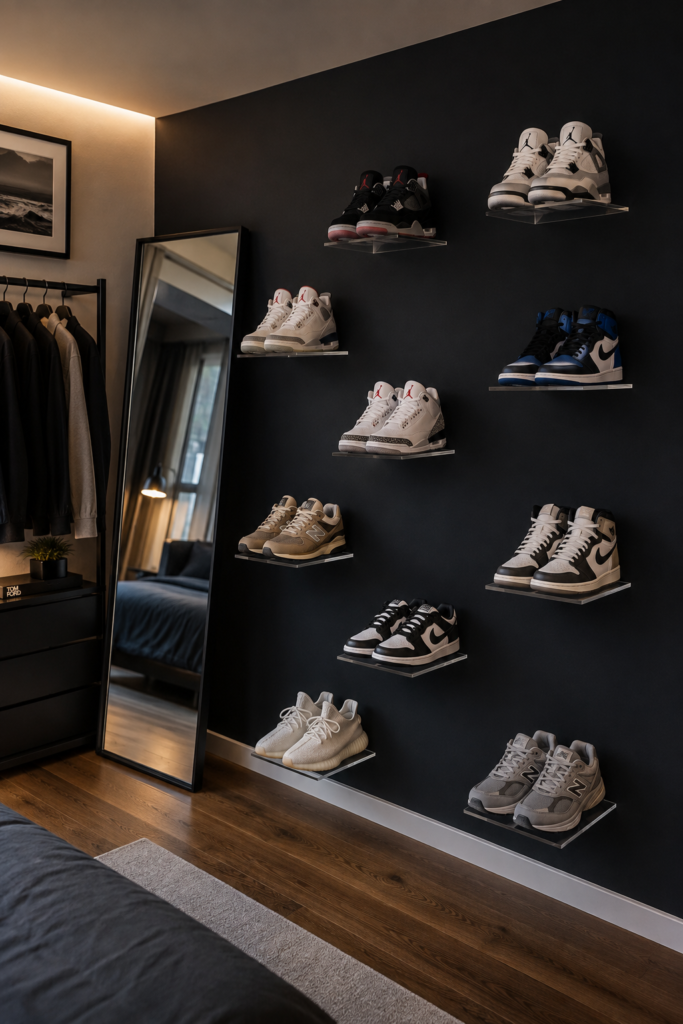
A properly executed sneaker display wall does two things simultaneously.
It solves the storage problem and creates the most visually striking element in the room. Done right, it looks like a gallery installation that happens to hold footwear.
Bachelor room decor ideas, done right
Done wrong, it looks like a shoe shop that forgot to lock up. The difference is almost entirely about breathing room.
Research on gallery display principles consistently shows that objects displayed with deliberate negative space around them register as curated and intentional, while objects packed tightly register as inventory.
One pair per shelf, minimum 4-inches of clearance on each side, uniform shelf depth. That is the entire formula.
Acrylic floating shelves are the standard for a reason. They disappear visually, allowing the sneaker itself to be the feature rather than the shelf.
Mount them in a staggered grid rather than a straight line
A straight line reads as utilitarian storage. A staggered grid reads as deliberate composition.
For the wall itself, dark charcoal or deep navy behind the display amplifies the visual contrast against the sneakers and creates the room ideas for men closet energy that pulls the whole aesthetic together.
A white wall behind a sneaker display reads like a shoe shop. A dark wall behind it reads like a collector’s studio.
RELATED: Adding a Gym Corner to Any Bedroom (Even a Tiny One)!
Brand Art and Figure Displays: What to Put on the Walls That Aren’t Shelves
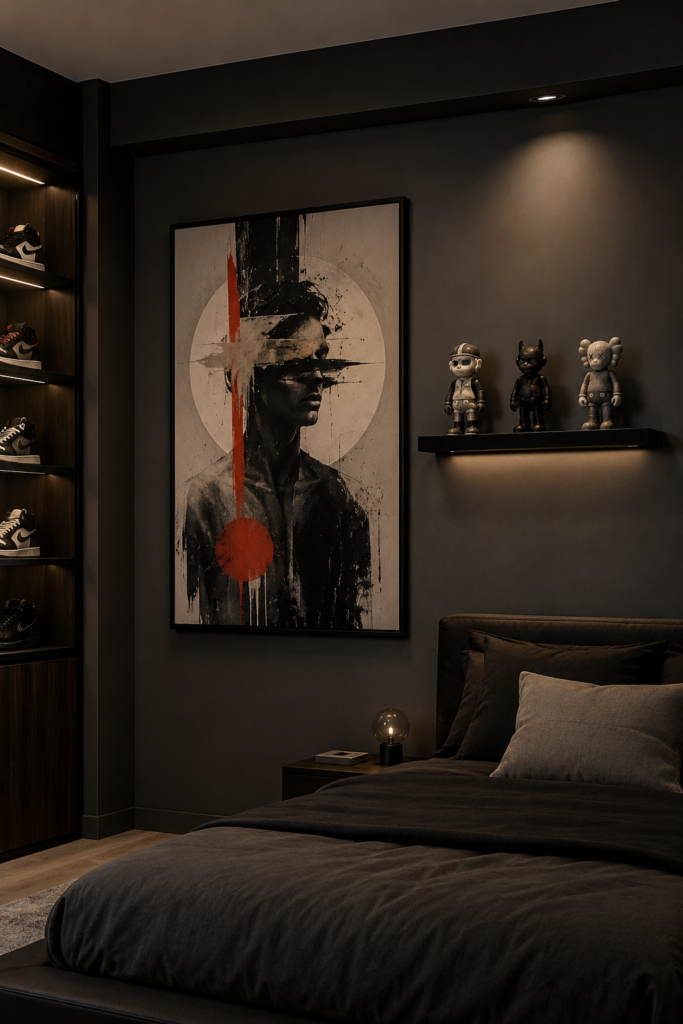
Brand art in a streetwear aesthetic bedroom works when it’s treated as actual art. Framed, considered, and positioned with the same intentionality you’d give a gallery print.
Unframed posters taped to the wall and Jordan prints stacked above each other on museum style hanging systems look like a teenager’s room, regardless of how rare the pieces are.
Three rules for brand art placement in a bachelor room decor:
- One large anchor piece per wall, centered and mounted at eye level. Not two. Not a cluster of five. One piece that earns its position.
- Frame everything. Matte black frames work across every brand palette. A framed hypebeast print reads as collected. An unframed one reads as a poster that hasn’t been dealt with yet.
- Create breathing room the same way you would with sneaker shelves. Art mounted too close together competes rather than coheres.
Art figures, KAWS companions, Medicom toys, vinyl collectibles? They work best on a dedicated shelf rather than scattered across the room.
A floating shelf at eye level, lit from above or below by a small LED spotlight, turns three figures into a genuine display. Scattered across multiple surfaces, those same three figures become clutter.
The Clothing Rack as a Design Element
Most hype beast room setups include an open clothing rack, and most of them get it wrong in the same way — too many pieces, zero editing, and a colour spectrum that fights with everything else in the room.
An open rack in a streetwear room should hold ten to fifteen pieces maximum.
The pieces on display should be edited to a tight palette.
Three to four colours that work together, hung with consistent spacing on matching slim velvet hangers.
The rack becomes a visual statement when it’s curated. It becomes an obstacle when it’s a wardrobe overflow.
Position the rack perpendicular to the sneaker wall rather than beside it, so the two main display elements frame the room from different angles rather than competing on the same sight line.
A matte black steel rack in front of a dark wall disappears beautifully. Put it against a light wall and it becomes a focal point it may not be strong enough to be.
RELATED: The Refined Masculine Aesthetic Nobody Is Doing on Pinterest Yet!
Lighting the Streetwear Room
Lighting is where the room ideas for men bedroom aesthetic either comes together or falls apart.
The streetwear room has more display objects than most aesthetics, which means it needs more intentional light placement to prevent the room from feeling like a spotlight on chaos.
The framework is three tier lighting:
| Light tier | Source | Temperature | Purpose |
| Ambient | LED strip behind bed headboard or ceiling edge | 3000K warm white | Room mood, base layer |
| Display | LED spotlights or strip above sneaker shelves | 3500K neutral white | Illuminate the collection |
| Task | Warm table lamp on nightstand | 2700K amber | Sleep and wind-down signal |
The display lighting is the tier most men skip. Without it, the sneaker wall fades into the dark background and loses its impact entirely.
A short LED strip mounted above the shelf line, angled downward, does the job for under twenty dollars and transforms the display from a shelf to a feature.
Cool white or blue spectrum lighting kills this aesthetic on contact.
Every light source in the room should run warm, the display lights can go slightly cooler than the ambient to create separation, but nothing below 3000K should be active after dark.
RELATED: The Clean, Calm Room That’s Harder to Pull Off Than It Looks!
Rugs, Bedding, and Textiles: Anchoring the Collection
The streetwear room fails when the collection is the only thing with personality and the rest of the room feels like a generic dark bedroom that the collection happens to live in.
Textiles are what integrate the collection into the room rather than letting it float above it.
Bedding in charcoal, black, or deep olive linen grounds the room tonally. Bright colored or branded bedding fights with the sneaker wall for visual attention — the wall should win that competition, and neutral bedding ensures it does.
Rugs should be large enough to extend under the bed and past the clothing rack area, creating one continuous floor plane rather than three separate zones.
Dark jute, wool, or low pile rugs in charcoal or warm grey. Brightly colored or patterned rugs compete with the collection in the same way bright bedding does.
Curtains at full floor length in dark linen or velvet add a level of finish that most streetwear rooms miss.
The ceiling-to-floor curtain treatment makes any room feel taller and more considered, and in a room where the eye is drawn to the collection on the walls, grounded curtains anchor the bottom of the space and prevent it from feeling top-heavy.
The Five Mistakes That Make a Streetwear Room Look Amateur
Most hype beast room ideas online show the end result without explaining what went wrong in the rooms that didn’t work.
These five mistakes account for almost every streetwear bedroom that looks great in concept and feels like a mess to actually live in.
Mistake 1 — Displaying everything you own. A collection on display is edited. A collection in storage is everything. The pieces on the wall and the shelf should represent the best of what you have, not all of it. Edit ruthlessly and rotate seasonally. The pieces you’re not currently displaying belong in clear stackable boxes, not competing with the ones that are.
Mistake 2 — No consistent color story.
Streetwear brands span every color palette imaginable. A sneaker wall with thirty pairs spanning every colorway reads as a chaos wall, not a curated collection.
Group colourways intentionally. Earth tones together, black and white pairs together, statement colorways as solo accents with space around them. The wall tells a story or it doesn’t.
Mistake 3 — Missing the frame.
Art figures on a dresser, sneakers on the floor, brand prints leaning against the wall.
None of these are displays. A display has a frame: a shelf, a wall, a designated surface with clear boundaries. Every piece needs its frame before it earns a place in the room.
Mistake 4 — Ignoring the floor.
Streetwear rooms often nail the walls and neglect the floor entirely. A dark hardwood or concrete looking floor with a well placed dark rug integrates the display elements into the room.
A carpet or light floor tiles disconnect the wall elements from the space and make the room feel like it has two separate design intentions happening at once.
Mistake 5 — Bright overhead lighting.
The overhead light is the enemy of this aesthetic. Warm, targeted display lighting for the collection. Warm ambient for the room.
No overhead cool light after dark. This single change does more for the visual quality of a streetwear room than any individual piece in the collection.
Every element in a streetwear room is competing for attention.
Sneakers, art, figures, brand pieces, clothing. Each one has visual weight, and the room can tip from curated to chaotic faster than any other aesthetic.
The rule is simple: every object on display needs to be in its designated home, and that home needs to exist. Sneakers on the shelf.
Figures on their dedicated shelf. Art on the wall, framed, centered. Clothing displays on the rack, edited. No overflow, no surfaces used as temporary landing zones, no piece waiting to be dealt with.
A streetwear room maintained this way reads as the room of someone with genuine taste and real resources. The same collection maintained loosely reads as the room of someone with a lot of stuff.
The collection earns its room through the discipline of how it’s kept, not through the rarity of what’s in it.
That is the design truth that most sneakerhead bedroom guides never tell you. The room is not a showcase for the collection. The collection is an expression of the person — and the room is the frame.