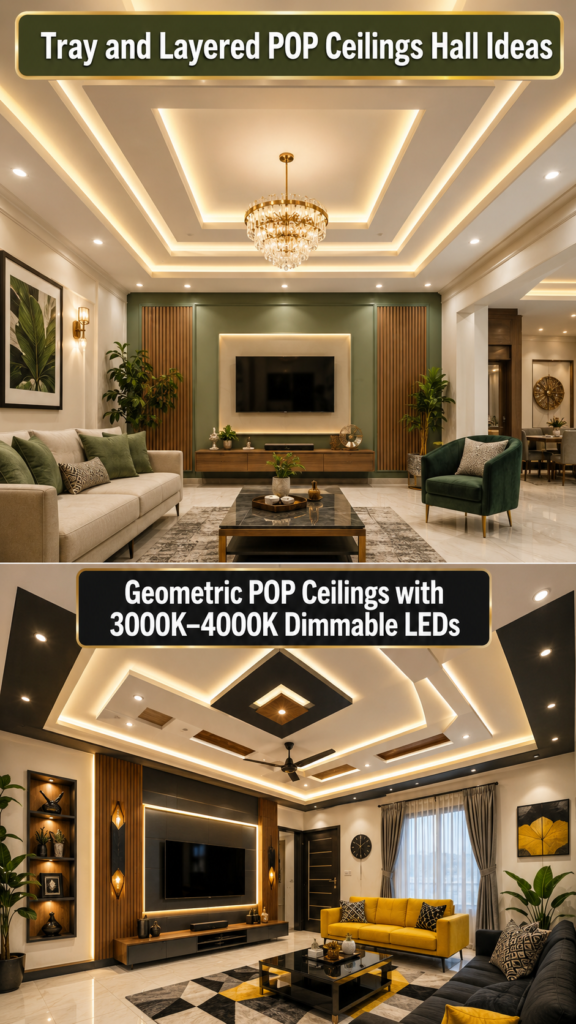
You’ve got 12 feet of ceiling height, and that’s not something to waste on a basic flat finish.
Most halls sit at 9 or 10 feet, so your already ahead. That extra height gives you room for a proper POP false ceiling, plaster of Paris layered into trays, coves, or stepped sections, without feeling cramped.
What comes next will show you exactly how to use it.
Why a 12-Foot Hall Is Ideal for POP False Ceiling Designs
Most halls top out at 8 to 10 feet, so a 12-foot ceiling gives you something most designers actually get excited about, room to work with.
You can drop a POP false ceiling, that’s plaster of Paris framework, 2 to 3 feet and still keep 9 to 10 feet of comfortable headroom below it.
That gap becomes useful fast. It hides wiring, AC ducts, and speakers without cramping the room.
You also get space for multi-layer tray designs and cove lighting channels that would look squeezed at standard height.
More ceiling, more options. Designs like multi-layered ceilings blend various shapes and elevations to create a stunning visual impact that standard-height rooms simply cannot pull off.
12 POP Ceiling Designs That Work Well in a Family Hall
Five POP ceiling designs cover the range of what actually works in a family hall, from bare-minimum cove lighting to zoned, multi-circuit setups built around how your family actually uses the space.
A perimeter cove with 3000K LEDs handles TV glare, a central LED panel, 24–48W kills shadows during homework.
Spotlights above the sofa run 3W–7W each for reading or feeding toddlers without lighting the whole room.
Fan-compatible layouts reinforce the center, so a ceiling fan doesn’t vibrate your POP into powder.
Zonal designs split the hall into circuits so you’re not powering 12 feet of ceiling for one kids’ corner. Textured ceiling designs can add visual depth to zonal layouts, making each section of the hall feel intentionally defined rather than arbitrarily divided.
How Tray and Layered POP Ceilings Change the Feel of a Hall
POP ceiling designs that zone your hall and split lighting into circuits do a lot of the heavy lifting before you even pick a fixture.
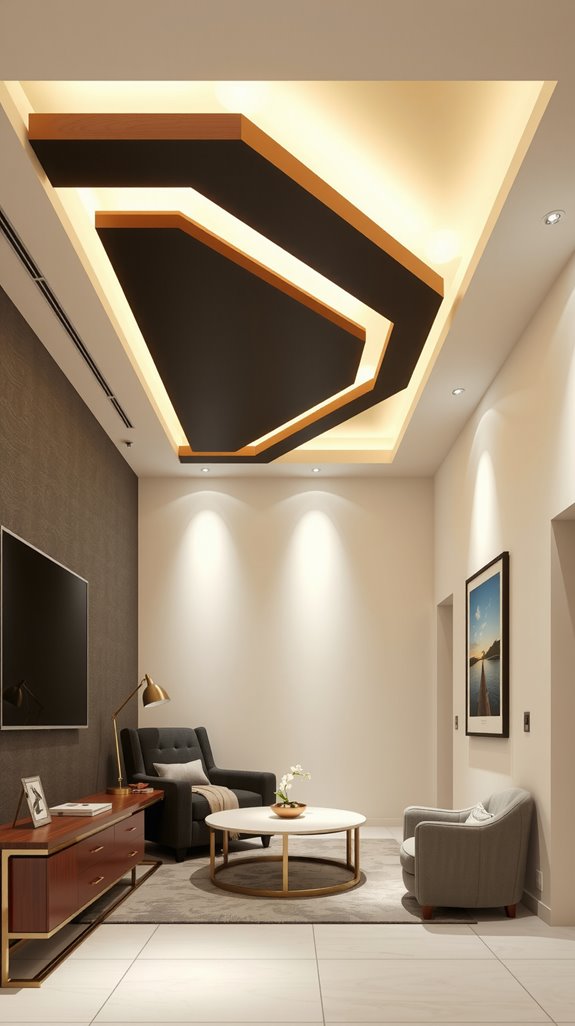
But the ceiling shape itself changes how the room feels before a single bulb turns on. A shallow tray, roughly 1 to 4 inches deep, adds perceived height without crushing an 8-foot ceiling.
Go deeper or stack multiple layers in a low room and it starts feeling like a tunnel.
In halls over 150 square feet with 9-foot ceilings, multi-step trays actually open the space up. Shape does real work here. Decorative moulding installed along the tray edges can further define each layer and give the ceiling a finished, intentional look.
Which LED Lighting Style Suits Each POP Ceiling Design?
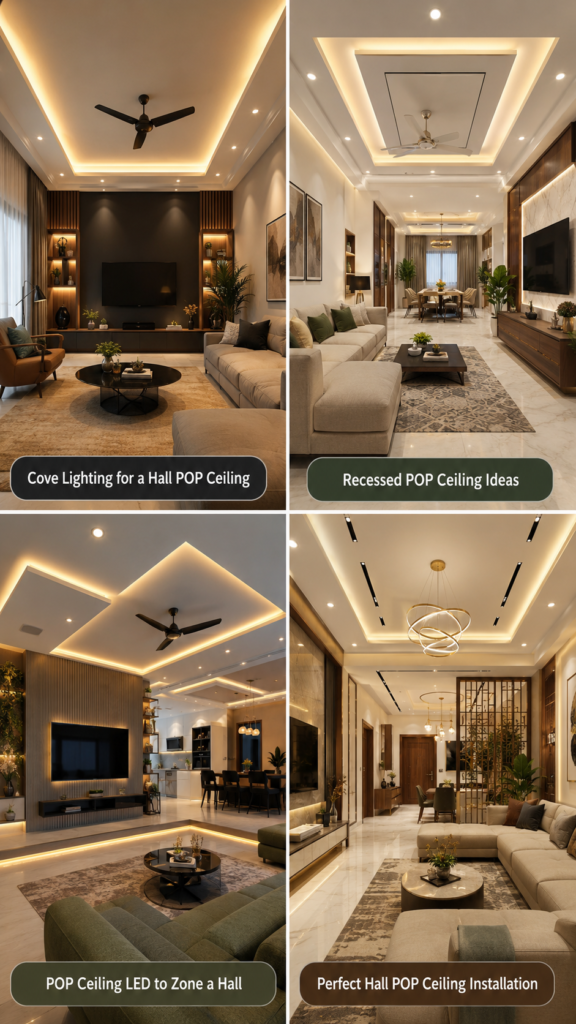
Each POP ceiling style has a different geometry, and that geometry tells you exactly which LED setup will work, and which will fight it.
Minimalist POP needs slim recessed aluminum profiles along seams, running 3000K–4000K dimmable LEDs, nothing flashier.
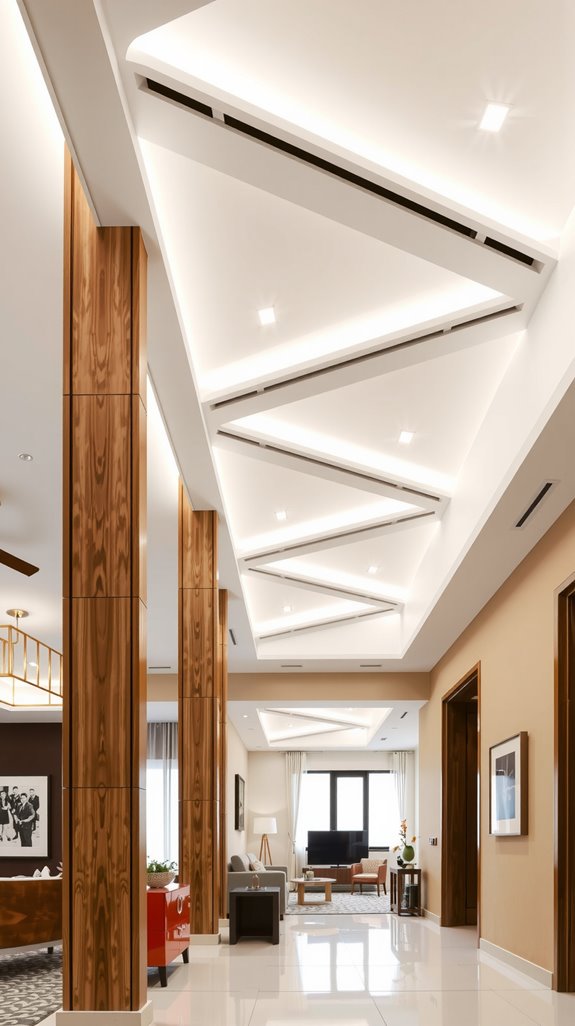
Geometric ceilings with hexagons or grids actually earn RGB strips outlining each shape.
Perimeter border designs work best with 12–15 W/m strips tucked behind the fascia, casting a halo that quietly makes tight halls feel bigger.
Central feature ceilings need a balanced combo: roughly 200–300 lumens per square meter centrally, softened by perimeter fill so nobody’s squinting at family photos. Surface LED panel lights affix directly to the ceiling and deliver uniform brightness that complements central feature designs without overwhelming the surrounding POP detail.
Cove Lighting vs. Recessed Spotlights for a Hall POP Ceiling
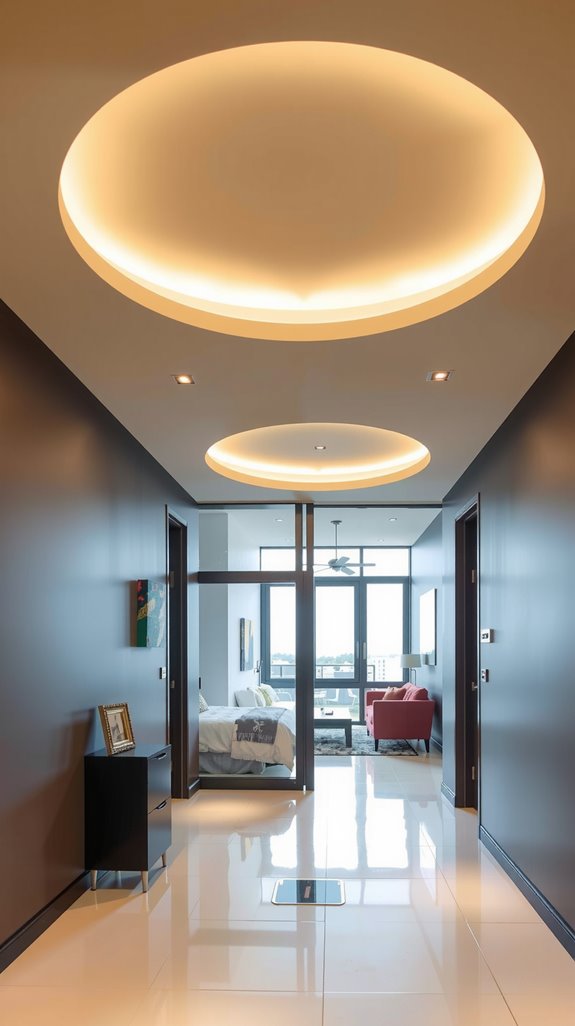
When you’re designing a hall POP ceiling for a young family, the cove versus recessed spotlight debate isn’t really a debate. You need both.
Cove lighting, which hides LED strips inside a recessed POP border, gives you soft, glare-free ambient light around 100–150 lux. That’s calming but not enough on its own.
Recessed spotlights spaced 1–1.5 meters apart push task zones past 500 lux, so you can actually see what your kid just spilled.
Layer them together: warm 2700–3000K cove light for evenings and neutral 3500–4000K spotlights for active daytime use. Unlike false ceilings, cove lighting maintains your ceiling height, keeping the room feeling open and spacious rather than boxed in.
How to Zone a Hall Using POP Ceiling and LED Placement
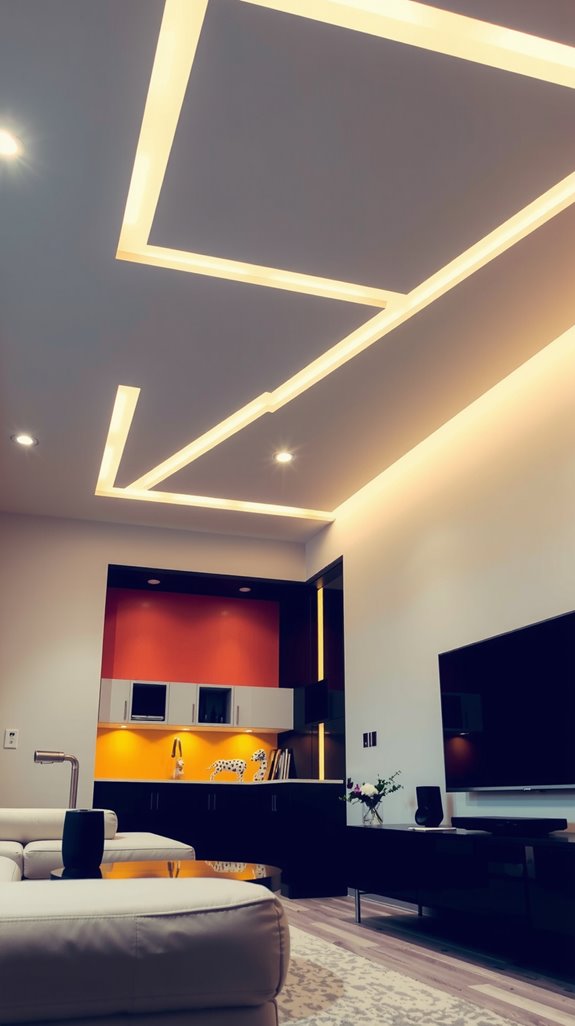
A hall without zones is just a big rectangle that confuses furniture and light equally. POP ceiling panels, those dropped or raised plaster sections, fix that fast.
A tray ceiling above your sofa cluster signals “lounge here,” while a flatter panel above a study corner says “work here.” No walls needed.
Match your LED placement to each zone, use 300–500 lux recessed lights over reading spots, drop to 50–150 lux near the TV, and go brighter above play areas.
Space recessed lights roughly half your ceiling height apart; an 8-foot ceiling means 4-foot gaps. Separate dimmers per zone handle the rest.
What a Hall POP Ceiling With LED Lights Actually Costs in 2026
Three numbers shape your hall POP ceiling budget, before you even pick a design: material rate, labor, and LED hardware.
Basic POP runs about $1.25–$1.60 per sq. ft in the USA. Designer layered ceilings with curves or coffers jump to around $1.90–$2.65 per sq. ft.
Add cove lighting channels, and you’re paying another $1.05–$1.60 per sq. ft where those coves run. Each recessed spotlight costs roughly $2.10–$3.15, just for the recess point.
Paint and primer tack on another $0.20–$0.40 per sq. ft.
A standard 144 sq. ft hall with modest LED work realistically lands between $370 and $580 once GST joins the party.
How Long Does Hall POP Ceiling Installation Take?
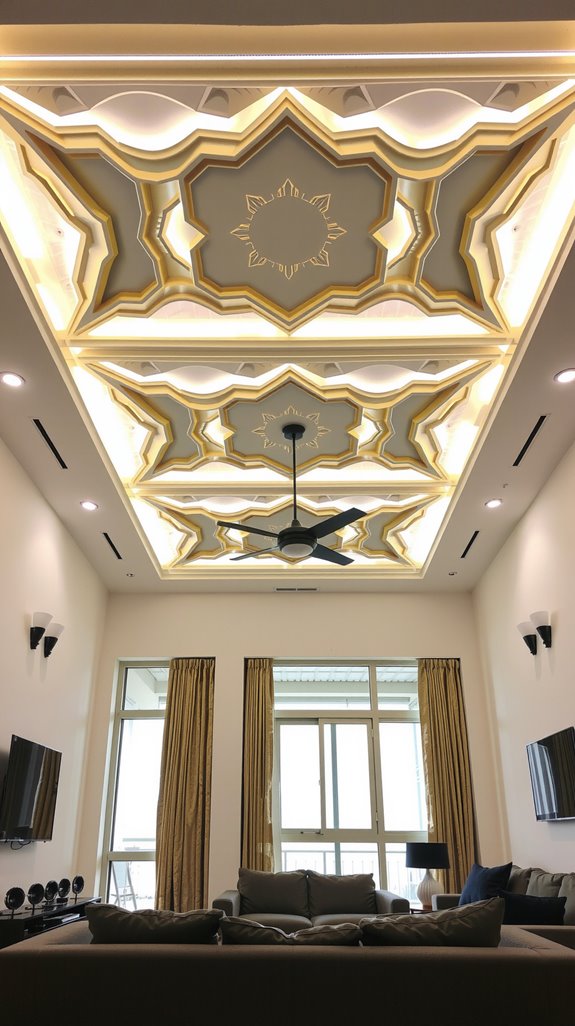
Most hall POP ceiling jobs wrap up in 2 to 5 days, and that range covers a lot of ground.
Simple framing and board work finishes in 1 to 2 days. POP shaping and detailing take longer because the paste needs drying time between coats. Humidity slows that down noticeably.
Prep work including fixture removal and surface cleaning adds half a day to a full day before anything goes up.
Custom lighting recesses or layered patterns can push the whole project past one week. A skilled crew using fast-drying materials keeps things moving closest to that lower end.
How Much Ceiling Height Do You Need for a POP Design?
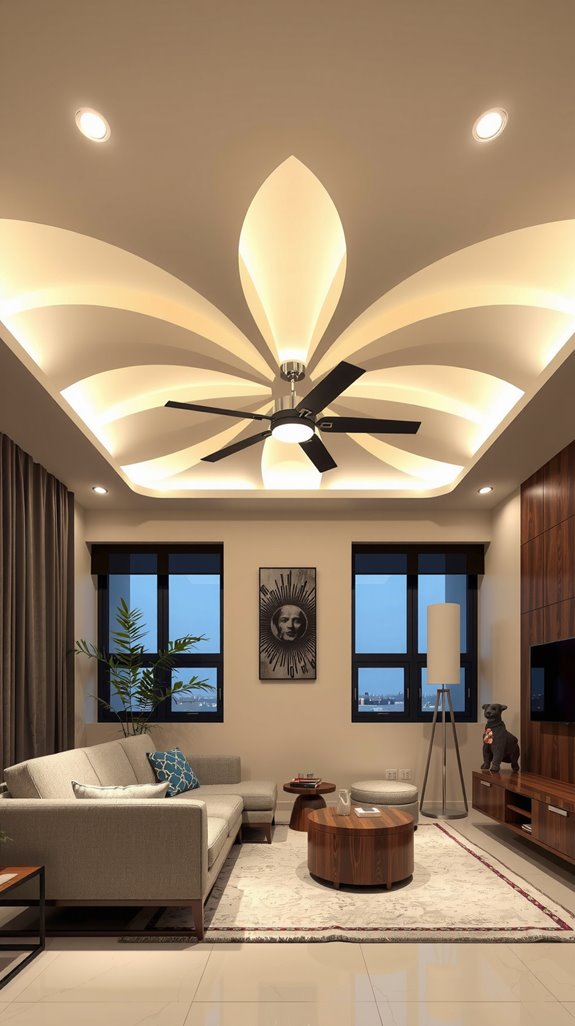
Eight feet is the bare minimum you’d want below a POP false ceiling in any livable room, but 8.5 to 9 feet is where it actually starts feeling comfortable.
A simple tray or border POP drops about 3 to 5 inches, so do the math before committing.
If your hall sits below 8.5 feet, keep the drop under 3 inches or you’ll feel like you’re living inside a shoebox.
At 9 feet or higher, you can push to a 6-inch drop for feature zones with LED coves, without sacrificing headroom.
5 POP Ceiling Mistakes That Ruin the Final Finish
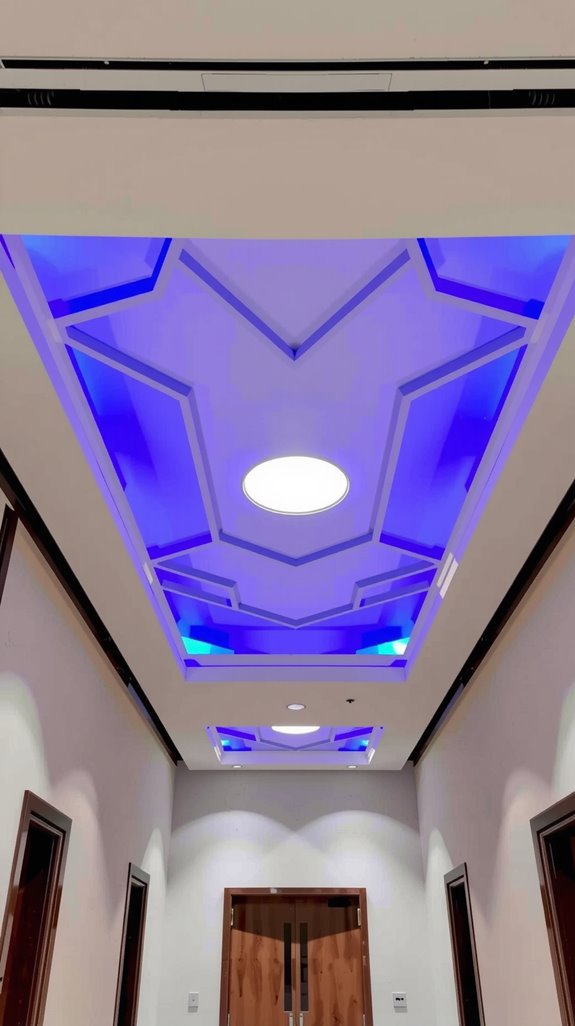
Even a well-planned POP ceiling can look amateur if the execution skips a few basics, and the worst part is most of these mistakes only show up after the painter packs up and leaves.
Contractors stretching one 25 kg POP bag into three batches weakens the mix causing powdering and flaking.
GI channels spaced beyond 2.5 feet apart cause visible sagging. Cutouts made after painting chip edges badly.
LED strips sitting too close to shallow coves create hot spots, that expose every wave.
And non-ISI POP powder looks fine for three weeks then starts looking like old chalk!
What to Ask a Contractor Before Starting POP Ceiling Work
Hiring a contractor without asking the right questions upfront is how you end up with a cracked POP ceiling, misplaced LED coves, and a phone that suddenly goes unanswered.
Ask for itemized quotes covering GI channel framing, joint compounds, LED drivers, and paint.
Request 2D drawings showing cove positions, fan cutouts, and spotlight spacing. Confirm LED specs, color temperature around 3000K, CRI above 80.
Ask about separate dimmer circuits for cove lights versus main lights. Get inspection checkpoints in writing; a good contractor welcomes these questions. A bad one gets vague.
What to Ask Before Hiring a POP Ceiling Contractor
Getting your questions ready before the first meeting matters more than most people think.
Ask for the contractor’s license number, and verify it yourself with your local building authority.
Confirm how many POP ceiling projects they finished in the last 24 months and what sizes those rooms were.
Ask who supervises daily on-site work, find out whether their crew handles electrical wiring or a subcontractor does.
Request an itemized quote covering POP materials, LED drivers, labor, and disposal.
Ask about written warranty terms for both workmanship and LED fixtures. Good contractors answer these questions without hesitation.