| What this is: A guide to building a fall room that works as a lived-in scene — not a styled object — so the space actually serves the slow, cozy evenings autumn is made for. Who it’s for: Anyone who has decorated a room for fall and still somehow never felt the urge to actually sit in it — and anyone who wants their home to feel like somewhere they genuinely want to be when the evenings get dark and cold. Why read it: Most fall decor guides tell you what to put in a room. This one tells you what the room needs to do — and the difference between those two questions is the difference between a room that looks like autumn and one that actually feels like it. |

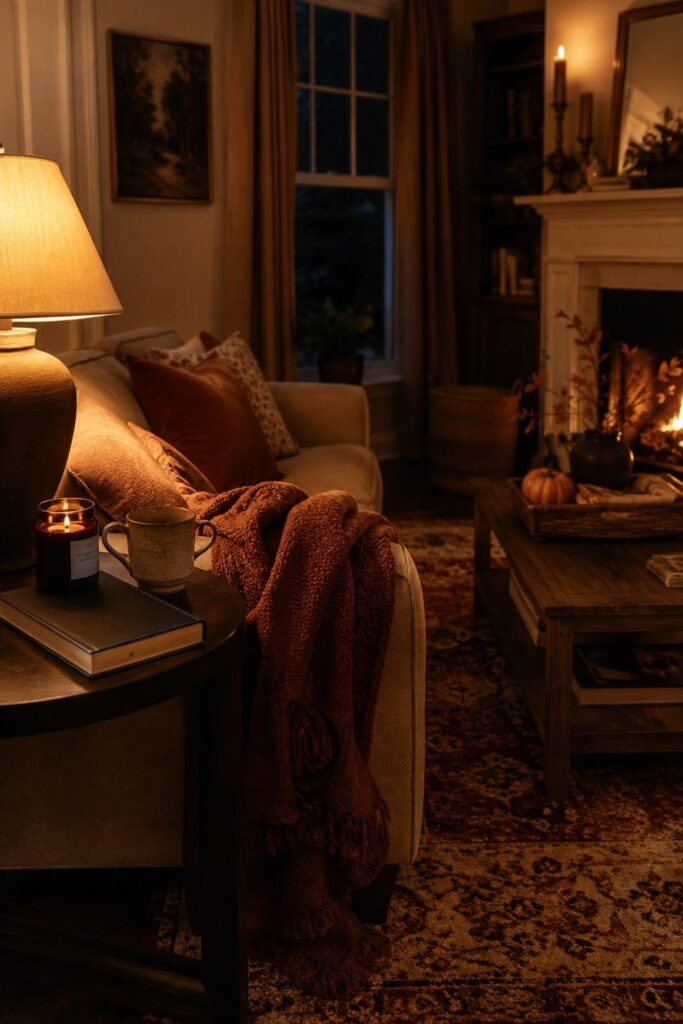
There is a particular kind of satisfaction in coming home on a dark October evening, closing the door behind you, and feeling the room receive you. The lamp is already on — you left it on a timer. The scent of something warm and spiced is in the air.
There’s a book face-down on the side table from last night, a blanket draped over the armrest exactly where you left it. You didn’t design a showroom. You built a place to live. And it just happens to be the most inviting room you’ve ever been in.
That’s what a cozy fall night in actually requires — not a specific number of pumpkins or the right throw pillow pattern, but a room that’s been set up for living, not photographing. This is the distinction the entire fall decor genre tends to miss. It’s also the reason so many beautifully decorated rooms feel oddly sterile when you’re actually in them.
Here’s how to build the other kind.
The Room Needs a Default State It Can Come Back To
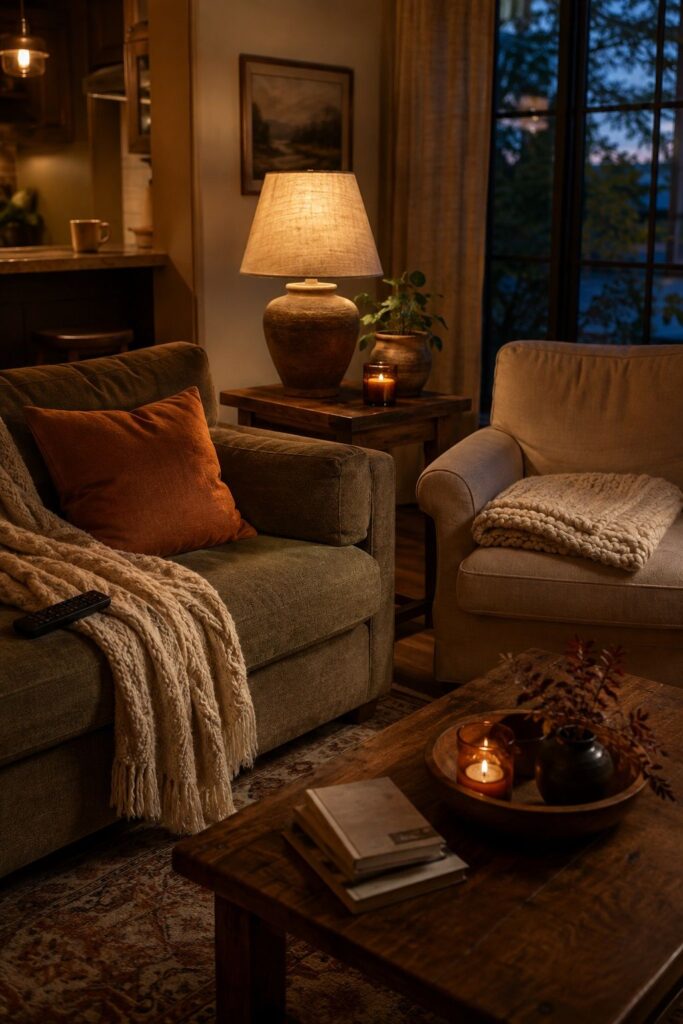
The most practically cozy thing you can do for your autumn evenings is establish what I’d call a default room state — the configuration the room is always reset to at the end of each day.
Lamp on. Blanket folded on the armchair. Book on the side table. Mug rinsed and on the counter. The room doesn’t need to be clean; it needs to be ready. Those are different things.
This matters because atmosphere is destroyed by friction.
If you have to hunt for the remote, move a pile of mail off the sofa, and dig out a blanket from a storage basket every time you want to sit down and relax, you will never fully relax — the friction of the setup keeps you in doing-mode rather than settling-mode.
But a room that’s already in its comfortable state the moment you walk in gives you permission to stop immediately.
The physical version of this is simple: designate one spot for the throw, one spot for whatever you’re currently reading, one spot for your evening drink. Keep those things there. That’s the default state. The cozy autumn vibes everyone is chasing aren’t primarily a decor outcome — they’re a friction-reduction outcome. The decor just makes it beautiful while you’re there.
Light Is the Lever That Changes Everything
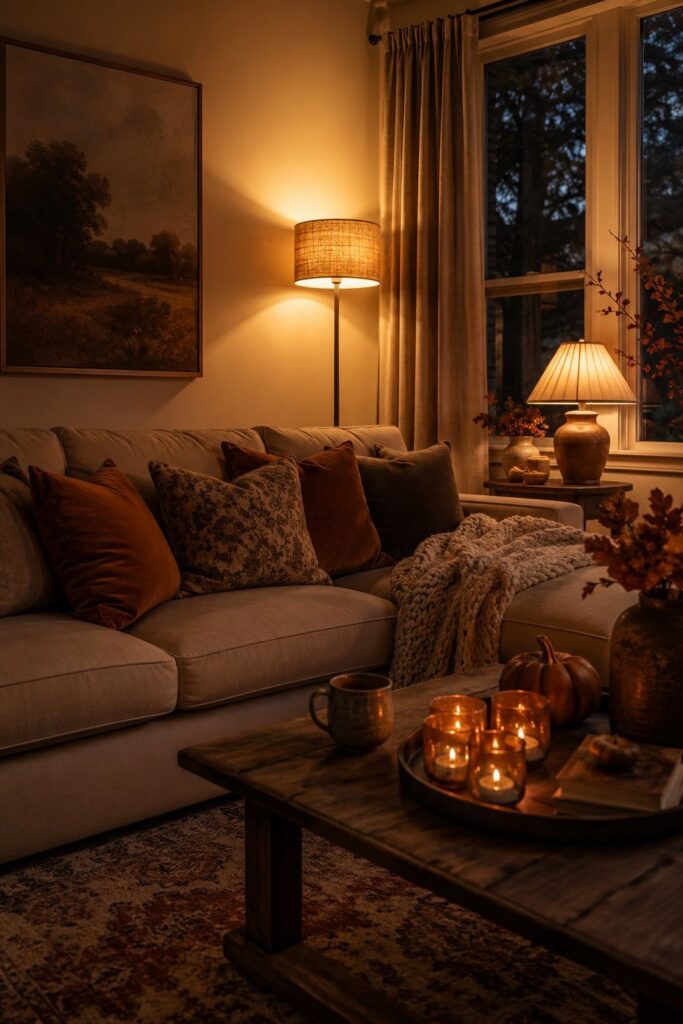
I’ve written before about how layering warm light sources at different heights transforms a room’s atmosphere, and for a fall evening specifically, this is not optional — it’s the whole mechanism.
Overhead lighting at full brightness is actively working against you. It signals “daytime operations.” It washes out every warm, textural thing you’ve built into the room. And it keeps your nervous system in alert mode when you’re trying to let it settle.
The evening switch is simple: overhead lights off, lamps on. A floor lamp in the corner, a table lamp by the sofa, a cluster of amber glass votives on the coffee table — these give you layered light at multiple heights that reads to your brain as shelter rather than exposure.
And the science supports what the atmosphere suggests: the Sleep Foundation notes that warm, low light in the evening supports natural melatonin production and helps the body transition toward rest. Your cozy fall room isn’t just *feeling* more relaxing — it’s physiologically helping you wind down.
Use 2700K warm white bulbs in every lamp. The color temperature difference between warm white and cool white is the difference between a lit fireplace and a fluorescent tube, and it costs nothing to change.
Put your main lamps on a smart plug or a simple timer so the room is already warm and lit when you come home. Walking into a lit room that smells like autumn is a qualitatively different experience from walking into a dark one and switching things on one by one.
Build the Room Around an Activity, Not an Aesthetic
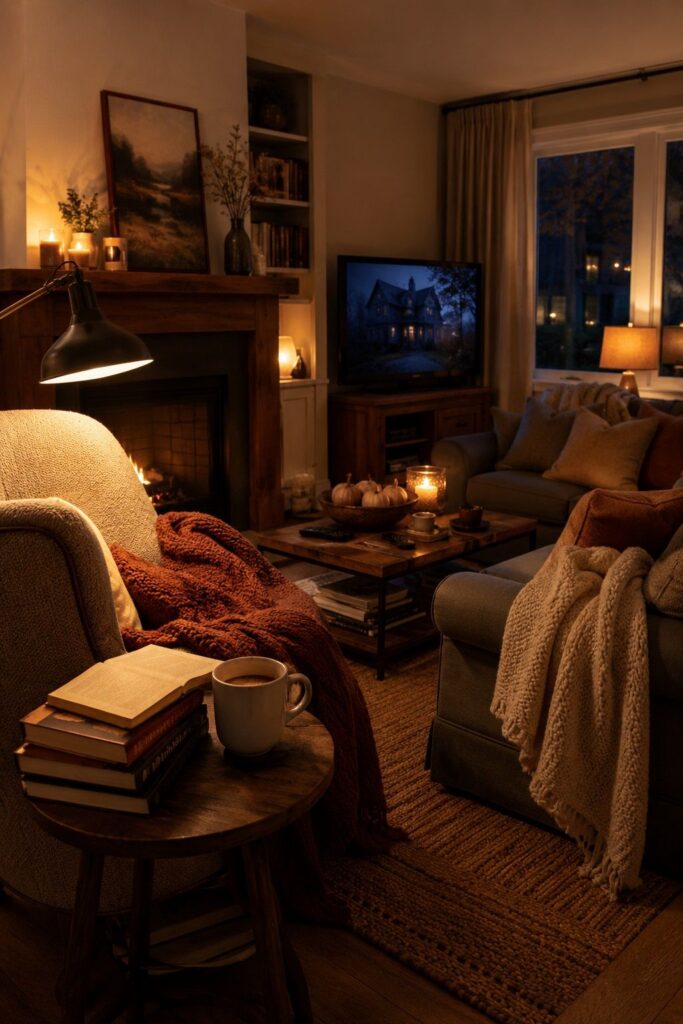
This is the structural shift that separates cozy fall rooms that work from ones that just look good in photos. Every room that genuinely feels lived-in is organized around what people actually *do* there.
The question to ask isn’t “what does this room need to look like?” but “what is the best possible version of a Tuesday evening in October in this room — and what does the space need to support that?”
For most people, the honest answer involves some combination of: reading, watching something, talking with someone, having a warm drink, and eventually feeling sleepy enough to go to bed. Design the room for those activities specifically.
For reading: a good lamp positioned over the shoulder — not in front of you, not behind you, over the shoulder — makes the difference between a comfortable reading session and one that ends in a headache.
A cozy fall books reading list on the side table and a blanket within arm’s reach means the setup takes three seconds. That three-second setup is the thing standing between you and actually reading on a weeknight.
For watching: the screen should be the brightest thing in the room or close to it, which means the ambient lighting needs to come down around it. The room works best for evening viewing when the lamps are at eye level or below and there’s nothing bright directly behind or beside the screen competing for your attention.
For talking: the seating needs to be genuinely comfortable and facing each other, not all angled at the TV. A room that can host both a conversation and a solo evening is a room that works for all of autumn, not just Netflix nights.
The Textile Layer Is Load-Bearing
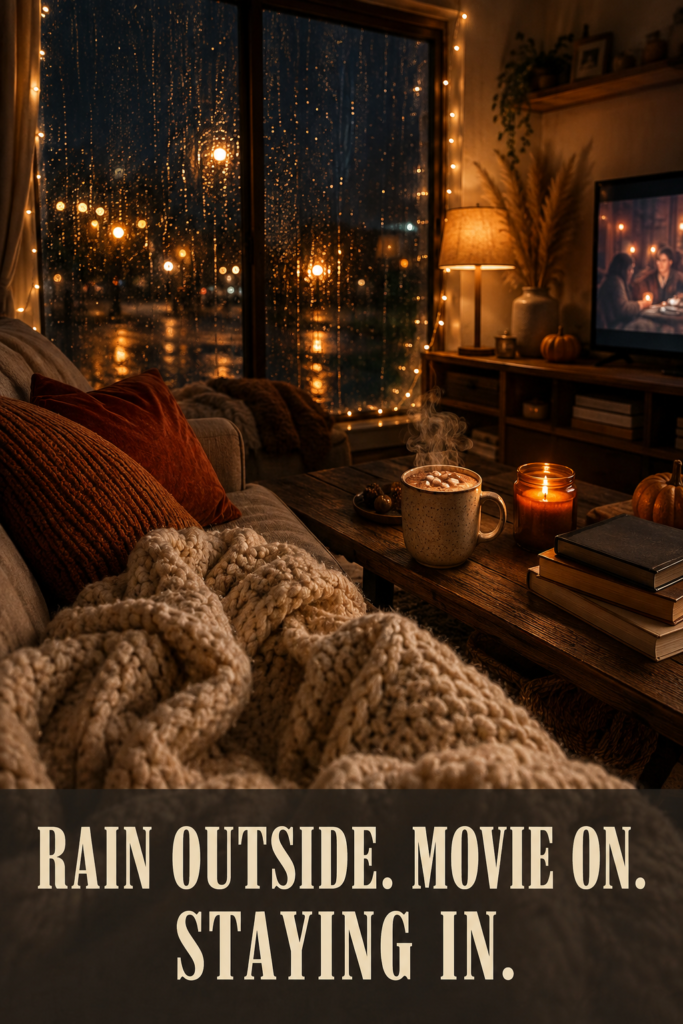
Most people think of throws and cushions as decorative. In a cozy autumn room, they’re structural — they’re the thing you actually interact with all evening. The difference between a sofa that’s comfortable for twenty minutes and one you’ll sink into for three hours is almost entirely textile depth.
The formula is three layers at minimum: a base cushion (whatever came with the sofa), a throw or blanket in a warm tone — layered textures like chunky knit and smooth linen together read as warmth and make the seating feel considered rather than default — and a proper scatter cushion you can tuck behind your lower back when you’re reading.
That third layer, the lumbar support cushion, is the one most people skip, and it’s the one that determines whether you last an hour or three.
For the bed, which is where a genuinely cozy fall night in eventually ends, the same principle applies in a heavier register. Flannel or jersey sheets, a substantial duvet or weighted blanket, and a chunky knit throw folded at the foot for the moment in the middle of the night when the temperature drops.
The National Sleep Foundation recommends keeping the bedroom dark and cool for optimal sleep — a well-layered bed means you can keep the room on the cooler side and add warmth through blankets rather than heating, which is both more comfortable and more energy-efficient.
Scent Is the Fastest Route to the Feeling
If you want one single lever that changes a room’s atmosphere faster than anything else you could do, it’s scent. Before the eye has processed the lighting, before the body has registered the textile comfort, the nose has already filed a report — and that report is either “this is somewhere I want to be” or it isn’t.
For a cozy fall evening, the scents that work are the ones that signal warmth, harvest, and shelter: cinnamon, clove, cedar, amber, apple, vanilla.
A candle clustered with amber glass pieces does double duty — it adds to the light layering and fills the room with scent simultaneously. If you prefer flameless options, a quality wax warmer with a fall melt achieves the same effect without the fire safety consideration.
One practical note worth making: a single large candle will scent a room more effectively than three small ones scattered around it. Scent needs mass to fill a space, and dispersed small sources tend to neutralize each other rather than compound.
The Room Should Know What Season It Is
There’s a version of fall decorating that’s entirely surface-level — a few seasonal accents dropped into a room that otherwise operates the same way all year.
And then there’s a room that has genuinely been reconfigured for the season: the lighting is warmer, the textiles are heavier, the seating is deeper, the scent is different, the default activities have shifted from summer’s outward energy toward autumn’s inward one.
The latter is the room people mean when they say they want a cozy autumn aesthetic. It’s not a visual category — it’s a behavioral one. The season you’re building for is defined by how people move through it: slower, warmer, more interior, more deliberate.
A room built for that movement will feel cozy almost regardless of what’s on the walls. A room that just has orange accents and a pumpkin won’t, even if every styling decision is technically correct.
The Evening You’re Building Toward
There’s a specific evening this room is being built for.
You already know what it looks like: dark outside by six, rain or wind making the window worth looking at, something warm in your hands, the lamp doing all the work, the book you’ve been meaning to get back to finally within reach.
The room is exactly right — not because it’s decorated, but because it was designed to hold that particular kind of evening.
That evening is not complicated to build toward. It just requires asking a different question than most fall decor guides ask. Not “what should I put in this room?” but “what should this room be for?” Answer that question first. Everything else follows.