What this is: A complete guide to building a Japanese minimalist bedroom — covering platform beds, warm wood tones, hidden storage, tatami adjacent flooring, shoji style dividers, and why this aesthetic is genuinely harder to maintain than it looks.
Who benefits most: Men who are attracted to the discipline and calm of Japanese interior design but aren’t sure how to execute it in a Western apartment without it looking sparse or unfinished.
Why it’s worth reading: The room ideas for men minimalist conversation online often stops at “own less stuff.” This guide goes further — it explains the specific design decisions that make a minimal room feel considered rather than empty.
Of all the men’s bedroom aesthetics floating around right now, the Japanese minimalist room is the one that sounds easy and proves hardest.
The concept sounds simple enough: low bed, warm wood, clean surfaces, hidden storage. But execution? That’s a completely different story.
Most men who attempt this aesthetic end up with a room that reads as unfinished rather than intentional. Surfaces that feel bare instead of purposeful, storage that bulges visually because it hasn’t been properly concealed!
And, a color palette so neutral it flatlines rather than calms. Getting this right is genuinely a discipline. And that’s exactly why it appeals to men who are serious about self improvement. Let’s break it down!
Why This Aesthetic Works for the Self Improvement Minded Man
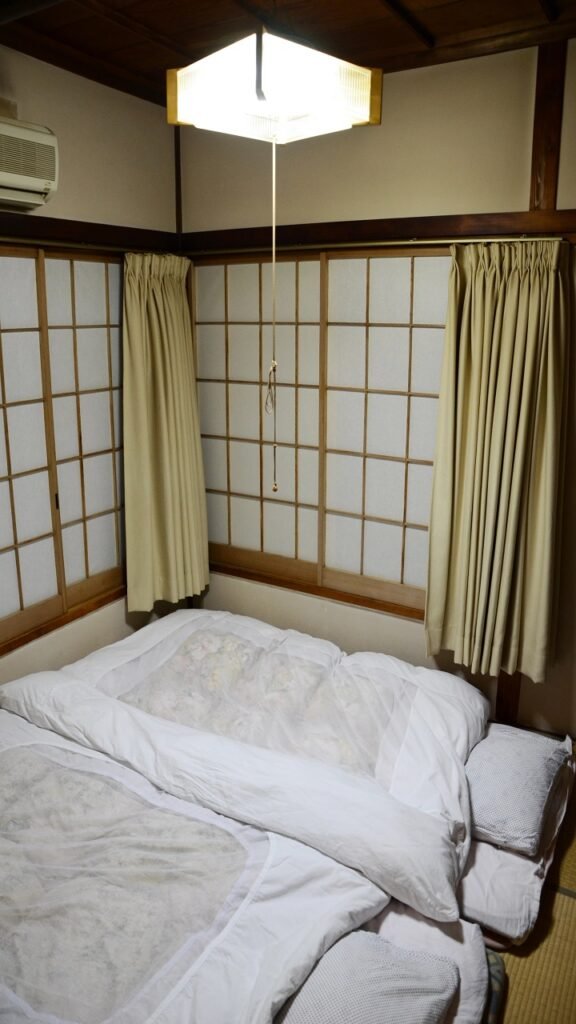
The Japanese philosophy of ma. The idea that empty space is not absence but presence, sits at the heart of zen room ideas men seek without always being able to name.
Design experts who study zen style interiors describe the core principle as a process of subtraction. Carefully selecting only what is truly necessary and avoiding waste. That sentence describes a discipline, not just a style.
Men who train hard, track their habits, and cut out distractions from their routines are already operating on this principle.
RELATED: The #1 Men’s Bedroom Aesthetic on Pinterest (and How to Do It Right)!
Applying it to the room is a natural extension of the same mindset.
A minimal room maintained correctly requires daily intention. Things returned to their designated places, surfaces cleared before sleep, nothing accumulated without purpose.
The room reflects the discipline and reinforces it at the same time.
Research on environment and stress consistently shows that visual clutter elevates cognitive load and cortisol levels.
A room with nothing unnecessary in it runs quiet in the background, no unresolved objects registering as tasks, no surfaces demanding attention. That quiet is not emptiness. It is the sound of a room doing its job.
The Platform Bed: The Foundation of the Japanese Room
The japanese men room ideas conversation almost always begins with the bed, and for good reason. The bed position relative to the floor defines the room’s entire visual language.
A low platform bed drops the room’s centre of gravity, makes the ceiling feel higher, and creates that grounded, close to the earth quality that defines the Japanese interior tradition.
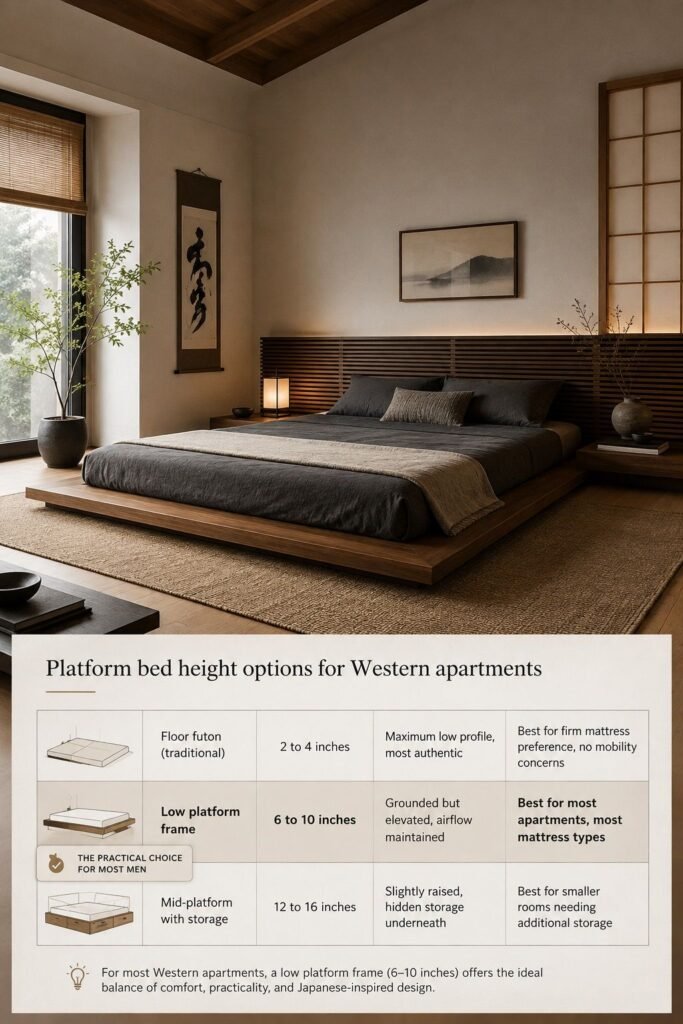
Platform bed height options for Western apartments:
| Bed type | Height from floor | Visual effect | Best for |
| Floor futon (traditional) | 2 to 4 inches | Maximum low profile, most authentic | Firm mattress preference, no mobility concerns |
| Low platform frame | 6 to 10 inches | Grounded but elevated, airflow maintained | Most apartments, most mattress types |
| Mid-platform with storage | 12 to 16 inches | Slightly raised, hidden storage underneath | Smaller rooms needing additional storage |
Research from zen interior design studies confirms that floor-level sleeping positions reduce perceived stress and align the body closer to the natural grounding the aesthetic is built around.
The low platform frame is the practical choice for most men.
A genuine floor futon looks extraordinary but creates airflow problems for foam mattresses and can aggravate back issues over time.
A six to ten inch platform preserves the low aesthetic while keeping the mattress in a healthy environment and providing clearance for under bed storage.
Timber finishes that work: natural oak, light ash, pale walnut. Dark wood clashes with the warm neutral palette of this aesthetic.
The bed frame material creates the same warm-wood-on-neutral-wall contrast that makes Japandi and Japanese-influenced interiors feel settled rather than stark.
Warm Wood and the Colour Palette
The room ideas for men bedroom japanese colour story runs on restraint. White or warm cream walls. Light natural wood.
Stone grey or warm linen in textiles. No bold accent colours, no dark walls, and absolutely no sharp contrasts between furniture finishes.
The palette works in three layers:
- Warm neutrals for walls and ceilings: off white, warm grey, or natural linen tones. Not brilliant white, it reads as clinical. Not beige — it reads as dated. Warm white or cream with yellow undertones.
- Natural wood for furniture and flooring: the warmer the tone the better. Light oak, pale ash, or blonde timber. The wood provides the colour variation in the room, so keeping all wood finishes consistent within two to three tones of each other is critical.
- Texture for bedding and soft furnishings: linen, cotton, and wool in warm cream, stone, or warm grey. No patterned textiles on the bed. No throw pillows competing for visual attention.
One plant in a simple ceramic or concrete pot earns its place here. The biophilic element, a single snake plant, a small olive tree, or a peace lily. Adds the only green note in the room without introducing pattern or complexity.
RELATED: Adding a Gym Corner to Any Bedroom (Even a Tiny One)!
Hidden Storage: The Hardest Part to Get Right
This is where most zen room ideas men attempt to build fall apart. Minimalism does not mean owning nothing. It means owning everything without showing it.
Hidden storage that genuinely conceals its contents is what separates a properly executed Japanese minimalist room from a room that looks like its occupant simply hasn’t unpacked yet.
The hidden storage hierarchy for a Japanese bedroom:
- Under bed drawers built into the platform frame. The best space to store seasonal clothing, gym gear, and anything used less than weekly
- Wardrobe with flush doors that run floor to ceiling, with handles recessed or absent. The wardrobe should read as a wall panel, not a furniture piece
- A single floating shelf above the desk or along one wall, holding only objects used daily and displayed intentionally: one plant, three books maximum, one object with personal meaning
- Bedside tables with a drawer — one drawer, one surface, lamp and one object. Nothing else.
Every surface that is visible is an editorial decision. Keep only what is used, and keep it in the same spot every day. The moment objects start accumulating on surfaces, the room stops reading as minimal and starts reading as unmanaged.
RELATED: Sneaker Displays, Brand Art, and Hypebeast Bedroom Design!
Tatami Adjacent Flooring for Western Apartments
Traditional tatami mats. Woven rush grass in modular sections are the flooring of the authentic Japanese bedroom, and they are rarely practical in Western apartments for reasons of installation, maintenance, and floor heating systems beneath them.
What works instead is a deliberately chosen tatami adjacent alternative.
Practical tatami adjacent flooring options:
- Natural jute or sisal area rug in a warm neutral tone, covering the central floor area with hardwood or laminate visible at the edges. The closest affordable equivalent to tatami’s natural texture
- Bamboo flooring if the apartment allows renovation. Warm, sustainable, and visually aligned with the Japanese interior tradition
- Cork floor tiles in natural tones. Warm underfoot, sound absorbing, and available in a surface texture that reads as organic rather than manufactured
- Pale oak laminate as the full floor surface, with a natural woven rug defining the sleep zone. The simplest option that still achieves the warm wood aesthetic
The rug should be large enough to extend past the platform bed on both sides. The same sizing principle as every other bedroom aesthetic in this guide, but applied here to define the sleeping zone clearly within the open floor plan.
Shoji Screens as Room Dividers
For men living in studio apartments or open plan spaces. The shoji screen approach is one of the most underused solutions in Western interior design.
Traditional Japanese shoji screens — lightweight timber frames with translucent paper panels. Divide a space without blocking light, creating the sense of separate zones within a single room.
Modern shoji-adjacent room dividers in Western contexts are typically rattan and paper panel folding screens. These are available from most furniture retailers, that achieve a similar light-filtering effect at under a 100$.
Positioned between a sleeping area and a desk or living area. They create the psychological separation between work and rest modes that the zone design principle in this content series describes.
And do not require walls that can never be built in a rental.
The screen should be lightweight enough to move and translucent enough to not darken the sleeping zone. Dark or opaque dividers close the space down and defeat the purpose.
Natural timber with a white or cream panel is the combination that works.
Maintaining the Minimal Room: The Discipline Nobody Talks About
Building a Japanese minimalist bedroom is the easy part. Maintaining it is where the aesthetic either survives or collapses.
A minimal room requires a daily reset — surfaces cleared, objects returned to their places, nothing left to accumulate overnight.
The evening reset takes three to four minutes.
Clothes that came off go on a hook or into the wardrobe.
Objects that came out go back to their designated spots. The floor is clear before sleep.
The next morning, the room communicates calm rather than chaos, and that communication starts the day on a completely different register than a room full of overnight accumulation.
This is why the Japanese minimalist aesthetic genuinely rewards the men who are already running disciplined routines in other areas of their lives. The room does not maintain itself. Neither does a training programme, a diet, or a reading habit.
The maintenance is not a burden — it is the practice.
And like every other discipline, the room that results from it pays back more than the effort it takes.