What this is: Twelve genuinely achievable DIY fall porch decor projects — the kind that take an afternoon, not a workshop, and cost less than a grocery run.
Who it’s for: Anyone who wants a styled autumn entrance without boutique prices or a table saw.
Why read it: Every project here was chosen because the payoff is disproportionate to the effort — two hours of work, results that look like two hundred dollars.
Most people assume the polished fall porches they save online came from a store.
Some did. But a surprising number — the leaners, the painted-pumpkin clusters, the layered mats — are the work of someone with a can of spray paint, an afternoon, and the good sense to stop before it got complicated.
The real secret of easy DIY fall front porch decor is that the best projects aren’t the fussiest. They’re the ones that know when they’re done.
No power tools. No advanced craft skills. Most of these need nothing more than what’s already in your garage or a single trip to the craft store.
A Painted Pumpkin Cluster Has the Highest Return of Any Project Here

Grab three faux pumpkins in graduated sizes and spray them in a single coordinated palette — flat cream, warm sage, or muted terracotta all outperform standard orange and work with nearly any door color.
Rust-Oleum Chalked spray paint, held ten to twelve inches from the surface in light overlapping passes, covers a pumpkin in about ten minutes and dries to a matte, weather-resistant finish boutique stores charge a lot for.
Group the three pumpkins together at the door — largest at back, medium in the middle, smallest tipped slightly forward — rather than lining them along the steps.
Add a couple of real gourds from the grocery store and the whole thing looks like a styled shoot. Total cost: under fifteen dollars if you already own the faux pumpkins.
The Layered Doormat Takes Twenty Minutes and Carries the Whole Entry
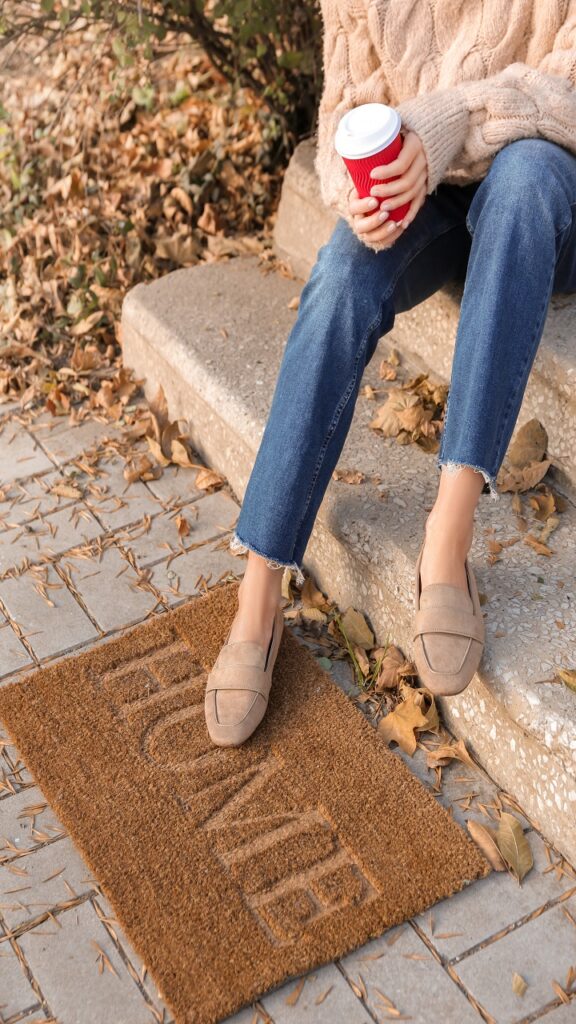
A large coir base mat with a smaller seasonal mat layered on top — about half the size, showing three to four inches of border all around — reads as designed rather than accidental.
The same layering principle that warms up a living room works even harder at the threshold because it’s the first thing every visitor looks down at. A couple of pieces of rug tape on the underside keeps the smaller mat from shifting.
This is the highest-impact, lowest-effort upgrade on the entire list. Twenty minutes, twenty dollars, the most-looked-at spot on the porch.
A Foraged Garland Brings Texture Money Can’t Replicate
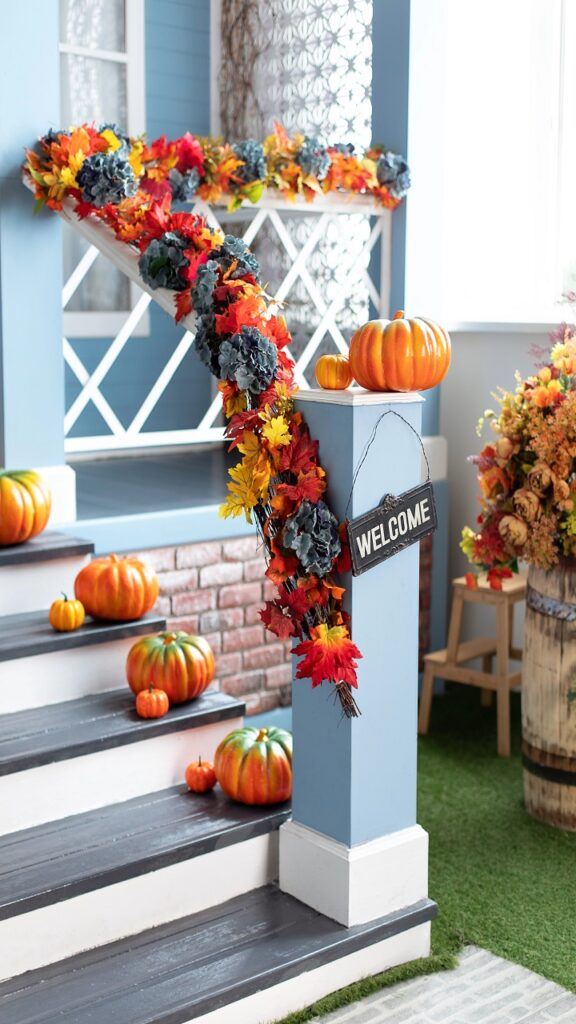
Walk your neighborhood in early September and you’ll find most of what you need: dried seed heads, turning oak branches, dried grasses, pinecones, and if you’re lucky, bittersweet sprigs with clusters of orange and red.
Bundle them loosely with twine, drape across a railing or door arch, and the result has a weight and irregularity no craft-store bundle can fake.
Foraged material smells like the season. Dried grasses, pinecones, and acorn caps are universally safe for this use — keep unknown berries to decorative use only and away from pets and children.
Pair the garland with dried citrus garlands for a porch that smells as good as it looks.
A Hand-Painted Sign Is Easier Than You Think
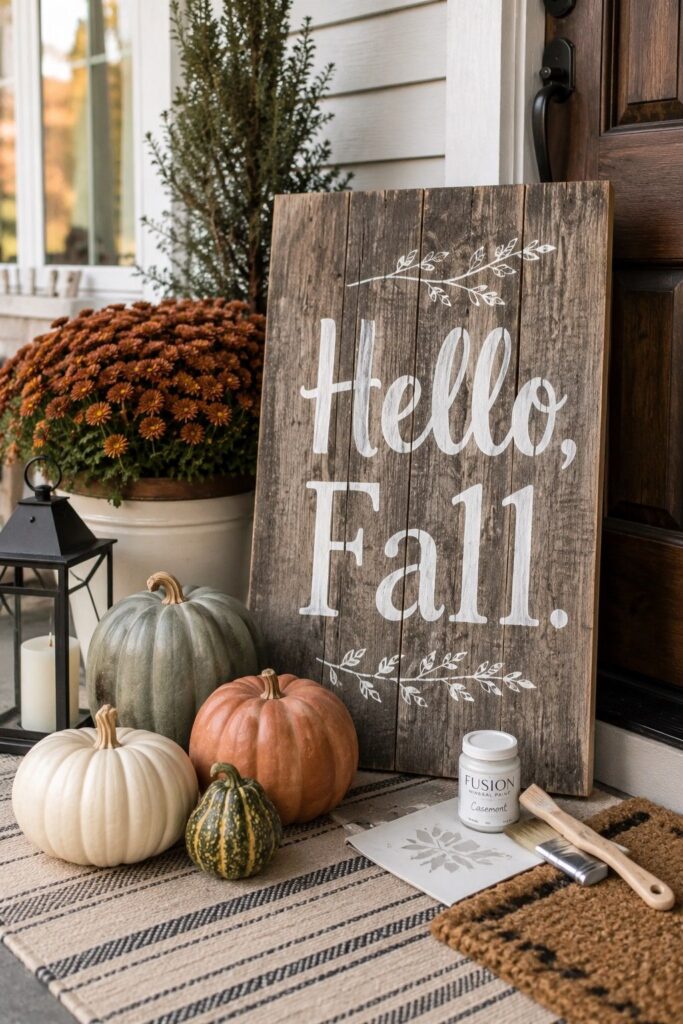
Farmhouse and rustic lettering doesn’t require perfect penmanship — it requires consistency and confidence, which are both learnable in twenty minutes of practice on scrap paper.
Sketch your words lightly in pencil on a piece of reclaimed wood or a craft board, paint over with chalk paint or acrylic, seal with two coats of matte exterior sealer, and it will survive the season outdoors.
Keep it to five words or fewer — “Hello, Fall.” reads from the street. “Welcome to our Autumn Wonderland” does not.
If lettering genuinely intimidates you, a vinyl stencil from a craft store delivers the same result in half the time.
Hay Bales Are a Platform, Not a Prop
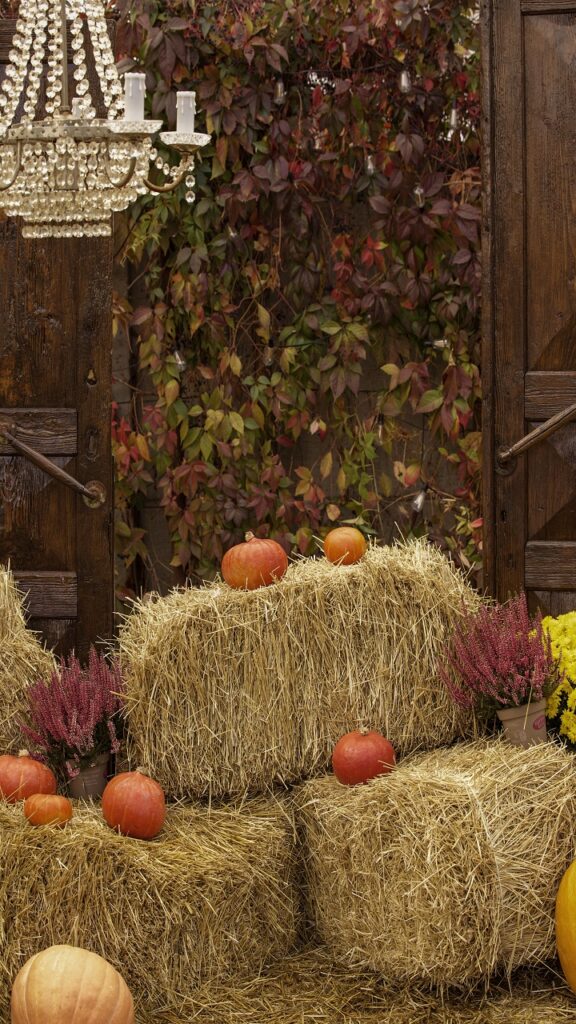
A single hay bale from a farm supply store — about eight to twelve dollars — is the most versatile thing on this list. It functions as a riser, a seat, a display platform, and a seasonal accent all at once.
The trick is to dress it: a small pumpkin grouping on top, a leaner behind it, a mum at the base. Now it’s a vignette, not a leftover from a county fair.
When the season ends, it composts into the garden as mulch — nothing to store, nothing to throw away. Works just as well on a tight stoop when paired with small-space fall decor ideas.
A DIY Porch Leaner Is One Plank and an Hour
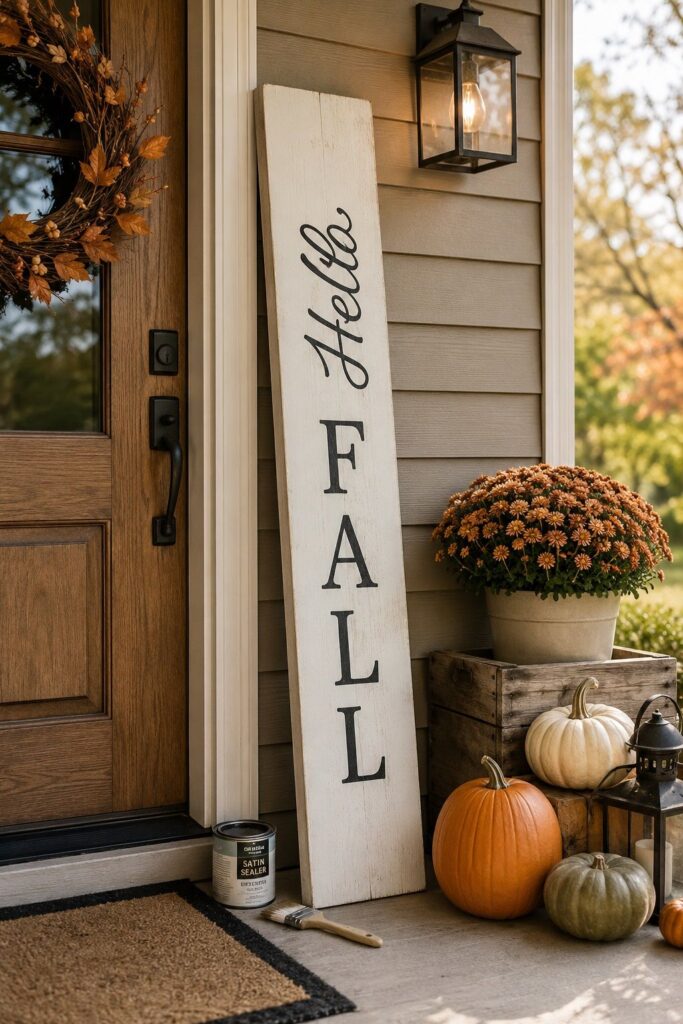
A single six-foot fence board from the hardware store, lightly sanded, painted with an exterior base coat, and lettered on top is a leaner that costs about six dollars in materials and looks like one that costs sixty.
The fence-board leaner is also the project that pays dividends across seasons: paint the base neutral, and it carries fall lettering, a Thanksgiving sentiment, and a Christmas design with nothing more than a fresh top coat between them.
A reversible leaner — fall on one side, Christmas on the other — is the smartest single thing you can build for your porch, and it’s what makes the fall-to-winter transition a twenty-minute swap rather than a full redecorating session.
A Twine-Wrapped Lantern Upgrade Costs Almost Nothing
Take any plain glass lantern — a dollar-store one is ideal — wrap the base in overlapping rows of jute twine secured with hot glue, tuck a sprig of dried eucalyptus into the wrap, and add a flameless pillar candle inside.
Total time: fifteen minutes. The amber glow of a lantern on a fall evening is the single warmest signal a porch can send after dark, and two mismatched lanterns unified by the same twine treatment read as a matched set.
Battery-operated flameless candles are the right call outdoors — safer around dry leaves and hay, and they can run on a timer so the porch glows every evening without any effort from you.
A DIY Wreath From Grocery Store Materials Costs Under Ten Dollars
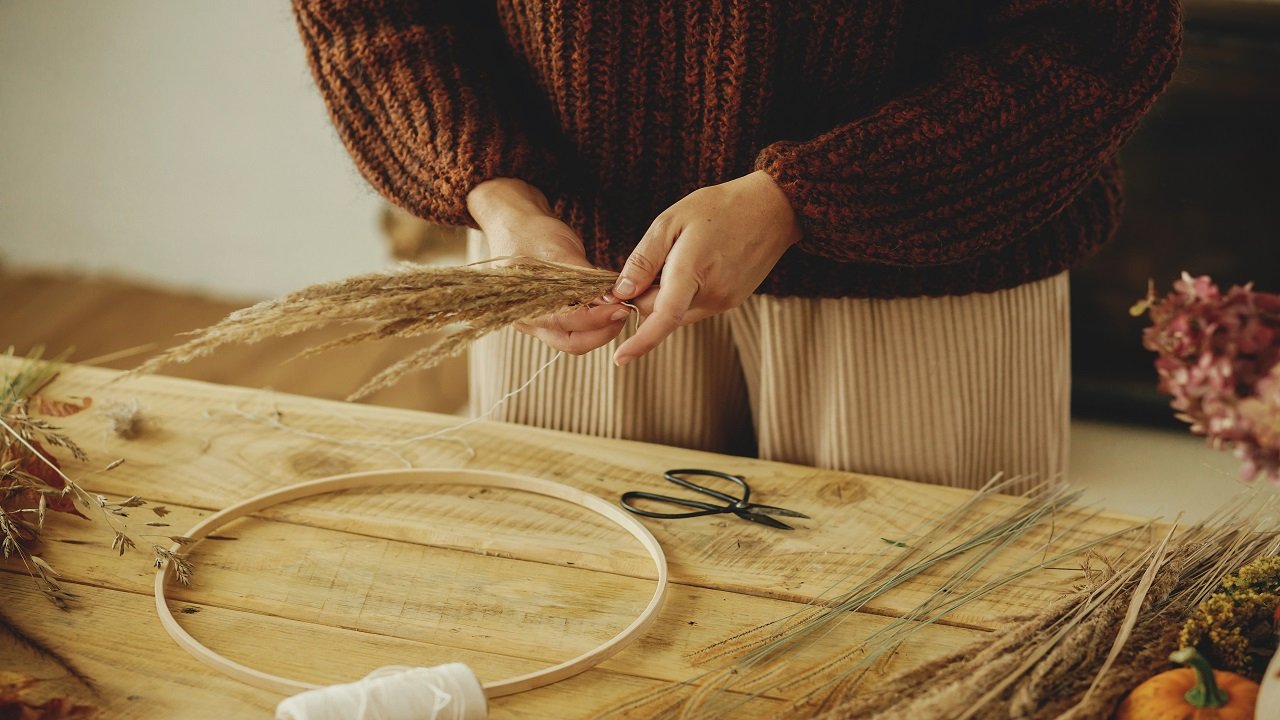
A plain grapevine base from a craft store, a bundle of dried wheat or pampas grass from the floral section, and a few sprigs from the grocery store’s fall bouquet selection — wired together and tied with ribbon — makes a wreath that reads as forty dollars.
The key is a two-color palette: cream and rust, or sage and burnt orange. Every element in the same two tones and the wreath looks curated; every fall color at once and it looks like a craft fair.
Size matters too — aim for eighteen to twenty-four inches in diameter so the wreath actually fills the door width rather than looking lost on it.
Painted Cornstalks Give Height for a Few Dollars
Three or four dried cornstalks from a garden center, lashed with twine and flanked symmetrically at the door frame, change the vertical scale of a porch in about ten minutes.
The placement is everything — one bundle on each side, tied to the porch column or leaned behind a planter, and the porch immediately reads as “someone composed this.” A light mist of flat black or deep green spray paint modernizes the yellow of dried corn for porches with a more contemporary palette.
A Porch Terrarium Holds Fall Better Than a Scatter of Props
A large glass apothecary jar or lantern filled with acorns, small gourds, dried moss, and faux-berry stems reads as intentional in a way that a scatter of individual items doesn’t.
Anything arranged inside a vessel reads as curated rather than random — that’s the whole design principle in one jar. Fill it loosely so the materials show rather than pack it tight.
The fall terrarium concept scales from a small mason jar on a side table to a full floor lantern with pillar candles and moss — and on a renter-friendly porch where you can’t stake or hang much, a terrarium is the easiest way to make one spot look completely finished.
A Crate Vignette Edits Rather Than Expires
A wooden crate — eight to twelve dollars at most craft stores — topped with a leaner, two pumpkins, and a lantern is a display you edit as the season moves rather than replace.
Swap the leaner from a fall sentiment to a Halloween motif in October, pull the fading mum and replace it with dried grasses for Thanksgiving, and the crate and lantern carry through unchanged into cozy Thanksgiving decorations territory without a full teardown. Build a base; swap the seasonal layer. That’s the only approach worth building for a porch.
The No-Tools Hanging Basket Is the Easiest Win on This List
A wire hanging basket lined with coco liner, planted with a small mum, a trailing ornamental sweet potato vine, and two mini gourds tucked into the sides, hangs from any existing hook or shepherd’s crook.
Assembly: fifteen minutes. It adds height and greenery at the door without taking up floor space, making it exactly right for a narrow or small porch where the ground is already spoken for.
The sweet potato vine trails and improves as the season progresses — unlike a potted mum that peaks and then browns out. Water daily in the first week, every other day after that, and it carries comfortably into Halloween.
Pick One. Finish It. Put It on the Porch.
The reason most DIY fall porch projects don’t happen isn’t money or skill — it’s the paralysis of wanting to start everything and beginning nothing.
Pick whichever project on this list matches what you already have on hand, finish it this weekend, and get it outside before you decide what comes next.
One cozy fall element done well sends the same message as ten mediocre ones: that the season turned and someone here noticed. Start with one. The porch will tell you what it needs after that.