What this is: Ten specific ideas for dressing a small front porch, stoop, balcony, or narrow landing for fall — with no pretending you have a wraparound Victorian.
Who it’s for: Apartment dwellers, renters, townhouse owners, and anyone whose outdoor space measures in feet rather than acres.
Why read it: You’ll learn the one principle that separates a small porch that looks curated from one that looks crowded — and the exact moves that make a few square feet punch well above their weight.
The Internet’s favorite fall porches are a lie you didn’t agree to — sprawling affairs with enough room to park a hay wagon, wide steps flanked by matching urns, rocking chairs with coordinated throws on each side.
Beautiful, sure. Useful, not at all, when your entire outdoor space is a concrete rectangle the size of a dining table.
Small front porch fall decor is its own discipline, and the rules run almost opposite to what works on a large space. More is not more. Height beats width. One well-chosen piece does what ten fussy ones can’t.
Get those three into your bones and even the most modest stoop starts working for you.
Treat the Door Like the Whole Point — Because It Is
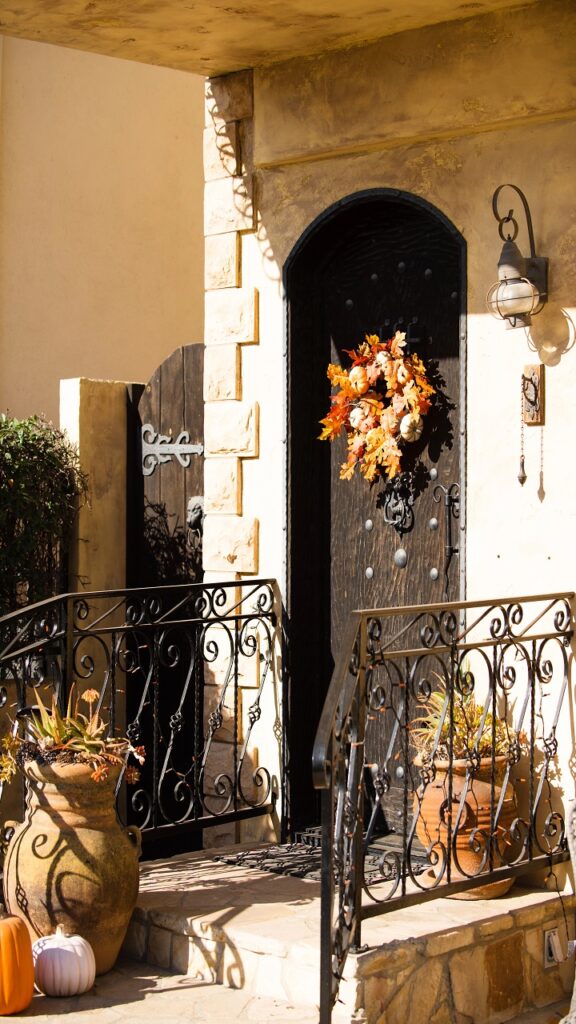
On a small porch, the door isn’t just the entrance — it’s the entire composition. There’s no room for a secondary focal point, so everything you put out should direct the eye there and support it.
A wreath at eye level, one tall piece flanking the frame, and a layered mat beneath: that three-point triangle does more for a small stoop than any amount of step-edge gourds.
Start by adding height at the door and work outward — a full-length seasonal leaner against the wall beside the frame if you have four inches to spare, or a door basket with cascading eucalyptus and mini pumpkins if you want to keep things completely flush. The door is the anchor. Everything else is punctuation.
One Generous Planter Beats a Scattering of Small Ones
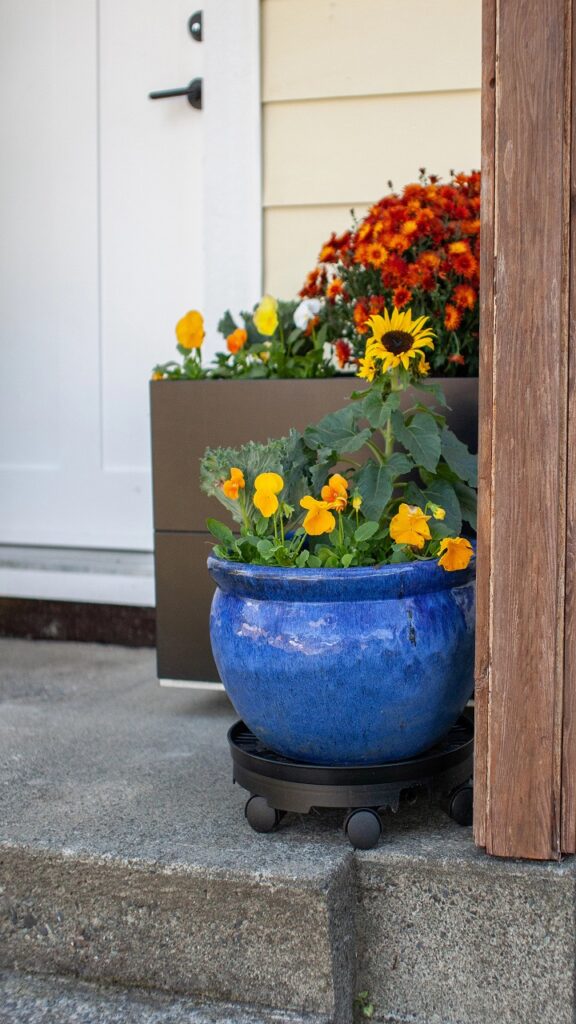
The fastest way to make a small porch look cramped is to cover it with small things. Eight mini gourds, four little potted mums, three short lanterns — each item fine, the whole arrangement visually exhausting because your brain has to count and catalog everything.
One generous, full planter registers as a decision; a collection of small pieces registers as stuff. On a small front porch, go for a single large container planted to full and let it be the seasonal statement on one side of the door.
A big pot of rust-colored mums or ornamental kale next to a trio of pumpkins in graduating sizes has more presence than twice as many individual pieces spread across the space. Velvet pumpkins in a single rich color pulled from your wreath tie it all together without requiring more square footage than you have.
Go Vertical When the Floor Runs Out
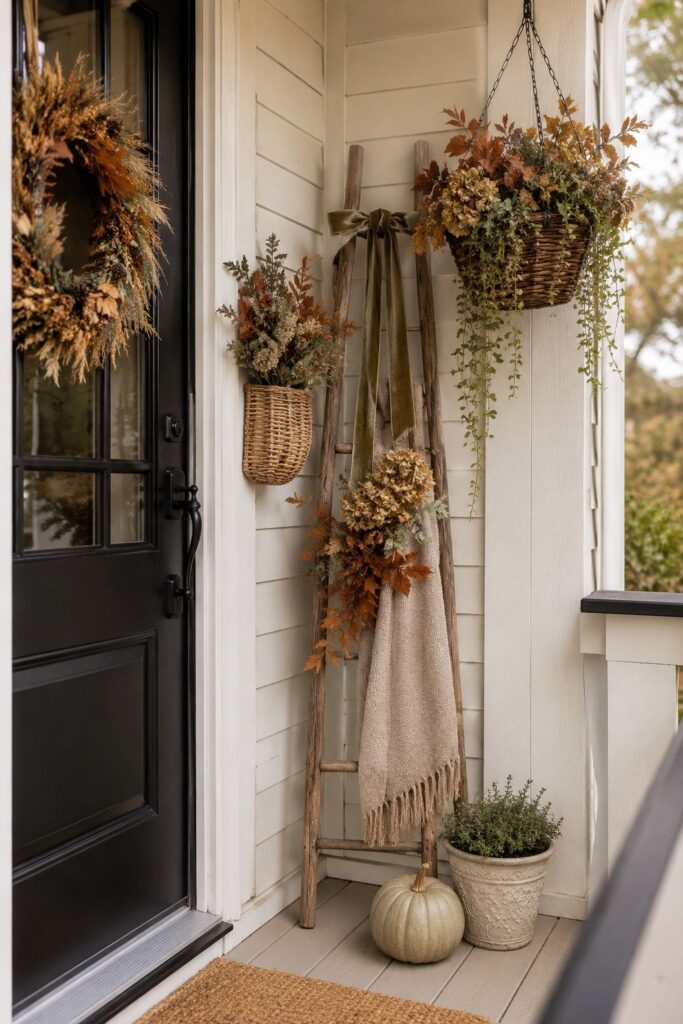
Here’s what separates a small porch that feels designed from one that feels defeated: vertical space is essentially free, and most people leave it completely empty.
Your eye measures a space by how high the decoration reaches as much as how wide, which is why a tall leaner or a hanging basket on a narrow landing can read as abundant when a floor full of stuff at ankle height just reads as cluttered.
If you can’t add floor pieces, add height — a hook inside the doorframe for a hanging basket, a slim floor ladder leaned against the wall and dressed with fall greenery and ribbon, or a wall-mounted planter at eye level.
This is also the whole strategy for narrow porch fall decor: when you can’t go wide, go up. A vertical arrangement that doesn’t block the door works with a space rather than against it.
The Layered Doormat Is Doing More Work Than You Think
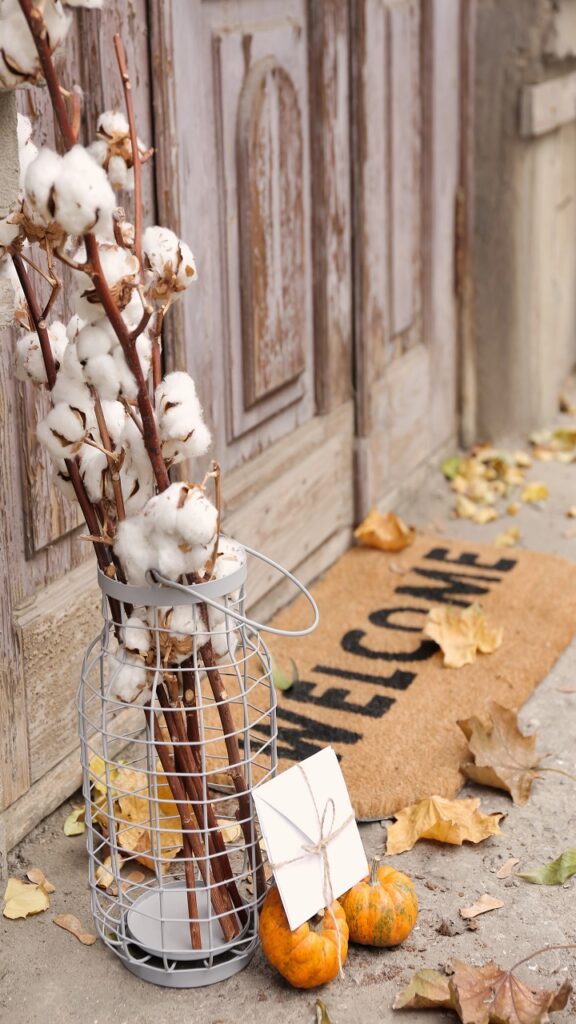
Every small porch is roughly thirty percent doormat, which makes the mat one of the highest-impact decisions in the entire setup. A single flat mat is functional.
A layered mat — a large natural-fiber base with a smaller seasonal one on top — reads as layered and intentional, the same way layering rugs adds warmth to a living room floor. On a tiny stoop, it’s often the only spot to introduce pattern and texture, so it earns its place.
The practical specs that actually matter: keep the base layer large enough to sit under whatever flanking piece is beside the door, and make sure the top layer is proportionally smaller — about half to two-thirds the size.
This creates a visual frame that grounds the whole entry, and it costs about fifteen to twenty dollars to do well.
Scale Your Pumpkins to the Space, Not the Season
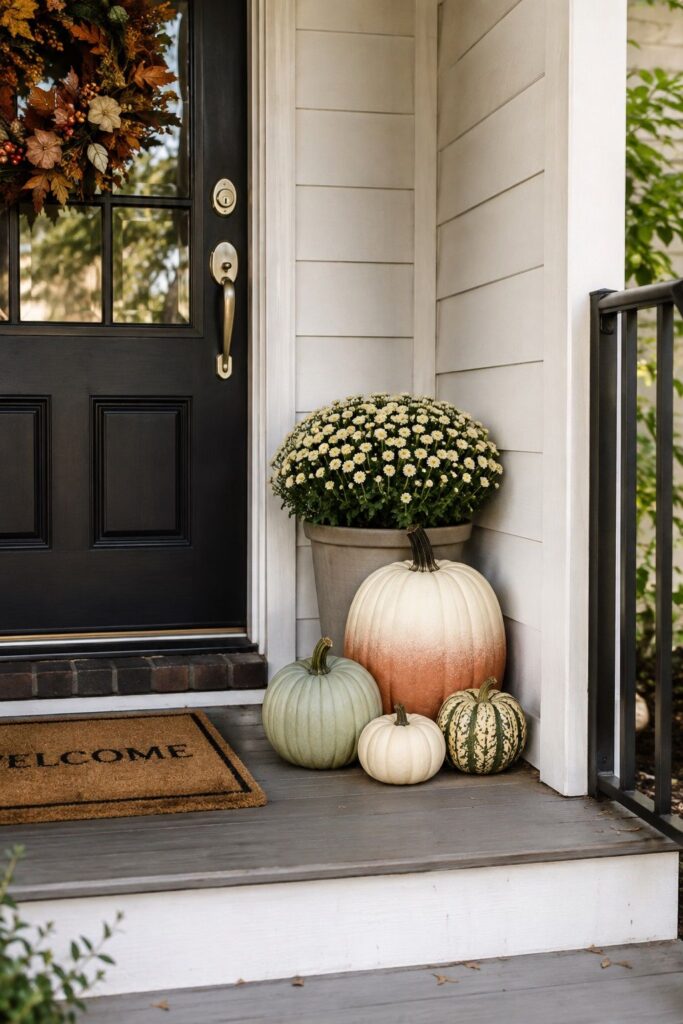
Fall decor orthodoxy insists on the biggest pumpkins possible. Real-space logic says a pumpkin that’s twelve inches across on a porch that’s eighteen inches deep is going to look like you’re storing a gourd, not decorating a home.
Scale your props to the actual dimensions you’re working with — a cluster of three mid-size pumpkins with a few small gourds will register as “fall porch” just as clearly as one enormous specimen that eats the whole landing.
For small spaces, the sweet spot is usually one medium pumpkin as the anchor and two or three small ones as companions, grouped together rather than spread in a line.
Spray-painting a set in a consistent palette — all cream, all sage, all terracotta — makes them read as a collection rather than a random pile, and ombré finishes extend the season into November without looking like leftover Halloween.
Apartment Balcony Fall Decor Has Its Own Set of Rules
A balcony is a small porch with extra constraints, and they matter. Most leases allow temporary outdoor decorations, but many restrict open flames, railing items, and anything that could fall to the unit below — check yours before anything goes on the rail.
Favor lightweight faux pieces over heavy ceramics: a 16-inch pot filled with wet soil can weigh forty to sixty pounds, and balcony load limits add up faster than most people expect.
The smarter balcony setup is a lightweight hanging basket in the doorframe, a slim faux-pumpkin cluster on the mat, and renter-friendly battery-operated lanterns that need no flame and no hooks. Full autumn look, zero liability.
Warm Light Does Half the Seasonal Work After Dark
A small porch that looks cheerful in daylight can disappear entirely at dusk — not because the decor changed, but because there’s no light to read it by.
A single warm light source transforms a small stoop after dark in a way that no additional prop can replicate. The goal isn’t bright; it’s the amber, low-flickering warmth that amber glass and lanterns throw when they’re lit from within — the kind that makes a house look occupied and welcoming from the street.
For a small porch, one medium lantern on the ground beside the door or a hanging lantern at eye level is enough — more than that and the space starts to feel like a fire sale at a candle shop.
Battery-operated flameless candles inside the lantern keep the look safe and maintenance-free, which matters when the porch is three feet wide and there’s nowhere to step around something if it tips.
The One-Tote Rule Keeps It Simple and Storable
Here’s a constraint that turns out to be a creative asset: everything for your small porch fall decor should fit in a single storage tote when the season’s over.
Not because you have to be minimalist — because editing to what fits in one bin forces you to choose only the things that actually earn their spot, which is exactly how a small porch ends up looking intentional rather than overstuffed.
The practical result is a porch built from two or three strong pieces rather than ten okay ones: a wreath, a doormat, a planter or lantern, a small pumpkin cluster.
Each item pulls full weight, nothing is there just to fill a gap, and the whole setup goes up and comes down in twenty minutes. That’s also what makes the fall-to-winter transition effortless — swap two pieces and the same tote serves the next season.
Corner and Wrap-Around Porches: Use the Angle, Don’t Fight It
A corner or wrap-around porch has more space, but the extra footage creates its own problem: the eye doesn’t know where to land. The fix is the same as on a small stoop — anchor the door with your primary arrangement, then use the turn as one secondary zone rather than filling every inch.
A hay bale and a few pumpkins at the corner, a rocking chair with a throw in the middle: deliberate groupings with breathing room between them.
A continuous line of stuff from one end to the other just looks like overflow. Think of front porch decorating the way you’d think about patio and backyard spaces — zones, not wall-to-wall coverage.
One Detail That Reads from the Street Changes Everything
I learned this one by accident the first fall I decorated a narrow row-house stoop — a space so shallow that nothing I put on the steps stayed there for longer than a gust of wind.
I ended up with a single large wreath on the door and a hanging lantern, both of which read instantly from thirty feet away, and the stoop looked more intentional than it ever had with stuff crammed on every step.
The whole small-space fall decor lesson in one moment: one detail that works from the sidewalk beats five details that only make sense up close.
From the street, a wreath, a tall leaner, or a warm lantern glow are the moves that land. You don’t need step-by-step gourds visible from thirty feet away — what you need is one clear signal that someone who cares lives here. Get that right and the size of the porch stops mattering.
Small Porches Reward the Edit
The goal was never the hay wagon. It’s a space that greets whoever walks up and says “fall” without making them dodge anything on the way to the door. And the smaller the porch, the more clearly your editing shows — in both directions.
Pick the door. Pick the height. Pick one strong focal point and let it breathe. That works just as well on a four-foot stoop as it does on a cozy fall room you’ve built around a season. Small doesn’t mean less. It means every choice counts.