What this is: A complete guide to fall front porch decor — how to style the door, choose a look, get the pumpkin-mum-lantern mix right, and pull it all together for any size porch and any budget.
Who it’s for: Anyone dressing a front porch, a small stoop, or an apartment landing for autumn — first-timers and people tired of their porch looking like everyone else’s.
Why read it: You’ll learn the one framing move that makes a porch actually read as fall from the street, plus the honest, hard-won specifics most guides skip — including a few angles almost nobody else bothers with.
Every September, the same thing happens on a million porches. Someone grabs a bag of mini pumpkins, lines them along the top step, plops a grocery-store mum by the door, and steps back waiting for the magic.
What they get instead looks like a produce display that fell off the truck — technically autumn, somehow still a little sad.
The problem isn’t the pumpkins. It’s that most people decorate a porch like it’s a shelf to fill, when it’s really a scene to compose. A porch that actually lands has a focal point, a couple of heights, and the sense that a human being meant it — and none of that costs a cent more than the random-pumpkin method.
This guide covers the whole thing: where to start, how to pick a style, the small handful of elements that do the real work, and how to make it sing whether you’ve got a wraparound porch or a slab of concrete the size of a welcome mat.
Here’s how to build one you’re glad to walk up to.
Your Front Door Is the One Thing That Actually Has to Read as Fall
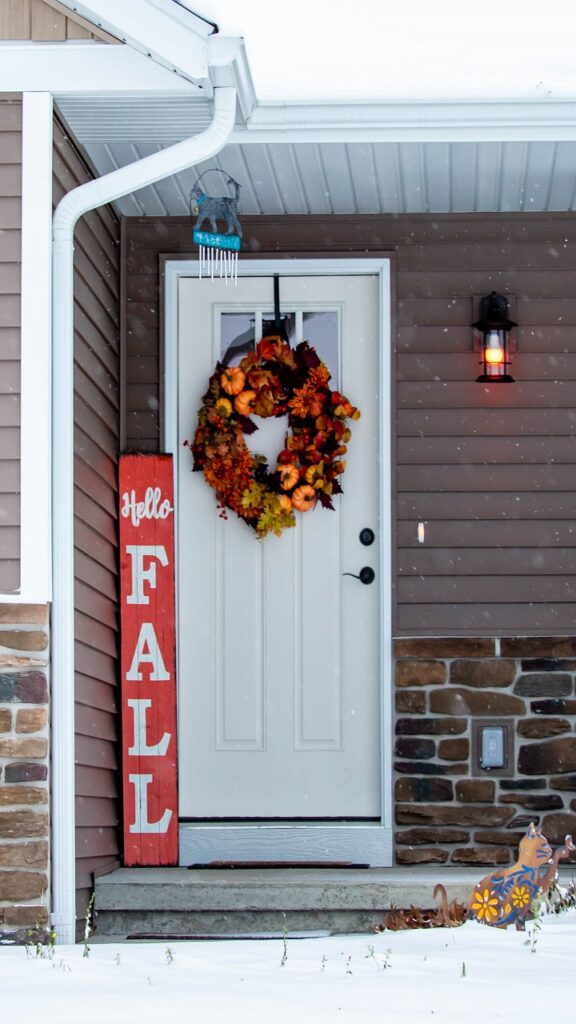
Here’s what nobody tells you: from the sidewalk, a porch reads as “fall” almost entirely on the strength of the front door and the few feet around it. Your eye goes to the entrance first because that’s where the whole architecture is pointing it — the roofline, the steps, the path all funnel a visitor’s gaze straight to the door.
Decorate the railings and the far corner but leave the door bare, and the brain files the whole thing as clutter surrounding a blank spot. So before you buy a single thing, treat the door as the anchor and everything else as support.
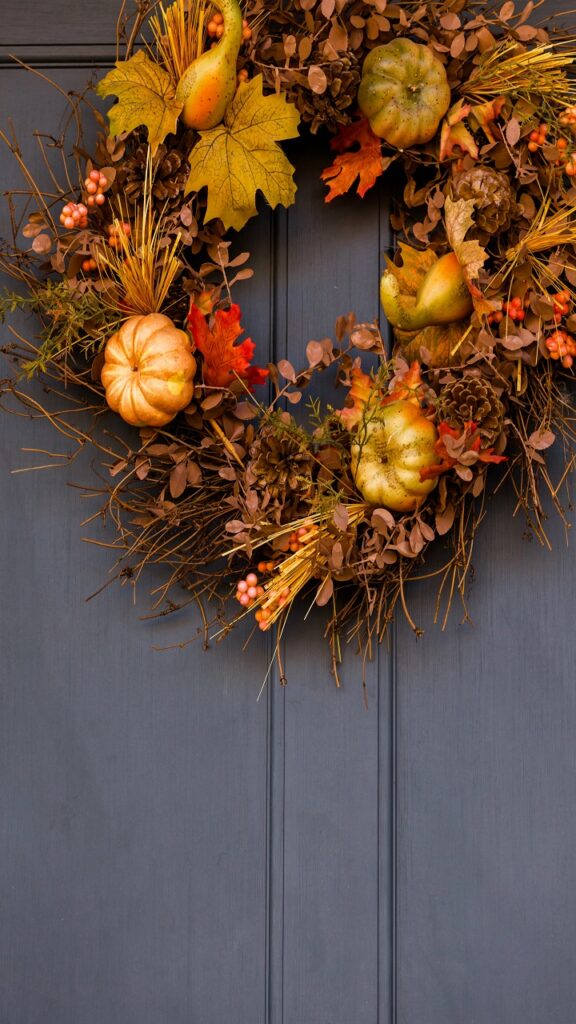
A wreath at eye level, something with real height flanking the frame, and a layered mat at the base — that little triangle does most of the heavy lifting, and it’s the difference between “decorated” and “decorated on purpose.” Build the door zone first, then let the rest of the porch answer to it, never the reverse.
Pick Your Fall Porch Style Before You Buy a Single Pumpkin
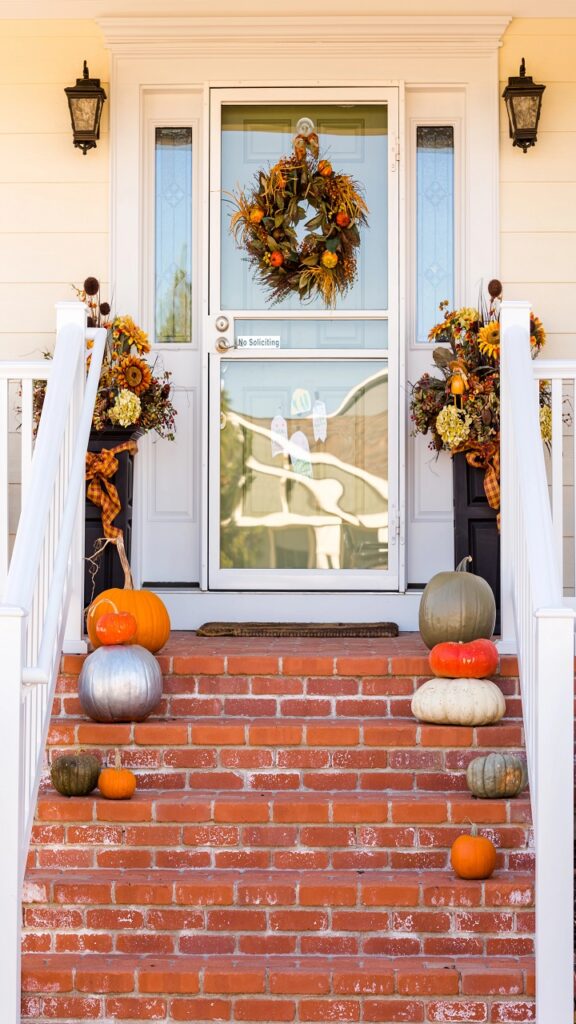
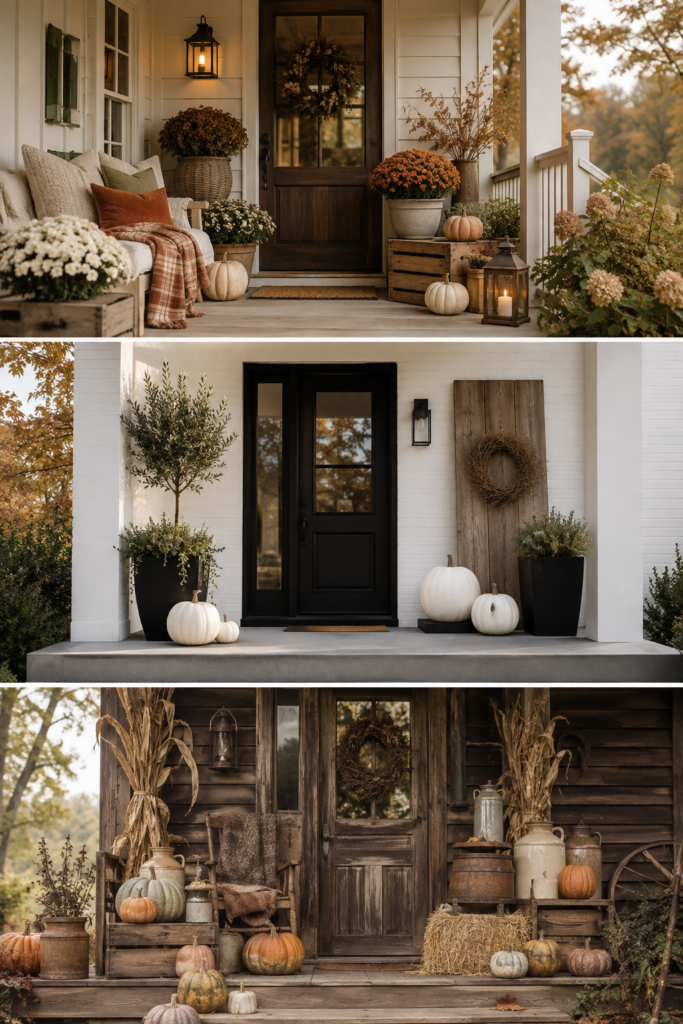
The fastest route to a cluttered, mismatched porch is to shop first and plan never — you come home with a leopard-print ribbon, a rustic crate, and a sleek matte-black lantern, and now your entrance is having an identity crisis. Pick a lane before you spend a dollar.
Most fall front porch decor falls into three camps: cozy farmhouse (warm, layered, and the most-saved look online for a reason), modern and minimalist (restrained, neutral, a few good pieces breathing), and rustic vintage (crocks, patina, and things that look like they have a history). If you want a soft way in, plush velvet pumpkins flatter almost any of them.
| Style | Palette | Hero pieces | Best for |
|---|---|---|---|
| Cozy farmhouse | Warm cream, rust, sage | Layered mums, wood crates, plaid, lanterns | Covered porches with room to layer |
| Modern & minimalist | White, black, natural wood | One statement leaner, white pumpkins, clean planters | Small or contemporary entries |
| Rustic & vintage | Deep brown, amber, patina | Antique crocks, hay bales, cornstalks | Farmhouses and character homes |
The mistake most people make is mixing all three and calling it “eclectic,” which is the polite word for a porch that can’t make up its mind.
Commit to one and let it be obvious — modern, ombré-painted pumpkins for the minimalist camp, warm terracotta-painted pumpkins for the farmhouse one. Coherence reads as expensive; variety reads as a clearance bin, even when you spent the same money.
The Handful of Elements Every Fall Porch Decor Setup Actually Needs
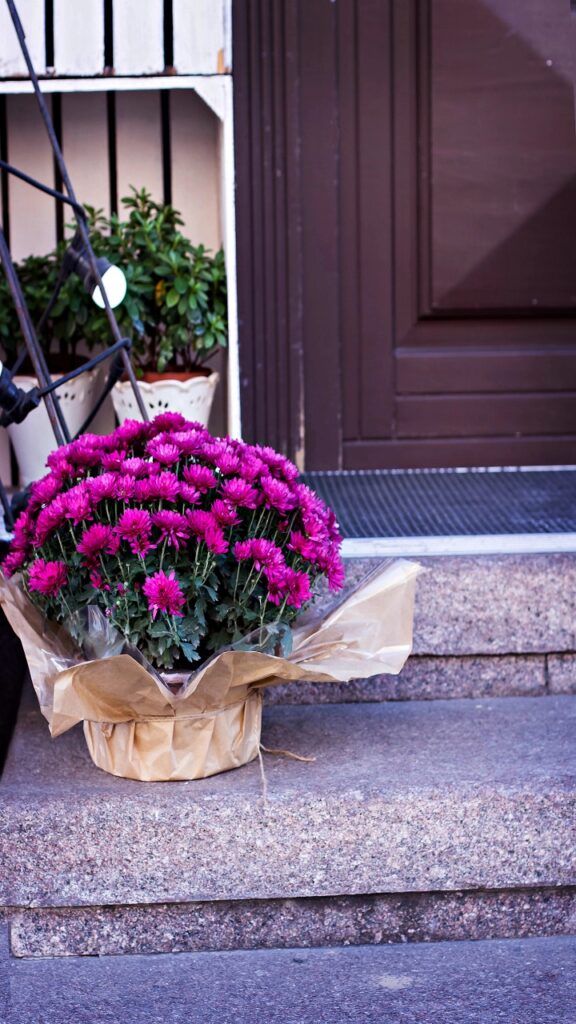
You need fewer things than the internet implies. The working parts of nearly every good fall porch are the same short list: pumpkins in a couple of sizes, one or two mums, a planter or two, a lantern for warmth after dark, and a mat at the door.
Add a leaner or a sign if you want height and a little personality, and hay bales or a wooden crate if you’re going for that harvest-stand feeling. That’s it — the rest is variation on a theme.
A few honest specifics, because vague advice helps no one. Mums are gorgeous and cheap and die fast if you ignore them — buy them tight in bud rather than in full bloom, water at the soil not the flowers, and they’ll go the distance; the University of Kentucky’s extension service has a tidy rundown on keeping mums blooming longer.
For evening warmth, nothing beats the honey-colored glow of amber glass and lantern light — it’s the detail that makes a porch feel occupied rather than staged. And layer your doormats — a big natural-fiber rug under a smaller seasonal one, the way you’d layer rugs for a cozy look indoors — because that single move quietly signals “someone who cares lives here.”
Small Front Porch Fall Decor Is About Restraint, Not Sacrifice
If your porch is really a stoop, congratulations — you have less to buy and a lower bar for looking intentional.
The trap with small front porch fall decor is trying to cram a farmhouse harvest festival onto four square feet, which turns a tidy entrance into an obstacle course you have to sidestep with the groceries.
The fix is scale: fewer pieces, but bigger ones. One generous planter reads as confident; a scatter of tiny gourds reads as leftovers.
Go vertical when the floor runs out — a leaner against the wall, a wreath on the door, a hanging basket — because your brain measures a space by how far up it’s decorated, not just how full the ground is.
Renters and apartment dwellers, this is your whole strategy; lean on small-space fall decor and renter-friendly pieces that hang, lean, or sit without a single nail. On a small porch, one great object beats ten good ones — the restraint is the style.
Cheap Fall Porch Decor Ideas That Don’t Actually Look Cheap
Here’s a truth the seasonal-aisle marketing would rather you not internalize: an expensive-looking porch and a cheap one use nearly identical parts.
The tells of a budget porch aren’t the price tags — they’re plastic that shines like plastic, everything at one boring height, and orange so aggressive it could guide planes in.
Fix those three things and a $40 porch passes for a $200 one. Spray a dollar-store pumpkin in a flat cream or muted sage and it stops looking like a dollar-store pumpkin instantly.
Shop your yard and your thrift store before the big-box seasonal aisle. Cut branches, dried grasses, and a few real gourds cost nothing and out-texture anything molded from resin, and a chipped crock or wooden crate from a thrift shop does more for a farmhouse porch than a full cart of new decor.
A round of cheap, easy DIY projects will carry you further than a credit card here. Texture and restraint are what money buys — and both are free.
Easy DIY Fall Porch Projects You Can Finish in an Afternoon
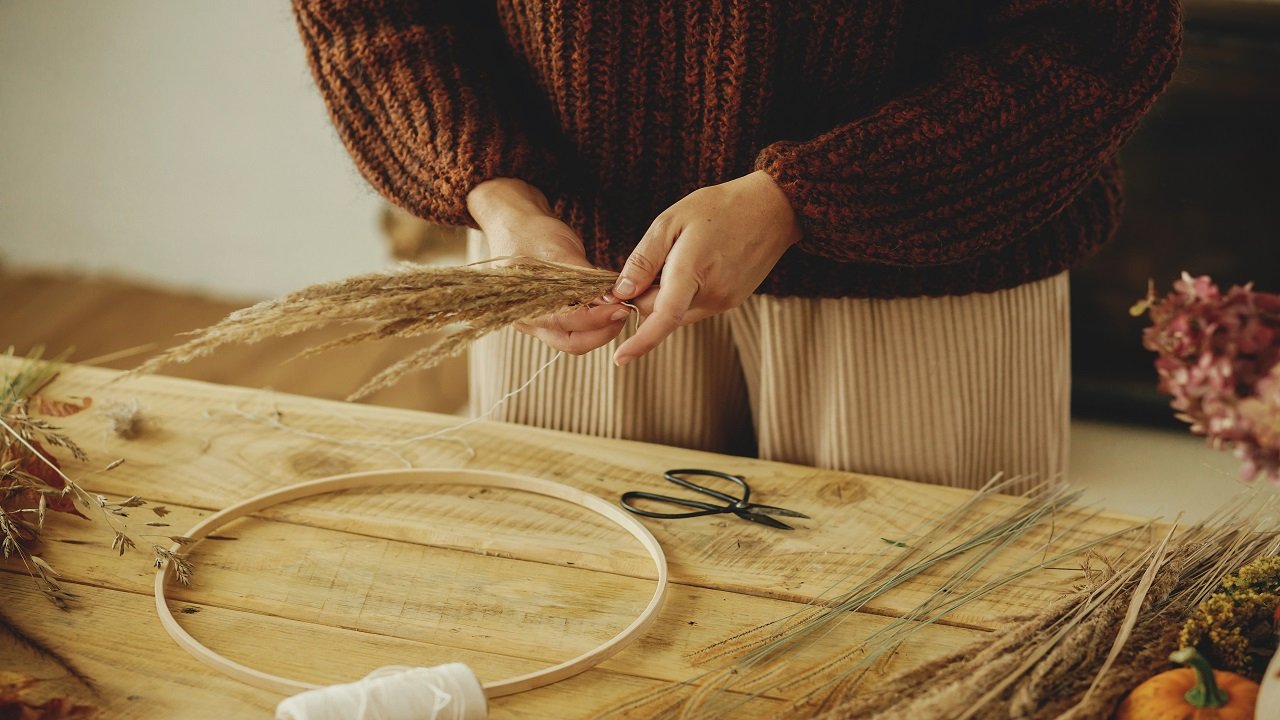
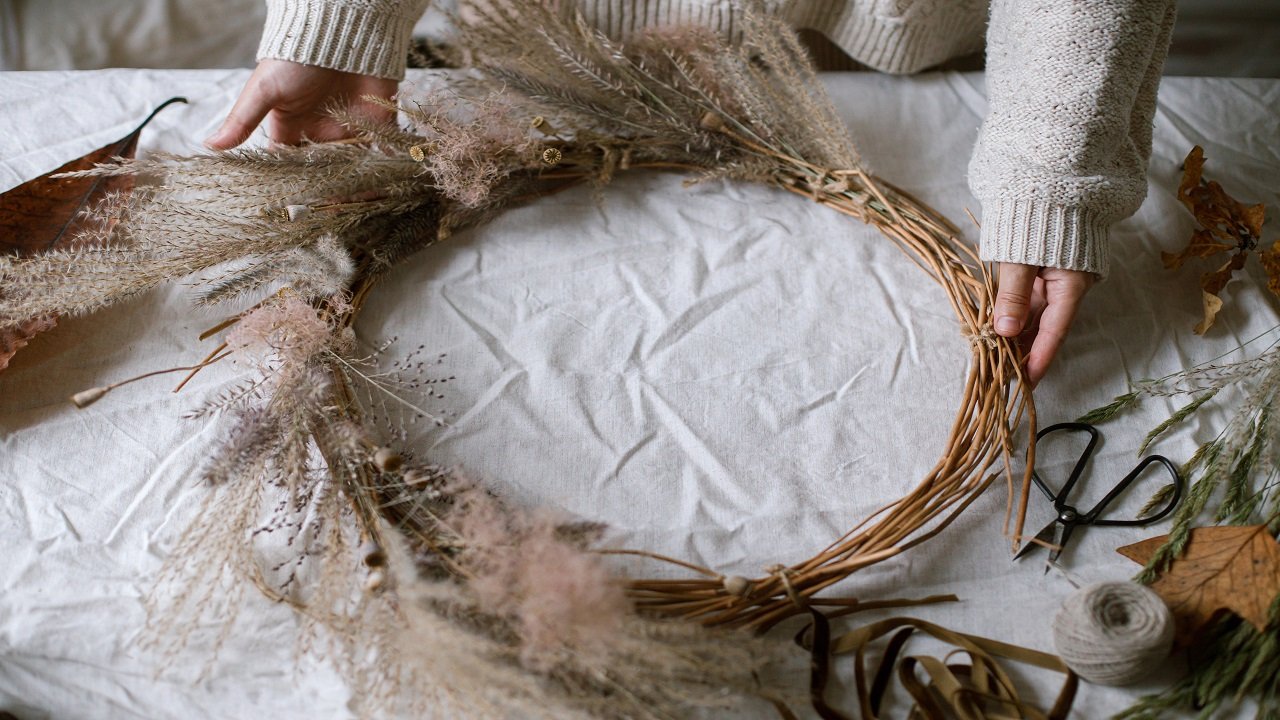
You don’t need a workshop or a router to make something for your porch — most of the highest-impact projects are an afternoon and a glue gun at most. Paint a cluster of pumpkins in a single tight palette so they read as a set instead of a grab bag.
Wire a few grocery-store stems and some foraged branches into a loose garland for the railing. Prop a length of leftover fence board against the wall, letter it by hand, and you’ve got a leaner that cost nothing and looks like it came from a boutique.
The one I’d start with is a layered doormat — buy a big coir rug, top it with a smaller patterned one, and you’ve upgraded the single most-looked-at square foot of the whole porch for about twenty bucks; the same layering trick that warms up a room works double duty at the threshold.
I hand-lettered my first porch sign at a kitchen table with a cheap brush and a steadier hand than I expected, and it has outlasted three store-bought ones. Handmade pieces don’t just save money — they’re the parts guests actually ask about.
Halloween Front Porch: Where Cozy Autumn Tips Into Something a Little Spookier
At some point in October, the cozy-harvest porch wants to get a little theatrical, and that’s the fun part.
The beauty of a Halloween front porch is that you’ve already built the foundation — pumpkins, lanterns, a leaner, layered light — so tipping it spooky is a matter of swapping accents, not starting over.
Trade the plaid throw for something inky, add a few carved or faux-terracotta jack-o’-lanterns, thread in warm string light or a flicker bulb, and the same porch reads haunted-but-tasteful after dark.
The trick is to let your existing anchors do the work and add atmosphere on top, rather than burying the porch under plastic tombstones. A little goes a long way once the light drops — shadow does half the styling for you.
If you want to push further into full-yard territory, there’s a whole playbook of outdoor Halloween decorations to raid, but on a front porch specifically, restraint plus one genuinely eerie detail beats a pile of props every time.
Halloween Front Porch Decor That Still Looks Good on November 1st
The quiet tragedy of most Halloween front porch decor is that it’s engineered to be garbage by dawn on the first — the inflatables deflate, the fake cobwebs sag, and you’re left with a porch that looks like a party nobody cleaned up after.
The smarter move is to build the Halloween layer on top of a fall base you keep, so October 31st to November 1st is a five-minute edit, not a teardown. Pull the skulls and the spiderwebs, and the mums, pumpkins, lanterns, and leaner underneath are still standing, quietly autumnal.
That’s the whole philosophy behind the chic, not-spooky approach: choose Halloween accents that lean seasonal rather than costume-shop, so removing them reveals a porch that’s ready for Thanksgiving instead of a crime scene.
pumpkins, warm light, and natural texture never expire on a calendar date. Decorate so that subtraction — not a shopping trip — is what carries you into the next holiday.
The Fall Porch Angles Almost Nobody Bothers With
Three things get almost no coverage and solve real problems, so here they are. First, pets: the cheerful mum you just set by the door is toxic to dogs and cats, and so are a surprising number of fall staples.
If you’ve got a nibbler, the ASPCA’s rundown of pet-safe fall plants points you to swaps like asters and pansies that give you the same color without the vet bill — and faux pumpkins sidestep the mold-and-rot problem entirely. Nobody’s building porches around this, which is exactly why it’s worth doing.
Second, plan the porch to transition instead of expire. The same neutral base — planters, lanterns, a leaner — can carry you from fall through Thanksgiving and straight into a Christmas porch with nothing but swapped accents, the way a smart fall-to-winter transition works indoors.
And third, if you live somewhere that’s still 95 degrees in September, decorate for your climate — real pumpkins turn to soup and mums scorch in that heat, so lean faux, choose heat-tolerant real plants, and stop trying to recreate a New England postcard on a west-facing porch in Phoenix. The best porch is the one built for the conditions you actually have.
When to Start, and How to Build It in the Right Order
Timing is the question everyone asks, so: late August through October is the sweet spot, and if you’re planting mums or gourds to last, it helps to know your first frost date before you commit anything living to the porch.
Start too early and the summer heat cooks it; start too late and you’re decorating for a season that’s already leaving. Aim to have it up by the first genuinely crisp morning — that’s the same door-first instinct behind a good spring door refresh, just pointed at autumn, and it’s when people start looking at porches again.
When you build, work big to small so it comes together instead of fighting you: clear the space, place the tall anchors (a leaner and a flanking planter or two), layer in the mid-size pieces (pumpkins, mums, a crate), soften with a throw and a layered mat, and finish with light.
If you’re using real candles in those lanterns, the NFPA’s guidance is to keep an open flame well clear of anything that can burn — or just use flameless and never think about it again. Anchors first, atmosphere last — do it in that order and a full porch takes an afternoon, not a weekend.
A Porch That Does the Work for You
Strip away the seasonal-aisle noise and it’s a short list: anchor the door, pick one style and mean it, layer a few real textures at a couple of heights, and build it to change rather than expire. Do that, and you skip the annual ritual of dumping pumpkins on the step and hoping — the thing greets people for you, tells them the season turned and someone here noticed.
That’s the payoff of treating the porch as a scene instead of a shelf. It’s the first thing your guests see and the last thing you walk past on the way in, so it may as well feel like a small, deliberate welcome — the kind that’s just as easy to nudge from harvest to Halloween to holiday when you’re ready. Now go make yours the porch on the block people slow down for.