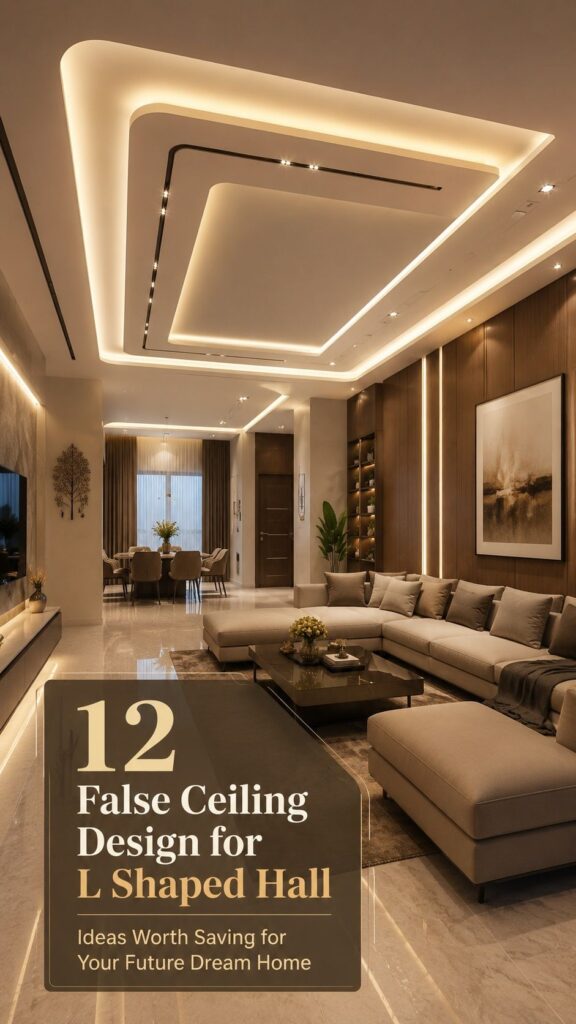
Your ceiling might be doing the bare minimum right now. An L-shaped false ceiling changes that fast.
It runs along two connected walls, dropping 6 to 12 inches below the original slab, and suddenly your hall looks twice as intentional.
You can add cove lighting, wood slats, or two-tone gypsum panels without gutting your budget. Twelve specific ideas ahead will show you exactly how far this one design move goes.
Wait — let me apply the rules properly:
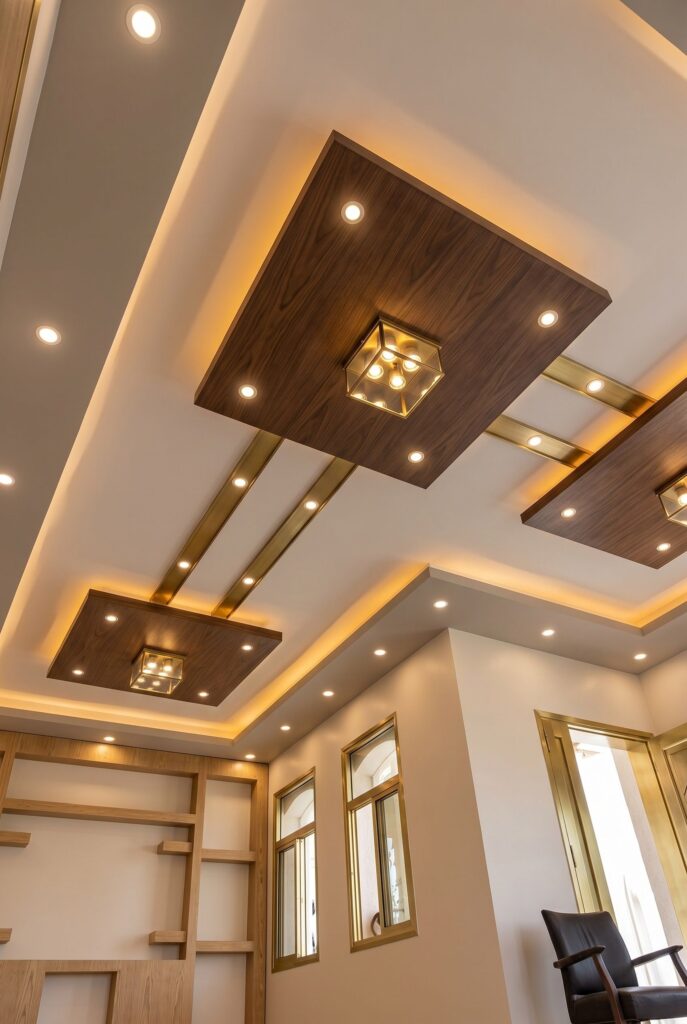
What Makes an L-Shaped False Ceiling Work in Open Halls?
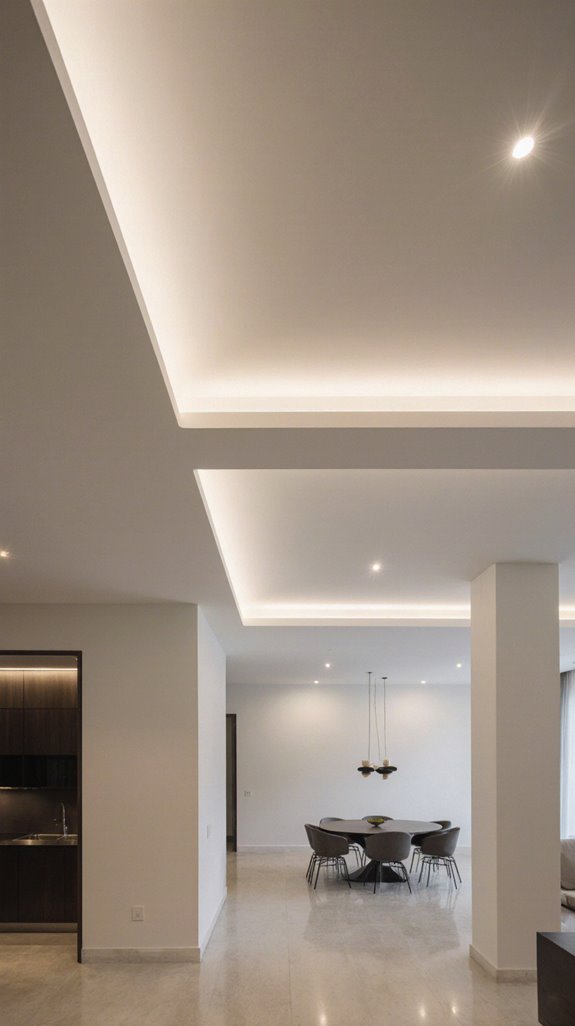
When a hall bends into an L-shape, a flat unbroken ceiling actually works against you. It flattens the space and makes it harder to tell where the living area ends and the dining area begins.
A false ceiling fixes this by using height changes, trays, and cove lighting to carve out zones without walls. Drop a soffit 100,150 mm and you’ve quietly told everyone where dining stops and lounging starts.
Align those shifts with your furniture layout below, and the ceiling starts doing real organizational work, no paint colors or room dividers required. Indirect LED strips tucked into tiered coves soften the transition between these zones while enhancing perceived spaciousness.
How a Curved Corner Transition Softens the L-Shaped Ceiling Bend
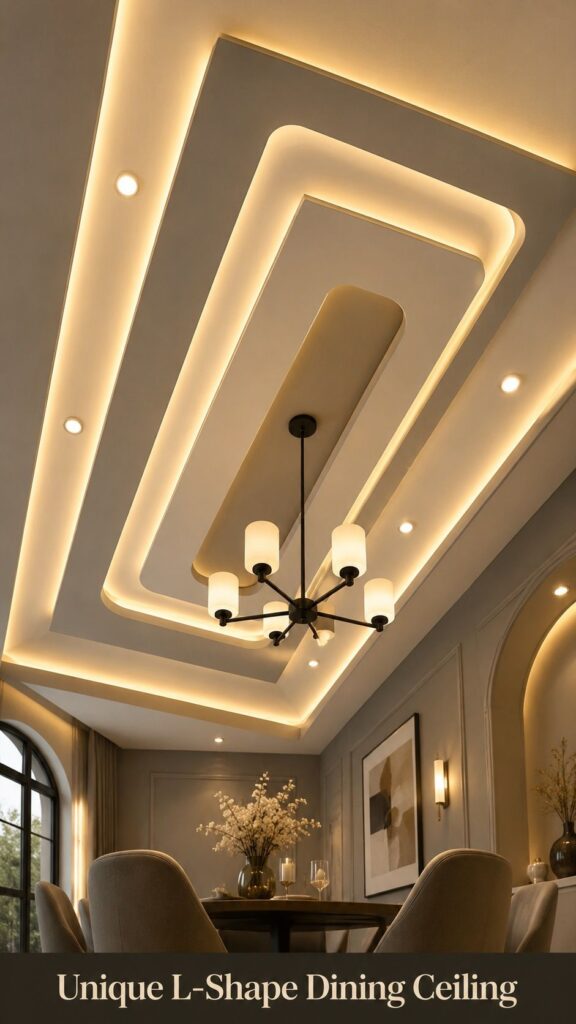
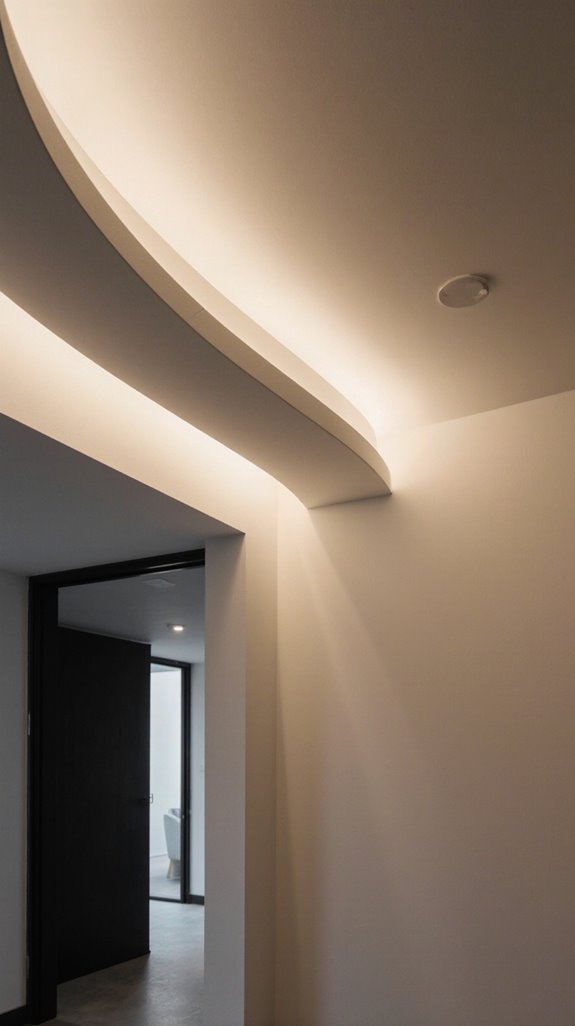
That sharp elbow where your L-shaped ceiling bends is the spot that quietly undermines the whole design if you ignore it.
A curved gypsum soffit, basically a smooth, radiused drop ceiling section, fixes this instantly. Aim for a 900–1500 mm radius; a 1.2 m inside radius is the reliable sweet spot for most halls.
The curve guides your eye continuously from one zone into the next without a hard stop. Embed an LED strip along the radius for indirect cove lighting, and the bend reads as a deliberate alteration rather than a construction compromise.
Continuous LED lighting along the curve also ensures uniform ambient illumination throughout the transition, tying both arms of the L together visually.
MORE IDEAS: 28 Latest False Ceiling Designs That Make Every Room Look Custom-Built.
Simple Cove Lighting for an L-Shaped Living and Dining Ceiling
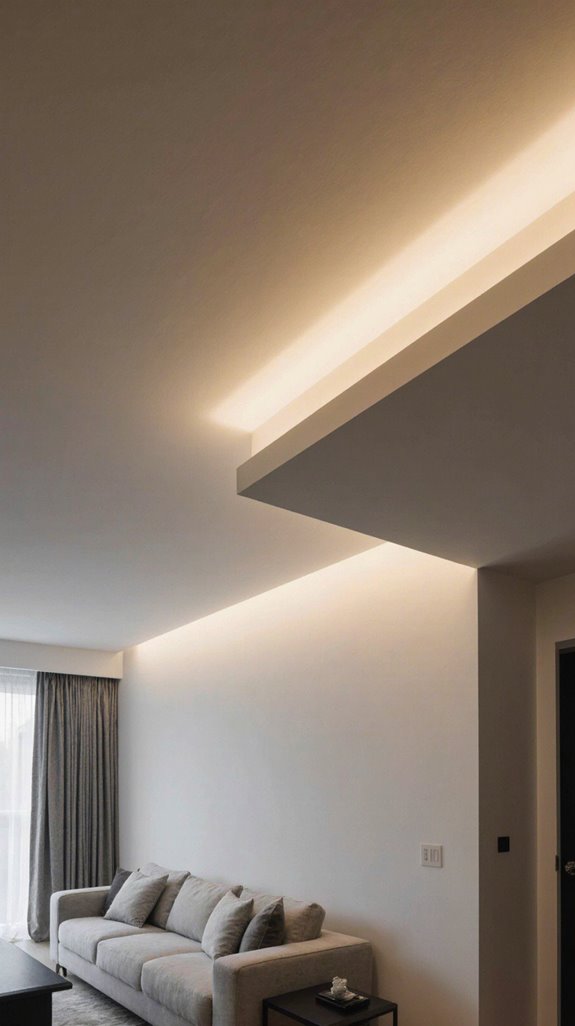
Cove lighting is just a hidden LED strip that bounces light off the ceiling instead of shining it in your face.
Run it along an L-shape to split your living and dining zones without building a wall. You’ll need a cove at least 75mm deep with a 40mm lip so nobody actually sees the strip.
Use 24V DC LED strips at 120 LEDs per meter to avoid that sad dotted-light look.
Paint the cove interior matte white with an LRV above 80%.
Keep dining at 2700K, 3000K, bump living areas to 3500K, 4000K. For best results, your ceiling should meet the minimum 9 feet height recommendation before planning any cove lighting installation.
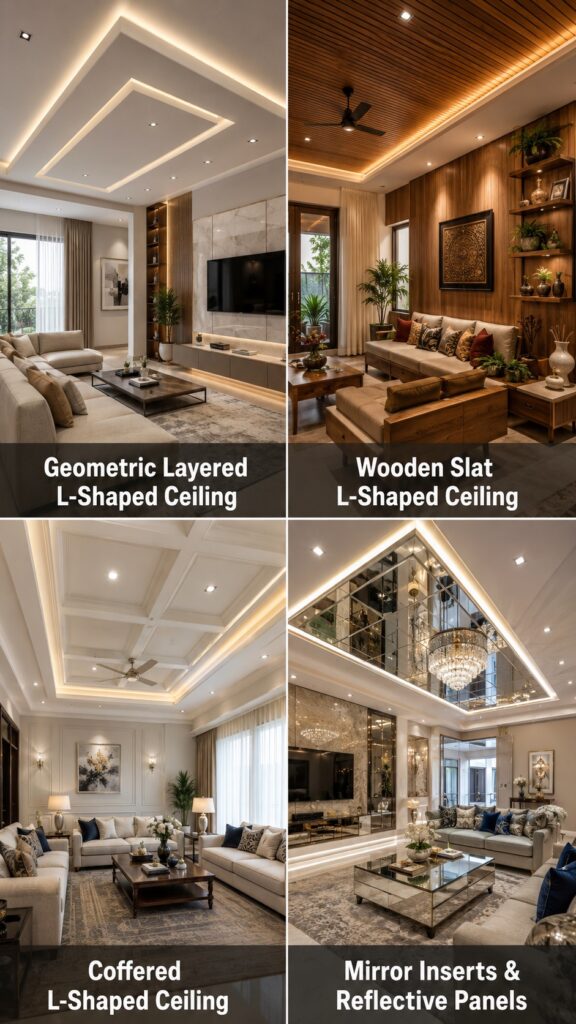
Geometric Layered L-Shaped Ceiling for a Bold Statement
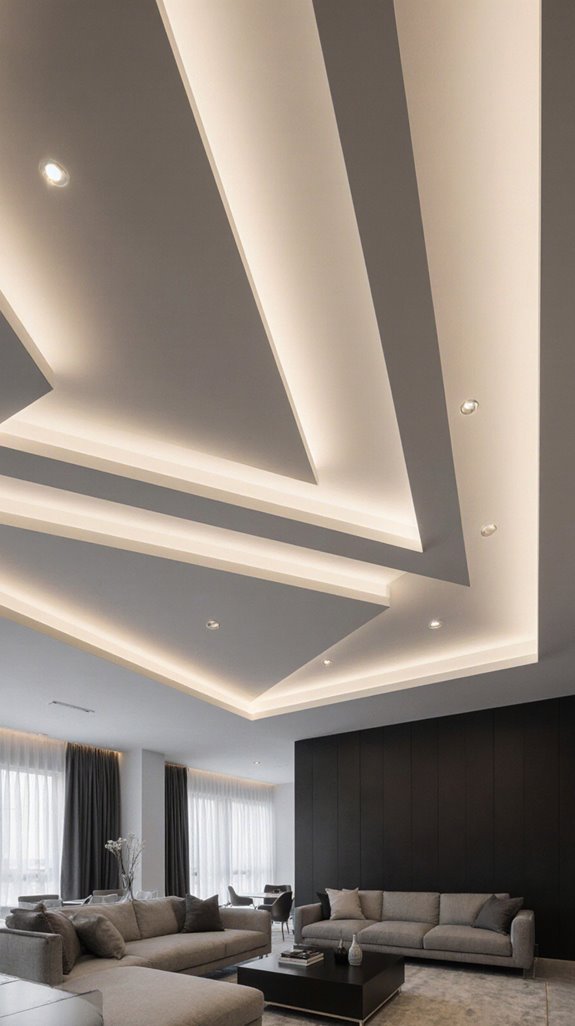
If cove lighting is the quiet workhorse of L-shaped ceilings, geometric layering is the one that shows up in a three-piece suit.
You’re stacking distinct planes, rectangles, chevrons, hexagons, at 100,150 mm drops between tiers. That spacing keeps you above the 7-foot habitable height minimum while carving out real visual zones.
A floating rectangular panel over the L-junction hides the awkward corner shift. Use POP for sharp angles or gypsum board for cleaner painted finishes.
Add recessed LEDs between tiers and the shadow lines do the heavy lifting. Bold geometry makes the L-shape look deliberate, not accidental. Gypsum, plywood, and modular panels each bring distinct advantages to geometric layered ceilings, so your material choice will directly shape how clean or textured those stacked planes ultimately read.
SEE THIS: 13 Top View False Ceiling Design Layouts (Plan Before You Build)!
Wooden Slat L-Shaped Ceiling for Warm, Acoustic Comfort
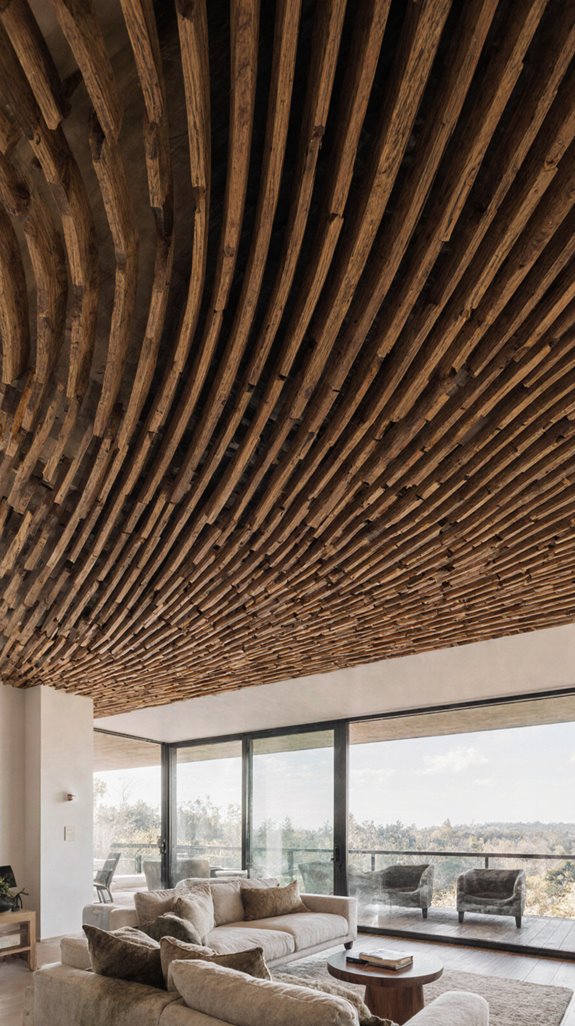
Wooden slats on an L-shaped ceiling pull double duty; they look good and actually fix room acoustics.
Run oak or ash slats along the longer arm to make that side feel even more expansive. Add acoustic felt backing rated NRC 0.85, and you’ll drop reverberation time to around 0.5–0.6 seconds, basically the sweet spot for clear conversation.
Miter the slats at the L-bend for a clean corner, or leave a shadow gap for a deliberate pause in the pattern.
Tuck linear LED strips between slats for lighting that doesn’t fight the wood grain. Real wood requires expansion gaps during installation, so veneer MDF is a practical alternative that holds its shape across seasonal humidity changes.
Coffered L-Shaped Ceiling With MDF Borders for Classic Halls
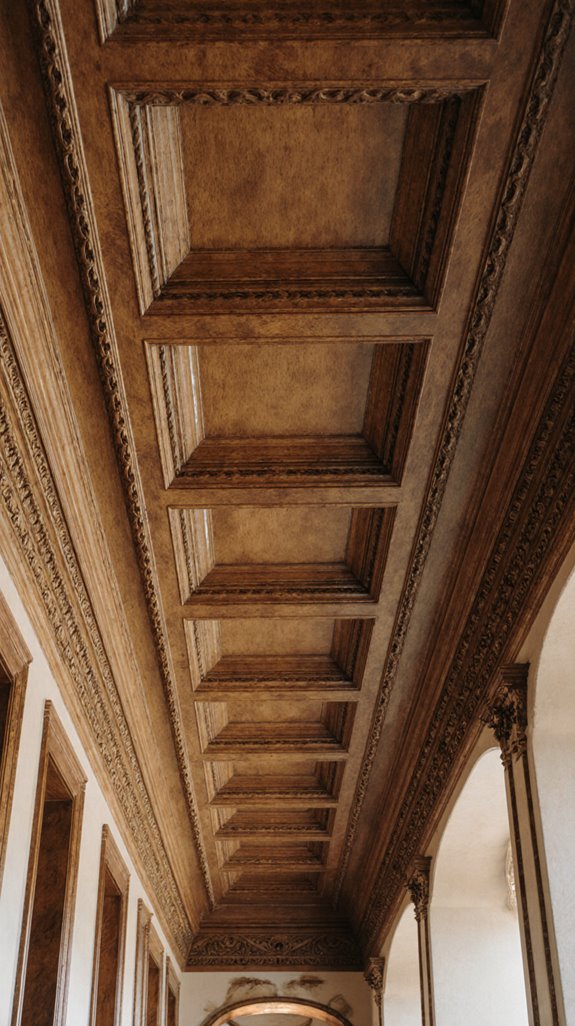
Coffered ceilings, those grid-style recessed panels borrowed from Renaissance halls, work surprisingly well on an L-shaped false ceiling because the geometry plays to the layout’s strengths.
Run the beams parallel to each arm of the L, and you get a rhythm that feels intentional rather than accidental.
Use MDF for the border trim, its a smooth, dense board around 700 kg/m³ that holds crisp moulding profiles without warping.
CNC-route an egg-and-dart detail along the borders for a high-end look at a fraction of solid wood’s cost.
Keep ceiling height at 9 feet minimum to absorb the 4–6-inch beam depth comfortably. Gypsum ceilings are customizable and economical, making them a practical alternative material to pair alongside MDF borders when you want to reduce overall weight on the ceiling structure.
How Mirror Inserts and Reflective Panels Make Small Halls Feel Bigger
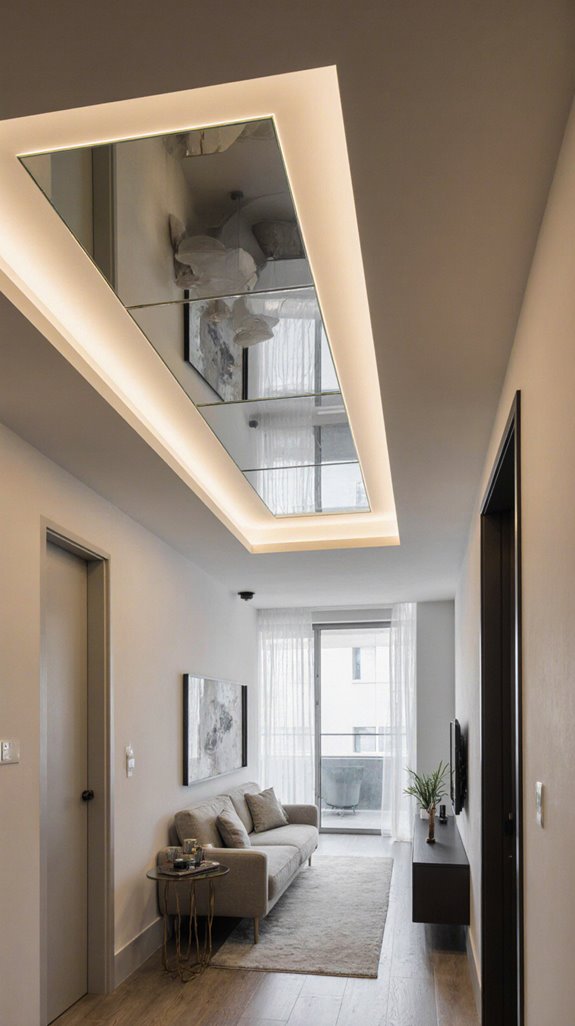
Mirrors don’t add square footage, but they do something almost as useful: they trick your brain into seeing more space than actually exists.
A full mirror panel along the shorter leg of your L-shaped hall balances the proportions between both arms. Skip beveled tiles; one uninterrupted sheet keeps the illusion seamless.
Mount panels to face a window or light source and you’ll gain up to 30 percent more perceived brightness.
Ceiling-mounted acrylic mirror laminates weigh 40 to 60 percent less than glass, making overhead installation practical without reinforcing your entire ceiling structure.
Smart RGB L-Shaped Ceiling Design for Living Room Ambience
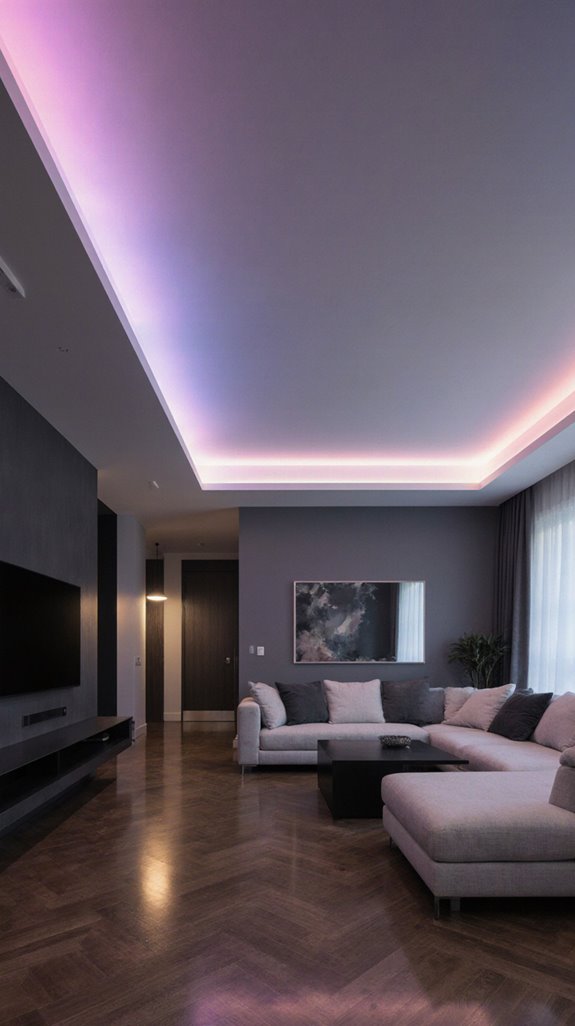
Reflective panels borrow light and stretch perceived space, but RGB LEDs, red, green, and blue diodes that blend into millions of colors, actually *generate* it.
Mount RGB strips inside cove channels along both arms of your L-shaped ceiling, and you’ve got independent zones you can control separately. Warm 2700K tones work for evenings, 4000–5000K bright white handles reading.
Smart controllers sync with apps or voice assistants, letting you switch from “movie night” to “dinner” instantly. Budget ₹250–₹500 per square foot for a full smart setup.
Just confirm your LED driver and dimmer are compatible; mismatched hardware causes flicker.
Minimalist White Gypsum L-Shaped Ceiling for Bedroom Serenity
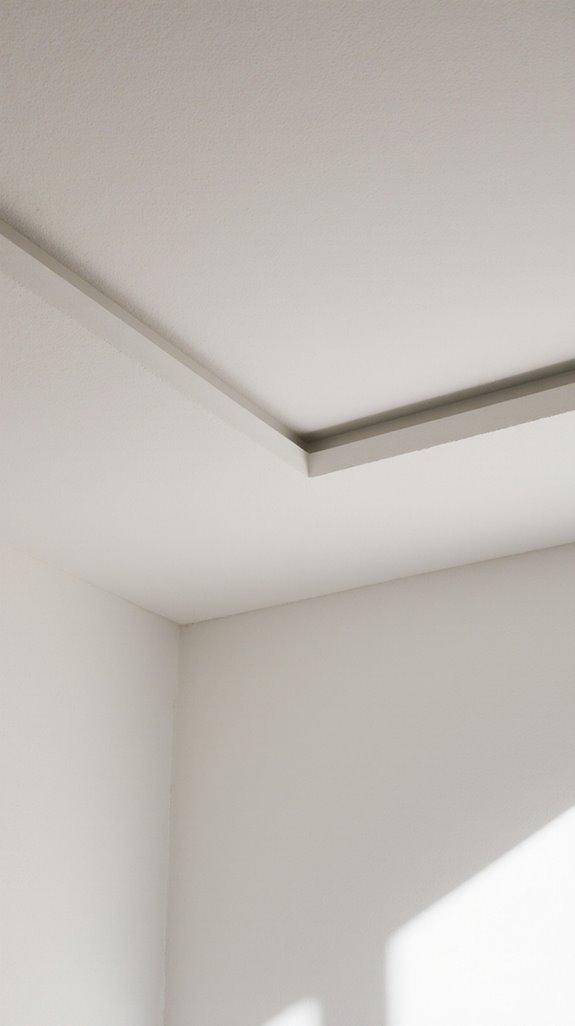
Where RGB strips paint your living room in a million colors, white gypsum keeps your bedroom exactly one, and that’s the whole point.
The L-shaped configuration adds geometric structure without visual noise, guiding your eye upward and making compact rooms feel taller. Gypsum is lightweight, fire-resistant, and molds cleanly into precise angles.
Pair it with recessed spotlights for task lighting and warm-toned cove LEDs along the L-edges for winding down. A matte or satin white finish reflects light evenly, keeps the space airy and requires almost no maintenance.
Simple ceiling, better sleep.
Two-Tone L-Shaped Drop Ceiling to Define Living and Dining Areas
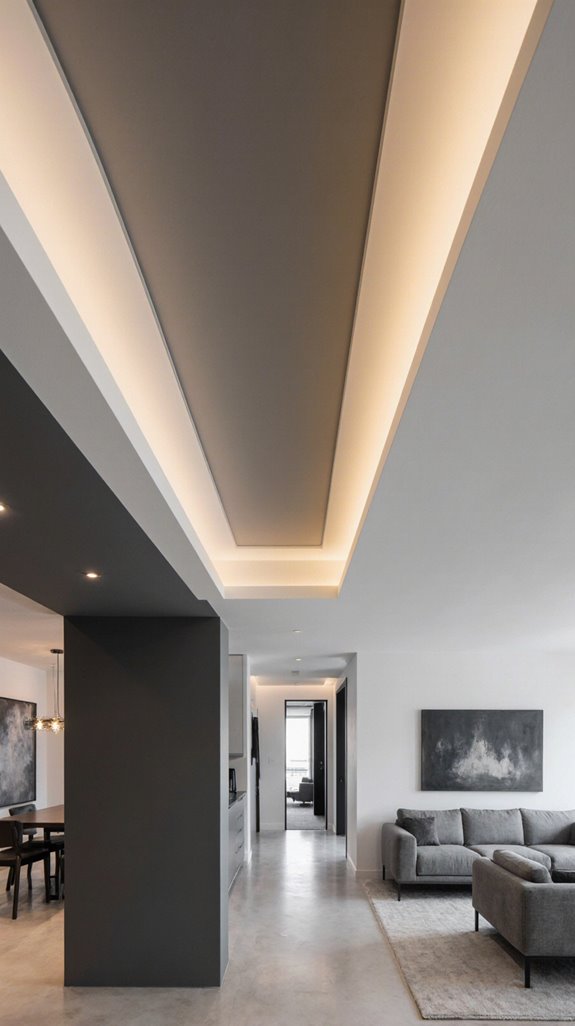
One ceiling, two colors, that’s the simplest way to split an open-plan living and dining area without building a single wall.
Paint the living arm a light, reflective tone and the dining arm something warmer and deeper, like a dusty terracotta or navy. The color shift lands right at the L-shaped corner, which does most of the work for you.
Run LED cove strips along that seam, around 2700K to 3000K, and you’ve got a subtle glowing border.
Keep ceiling drops between 60–90 mm on standard 2.7 m slabs or you’ll feel like your eating in a basement.
PVC Panel L-Shaped Ceiling for Budget-Friendly Hall Makeovers
PVC panels give you three things at once: low cost, quick install, and zero plastering mess, which is a rare combination in any ceiling material.
At ₹60, ₹80 per square foot, you’re getting moisture resistance, decent durability, and finishes that convincingly fake wood or marble.
Twin L-shaped panels with square cutouts fit recessed spotlights cleanly and hide LED strip wiring without fuss, since PVC is non-conductive and easy to drill.
Damaged sections swap out individually, so you’re never replacing the whole ceiling over one bad panel.
For rented halls especially, the detachable modular setup means you take your ceiling with you.
L-Shaped False Ceiling Cost in India: What to Budget
Budget clarity matters before a single drill touches your ceiling.
L-shaped false ceilings in India typically run ₹65, ₹150 per sq ft depending on your material choice. POP is cheapest, gypsum mid-range, and metal the premium option nobody budgets for until they see a showroom.
Your city affects pricing too. Mumbai and Delhi NCR push gypsum rates to ₹170 per sq ft, while Hyderabad stays closer to ₹150.
A 12×12 ft room lands around ₹10,000, ₹22,500 with moderate design. Add cove lighting and you’re paying ₹25, ₹45 per running foot extra.
Plan those numbers before falling in love with a design.