
Your porch ceiling is doing the bare minimum right now, and you can fix that without a full renovation.
A false ceiling, a secondary ceiling installed below the structural one, gives you better looks, insulation, and a place to hide wiring.
Materials range from $1.50/sq ft PVC panels to charred shou sugi ban wood that genuinely repels moisture and pests. Thirteen options are lined up and a few will surprise you.
Choosing a Porch False Ceiling: Material, Budget, and Climate Factors
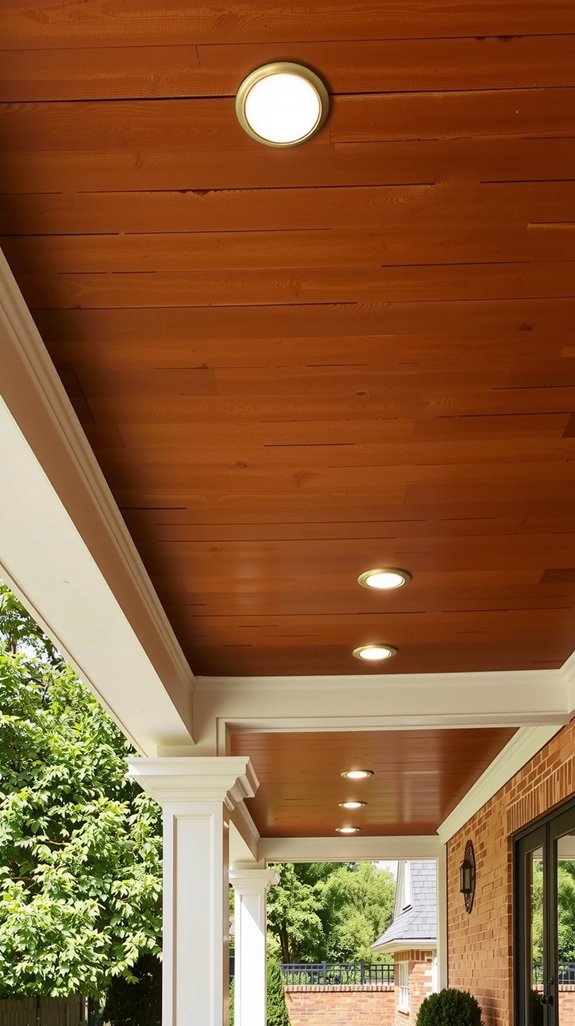
Before picking a ceiling material, you’ll want to think through three things: what your porch is exposed to, what you want to spend, and how much upkeep you’re willing to do.
Heavy rain or coastal humidity rules out untreated gypsum fast. Cedar, teak, and metal panels handle moisture well, while pine needs pressure treatment to survive wet climates.
Budget-wise, beadboard wood starts around $5, $6 per square foot, and labor adds $3, $8 more. Open rafter designs skip panel costs entirely.
Wood needs resealing every 3, 5 years. Metal just needs occasional cleaning.
Pick the one that fits your life, not just your aesthetic. Materials like PVC are also worth considering since lightweight and waterproof properties make them especially practical for porches exposed to rain and humidity.
PVC Panel False Ceiling for Porches
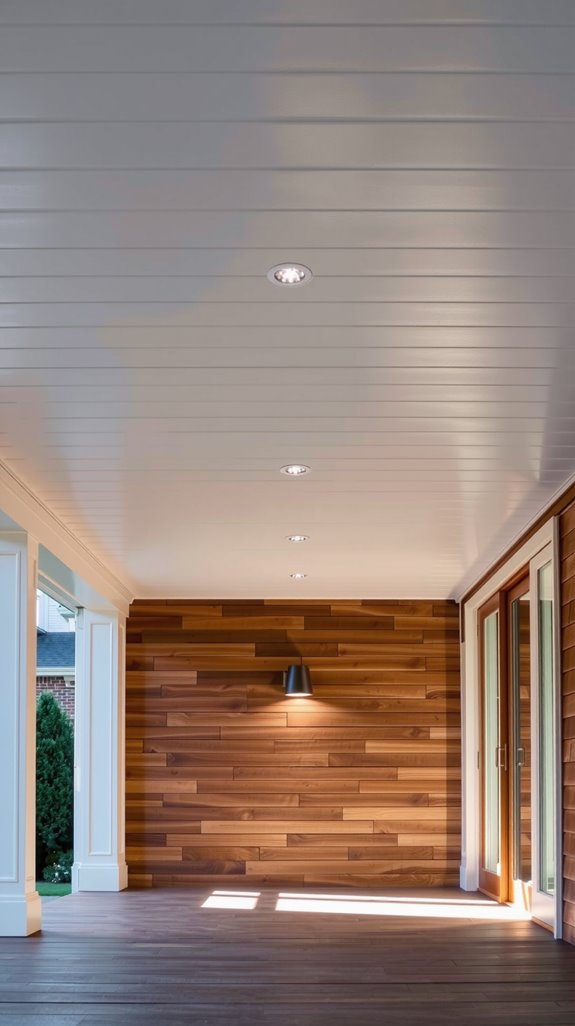
PVC panels might be the most practical false ceiling material you’ll ever ignore at the hardware store. They don’t rot, crack, warp, or attract termites, which makes them unusually well-suited for covered porches.
Maintenance means wiping them down occasionally. That’s it. No repainting, no sealing, no regrets.
You can find them in classic white beadboard, V-groove profiles, or even a Southern “Haint Blue” with color extruded straight through the material. One 4-by-8-foot sheet covers what eight individual planks would.
For runs over 12 feet, leave small expansion gaps because PVC moves more than wood when temperatures shift. PVC is also immune to mold and mildew, which significantly extends the lifespan of your porch ceiling compared to traditional materials.
MORE IDEAS: 28 Latest False Ceiling Designs That Make Every Room Look Custom-Built (Living Room, Bedroom, Kitchen & More).
Metal Panel False Ceiling for Modern Porches
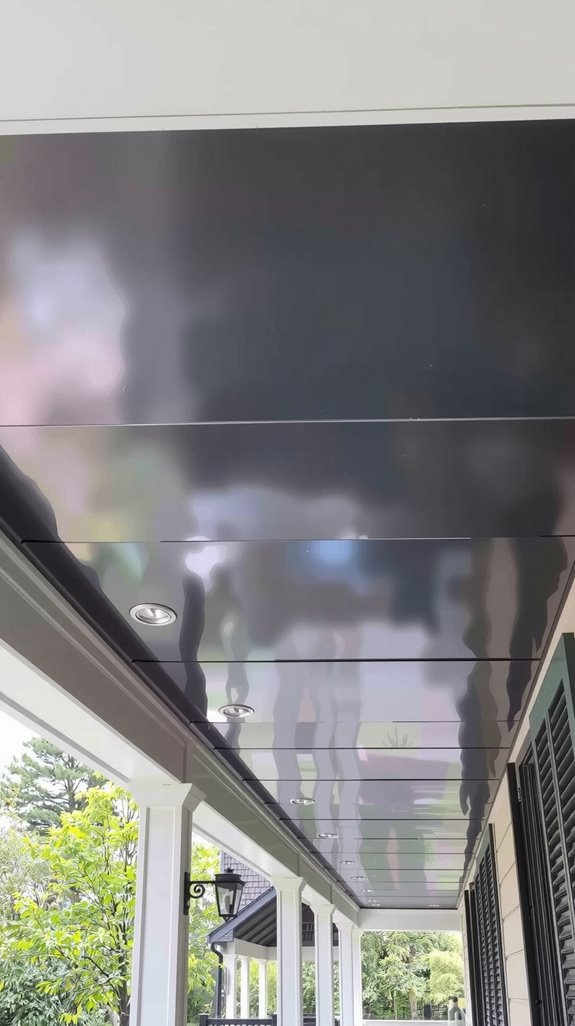
Metal panels are the go-to ceiling material when a porch needs to handle serious weather without apologizing for it.
Aluminum alloys like AA3003-H24 resist corrosion, and a PVDF fluorocarbon topcoat locks out moisture at the pore level. Field studies show coated metal holds above 85% gloss retention after 20 years in tropical conditions.
Wood swells, PVC goes brittle, gypsum dissolves, aluminum just doesn’t care.
You can also perforate panels, back them with Rockwool, and cut reverberation by up to ten decibels.
Concealed suspension grids hide HVAC diffusers, lighting, and sprinklers cleanly and individual panels pop out tool-free when you need access. Prefabricated metal panel systems can reduce site labor by 30% or more compared to stick-built wood installations, eliminating the need for on-site staining and sealing.
SEE THIS: 11 Latest Gypsum Board False Ceiling Design Ideas (Budget to Premium).
Fiber Cement Porch Ceiling for Zero-Fuss Durability
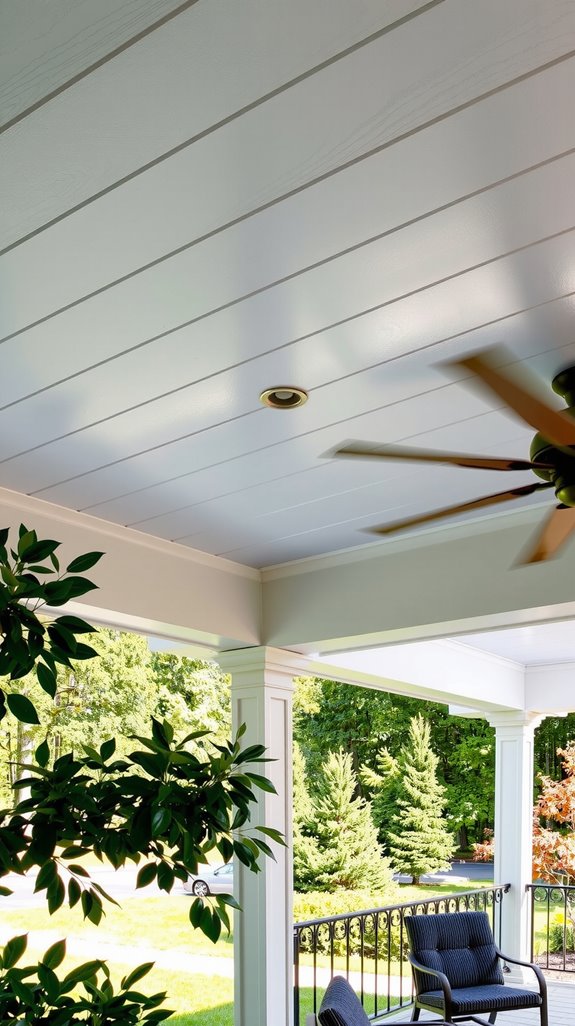
When wood beadboard starts peeling and fiber cement doesn’t, the choice gets simple.
These 4×8 panels replicate the look of real beadboard without the rot, warping, or insect damage that eventually ruins traditional wood ceilings.
They’re fire-resistant, moisture-resistant, and engineered to handle rain, humidity, and wind-driven precipitation without degrading.
The panels arrive factory-primed, so you skip the staining step entirely and paint directly to match your trim, handrails, or architectural details.
A 50-year limited warranty backs the whole thing up.
Less repainting, no warping repairs, no insect damage, just a clean ceiling that holds up without asking much from you. Fiber cement is also affordable and stylish, making it a practical choice that doesn’t force you to trade good looks for long-term durability.
SEE THIS: 10 Farmhouse Style False Ceiling Designs for Kitchen Spaces!
POP Plus-Minus False Ceiling for a 3D Porch Effect
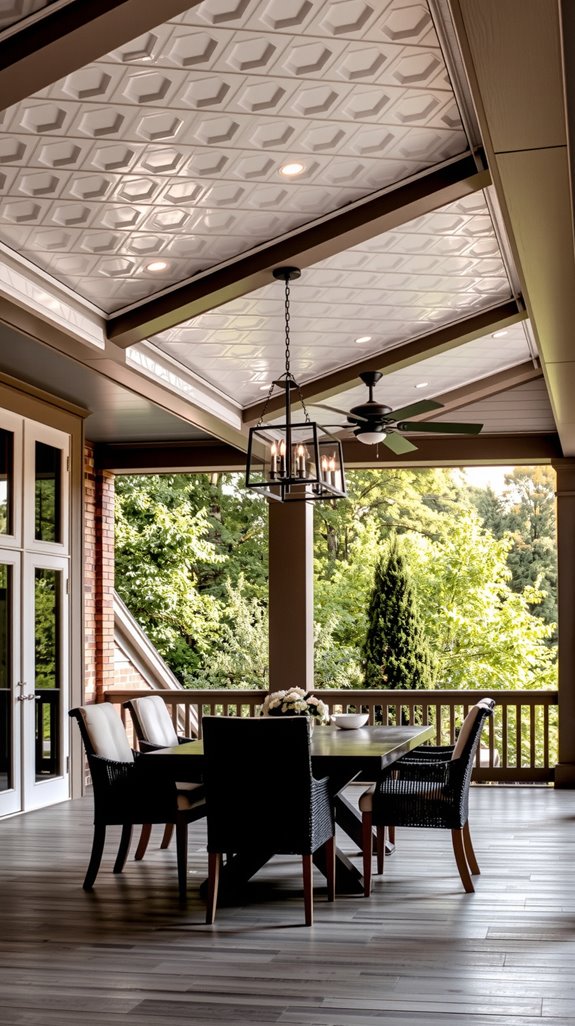
Fiber cement keeps things simple and maintenance-free, but it won’t give your porch ceiling any visual drama.
POP, short for Plaster of Paris, fixes that. It’s a lightweight gypsum-based powder that sets fast and carves into almost any shape. The plus-minus design alternates raised and recessed sections, and the resulting highlights and shadows create genuine depth.
Tuck LED strips into those recessed grooves, and the effect doubles after dark.
POP costs roughly 25-40% less than gypsum board, lasts 10-15 years with repainting every 3-5 years, and handles porch humidity fine with a waterproof topcoat. If you ever run into issues during your project research or sourcing phase, note that suspicious activity blocks can temporarily interrupt access to supplier or design platforms, so keep your reference details handy.
SEE THIS: 13 False Ceiling Designs for Office Cabin (Clean & Professional Look)!
Coffered Gypsum False Ceiling for a Traditional Porch Look
Coffered ceilings divide a flat porch ceiling into a structured grid of raised beams and recessed panels, turning a plain surface into something that looks deliberately designed.
Moisture-resistant green board gypsum handles outdoor humidity without warping or growing mildew. You can paint the recessed panels haint blue, a traditional coastal color, while keeping the beams white or dark gray for contrast.
Coffer depth is adjustable using furring strips, so you control whether the grid reads as subtle or dramatic.
Route wiring through the cavity above, then mount flush LED downlights inside each panel for clean uncluttered illumination.
SEE THIS: 10 CNC Cut False Ceiling Designs That Add Pattern & Detail!
Gypsum Board With Wooden Beams for a Rustic-Modern Porch
Pairing smooth gypsum board with exposed wooden beams gives you that rustic-modern look, farmhouse warmth from the wood, clean contemporary lines from the gypsum.
White or light beige gypsum reflects natural light, making your porch feel bigger. Dark-stained cedar or redwood beams add depth without overpowering the space.
Skip standard drywall, use moisture-resistant green board or cement board instead, then seal it with elastomeric exterior paint.
For lighting, recess LED downlights flush into the gypsum between beams.
Want lower maintenance? PVC faux beams mimic real wood grain while handling humidity and UV exposure without ever needing refinishing.
Tongue and Groove Wood Ceiling for a Cottage Porch
Tongue and groove, T&G for short, boards that lock edge-to-edge with a protruding tongue fitting into a milled groove, is the classic choice for cottage porch ceilings because it installs fast, hides fasteners, and looks like it’s always belonged there.
Western red cedar and cypress resist rot and insects without any help from chemicals. Knotty pine costs less and ages into a warm golden tone.
Run the boards perpendicular to your house wall and a shallow eight-foot porch suddenly reads deeper.
Finish with haint blue, crisp white, or a clear UV sealer; bare cedar grays fast without one.
Faux Exposed Beam False Ceiling for Farmhouse and Tropical Porches
Solid timber beams can weigh 10 to 15 pounds per linear foot, which means your porch ceiling joists need serious reinforcement before you ever swing a hammer.
Faux polyurethane beams weigh 1 to 2 pounds per linear foot instead. You mount wood blocks to your joists first, then slip the hollow beam over them. No structural engineer required.
For farmhouse porches, pair dark walnut-stained beams against haint blue ceilings, spacing them 4 to 6 feet apart.
For tropical porches, use bamboo-wrapped faux beams spaced 24 to 36 inches apart, allowing airflow while keeping the resort aesthetic intact.
Beadboard Porch Ceiling in Wood or Vinyl
Beadboard is the go-to porch ceiling material for good reason: it’s affordable, it installs without special skills, and it looks intentional rather than accidental.
Pine tongue-and-groove runs $3,$9 per square foot, while MDF starts at $1. Vinyl, from brands like CertainTeed, costs $2,$5 and never needs painting or scraping.
For installation, face-nail the first board every 12,16 inches using 2-inch finish nails.
Blind-nail every board after that through the tongue. Keep a ¼-inch expansion gap around the perimeter and cover it with lattice trim.
A pneumatic nailer makes the whole job move faster; it’s one of the easiest upgrades you can make to a porch.
Stained Reclaimed Wood Slat Ceiling on a Budget
Reclaimed wood slats cost almost nothing if you know where to look. Pallets from local businesses, Facebook Marketplace, and Craigslist are often free for the taking. Salvage yards sell old barn wood for a fraction of new hardwood prices.
If you’re buying new, white furring strips in 1×2 or 1×4 sizes keep a 16-foot wall project under $400.
Before installation, stain and seal all six sides of every board using a semi-transparent exterior stain like Special Walnut, then follow with spar urethane. Skipping that step causes warping.
A spare board works perfectly as a 1.5-inch spacing guide between slats.
Shou Sugi Ban Charred Wood Porch Ceiling for Dramatic Style
Burning wood on purpose sounds like a mistake, but shou sugi ban (show-soo-gee-bahn) is a Japanese technique where you char the surface of boards to make them tougher, not weaker.
The carbonized layer repels moisture, blocks UV, and resists rot and insects without any chemical treatment. Traditional Japanese cedar structures built this way have lasted over 100 years.
For your porch ceiling, use western larch or sugi boards, brush off loose soot after charring, and finish with linseed oil.
Always use stainless steel fasteners; standard steel corrodes against char and leaves rust streaks across your dramatic new ceiling.
Steel Mesh False Ceiling for an Industrial Porch Look
If you want a porch ceiling that looks like it belongs in a converted warehouse, steel mesh is your material. Expanded metal mesh, a single sheet that’s been slit and stretched, installs onto a sub-frame of steel angle iron anchored to your existing joists.
Standard panels run 4′ x 8′, so fitting a typical porch is straightforward. A powder-coated matte black finish handles weather and nails the industrial look simultaneously.
Bonus: rain passes straight through, birds can’t nest above it, and you’ve got a hidden plenum for running speaker wire. It’s functional in ways a drywall ceiling simply isn’t.
Conclusion
Your porch ceiling isnt exactly the thing people lose sleep over, until it warps, stains, or sags after one rainy season. Funny how that works. You’ve got eight solid options now, from ½-inch PVC panels to steel mesh and charred shou sugi ban wood. Pick what fits your climate, budget, and how much maintenance you actually enjoy doing. The right ceiling mostly just stays up and looks good doing it.