Most people assume a false ceiling is just drywall slapped overhead to hide ugly pipes.
It’s not that simple. The ceiling you choose for your office cabin directly affects how clients perceive you, how sound travels, and even how large the room feels.
Thirteen specific designs actually solve different cabin problems, from tight budgets to awkward dimensions. Stick around because a few of these options will genuinely suprise you.
Gypsum Board False Ceilings for a Clean, Layered Cabin Look
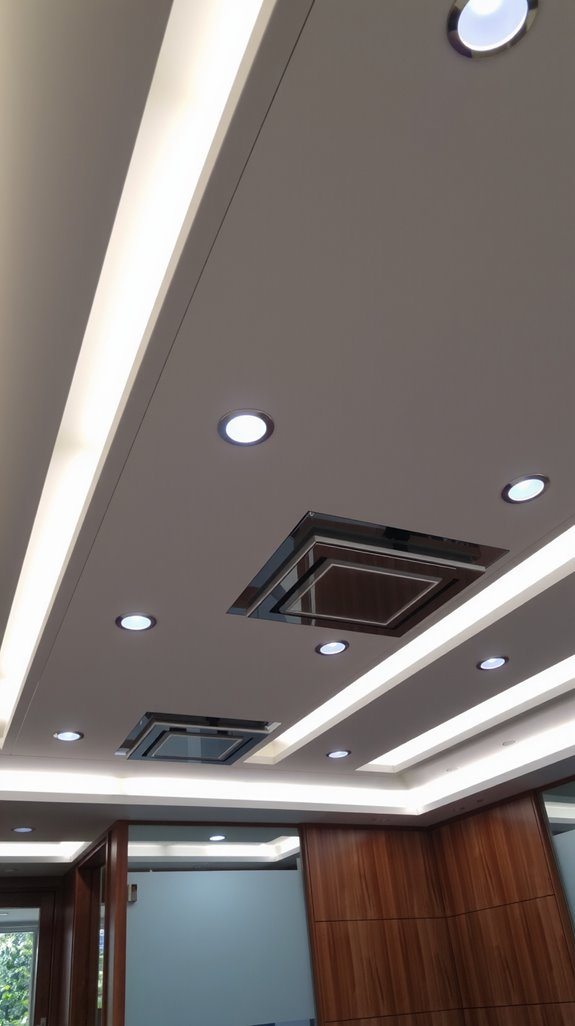
When you’re fitting out a small office cabin, gypsum board false ceilings do most of the heavy lifting without actually being heavy. The boards are lightweight and flexible so you don’t need heavy structural support to install them.
They accept paint evenly, which means your corporate colors look crisp rather than blotchy. Moisture-resistant variants won’t sag or grow mold in air-conditioned spaces.
For the look itself, try a tray ceiling with a recessed central panel, a slim shadow gap between planes. That combination adds depth while keeping every line sharp and clean. Gypsum can also be cut and molded into unique shapes, giving your cabin a more dramatic and distinctive aesthetic.
POP False Ceiling Designs That Look Detailed Without Overwhelming the Room
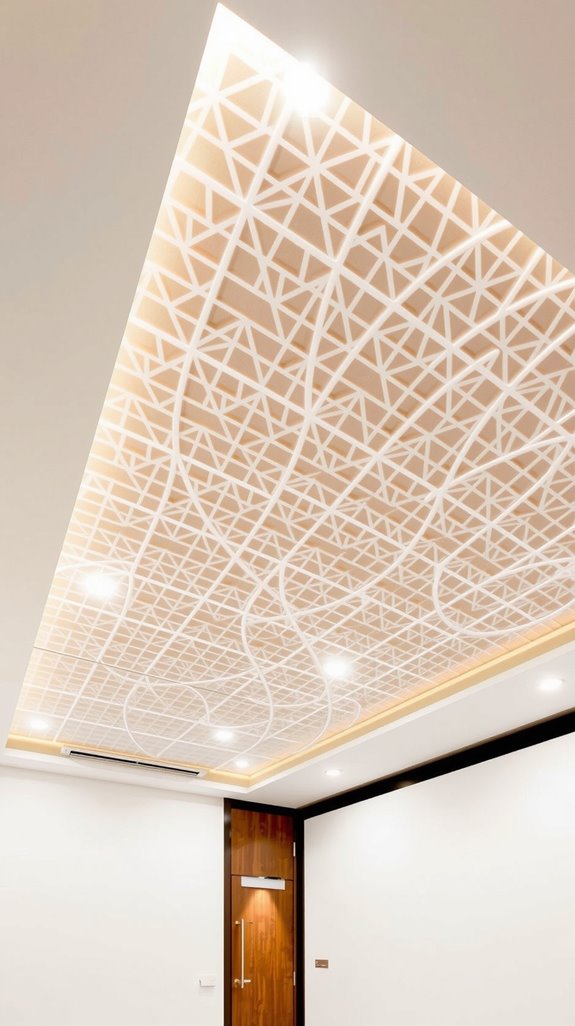
Gypsum board gets you clean lines fast, but if you want actual shape built into the ceiling, POP is your material. Plaster of Paris is gypsum mixed with water, its moldable while wet, meaning you can build curves, grooves, and tray layers directly on-site without cutting prefab panels to fit awkwardly.
For a cabin, keep it to two or three tray tiers, shallow recesses, and a perimeter cove hiding LED strips.
That floating light effect does more visual work than any carving. Paint it all one matte white tone, and the detail reads as refined, not restless. POP can also be shaped into honeycomb and geometric designs that add visual interest without overwhelming the proportions of a cabin space.
SEE THIS: 14 Modern False Ceiling Designs Inspiration for Office Spaces!
PVC Panel False Ceilings for Budget-Conscious Office Cabins
PVC panels cost between INR 80 and INR 85 per square foot for materials alone, which already puts them in a different budget category than gypsum or wood.
Add framework and installation, and you’re still looking at INR 120 to INR 180 per square foot total, that’s a real number you can plan around.
They’re also 100% waterproof, so condensation from your air conditioning unit won’t warp or sag the ceiling over time.
Perforated variants with acoustic backing hit sound absorption coefficients of 0.70, keeping cabin conversations from bleeding into the open floor outside. PVC false ceilings also support customizable designs that can be tailored to match the aesthetic direction of your office cabin without inflating the overall project cost.
SEE THIS: Latest False Ceiling Designs for Bedroom (Cozy + Modern Styles)!
Wooden Beam False Ceilings That Give Cabins an Executive Feel
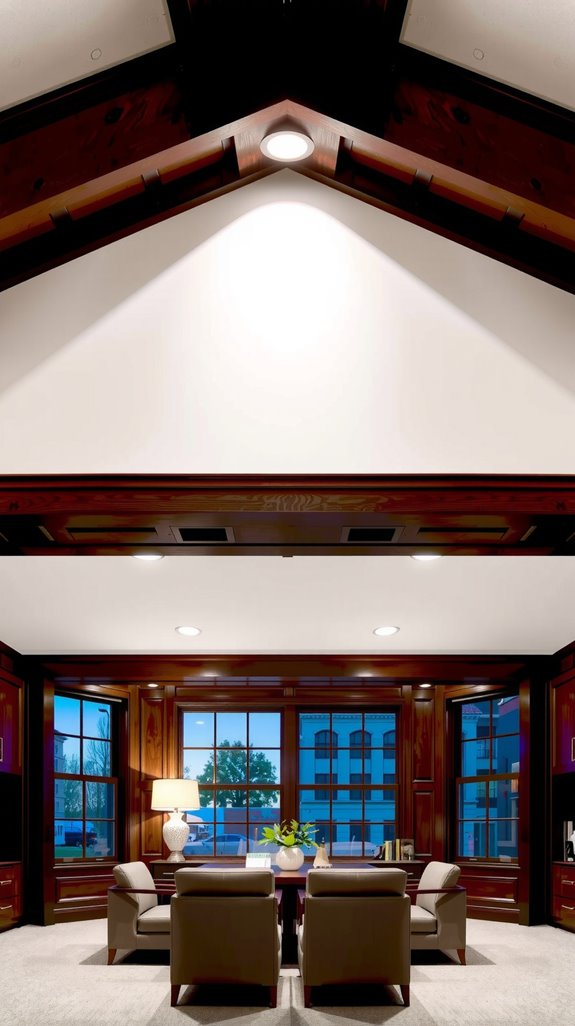
Budget ceilings do the job, but if your cabin needs to signal authority the moment someone walks in, wood beams are a different conversation entirely.
You don’t need actual solid timber. High-density polyurethane faux beams are hollow, lightweight, and hide your wiring inside them cleanly. Finishes like Espresso Brown or Old Tuscan add rustic weight without the structural headache.
Pair recessed LEDs along the beam edges and you get depth, not drama. Wood also absorbs sound naturally so your conversations stay in the room.
It’s one ceiling doing four jobs: aesthetics, acoustics, insulation, and cable management. For meeting rooms, a criss-cross grid pattern using beams like Old Barn in Espresso Brown adds visual interest while keeping the space looking cohesive and intentional.
MORE IDEAS: 28 Latest False Ceiling Designs That Make Every Room Look Custom-Built (Living Room, Bedroom, Kitchen & More).
Metal Tile False Ceilings for a Sleek, Modern Office Cabin
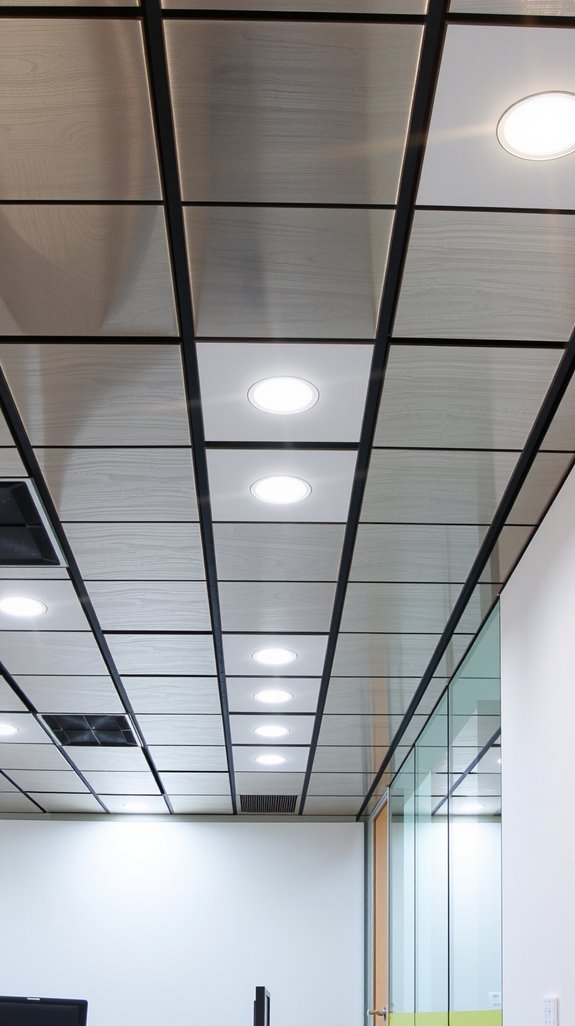
Metal tiles give you five things at once: a finish that looks expensive, built-in acoustics, fire resistance, lighting integration, and almost zero maintenance.
Choose brushed aluminum, anodized bronze, or matte black powder coating depending on your cabin’s tone. Coffered layouts with recessed panels push the aesthetic closer to boardroom than breakroom.
Pair the tiles with Rockwool acoustic backing. A 10,20% perforation ratio hits NRC values that actually reduce reverberation, not just look like they do.
Pre-engineered openings align with recessed LEDs, air diffusers, and sprinkler heads. Mirror-finish options visually expand cabins under 2.7 m. Wipe occasionally. Done.
Metal ceiling tiles are frequently made from recycled materials, making them a sustainable choice that aligns with green building standards without compromising on performance.
SEE THIS: 11 False Ceiling Designs With Hidden Lighting for a Luxury Look!
Tray False Ceiling Designs That Zone Your Cabin Without Walls
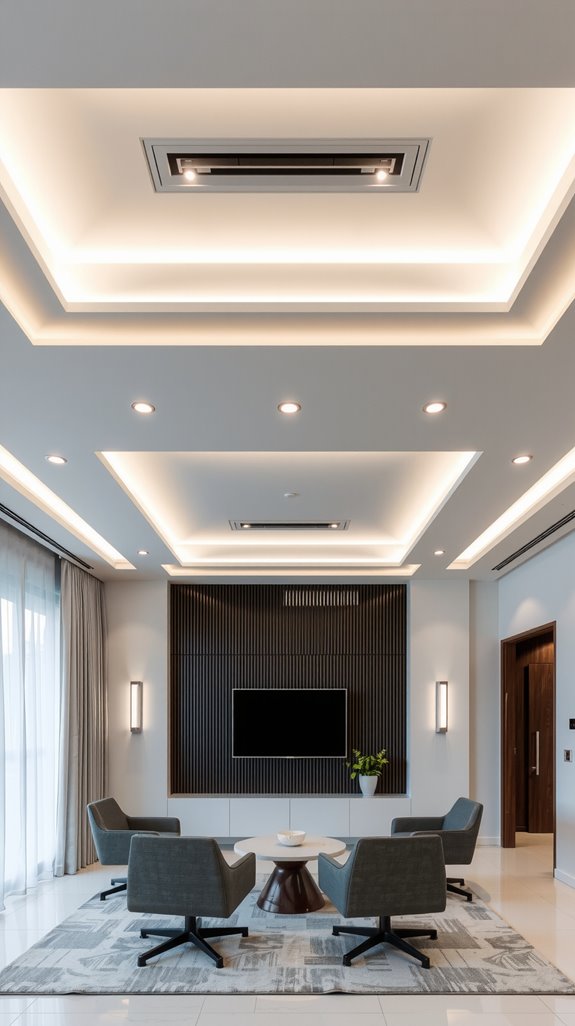
Tiles and panels handle surfaces well, but they don’t tell your brain where one work zone ends and another begins. A tray ceiling does exactly that. You recess the center panel 4,12 inches, and suddenly your desk cluster has its own defined territory, no walls required.
Line that recess with acoustic felt or perforated gypsum to hit an NRC of 0.70, cutting echo noticeably. Hide linear LEDs along the tray step for a floating effect.
Use wood veneer on the tray base for executive warmth or dark-painted interiors for a sharper, modern boundary; the choice depends entirely on the tone you’re going for. Same room, smarter layout.
Cove Lighting False Ceilings That Create a Focused Cabin Atmosphere
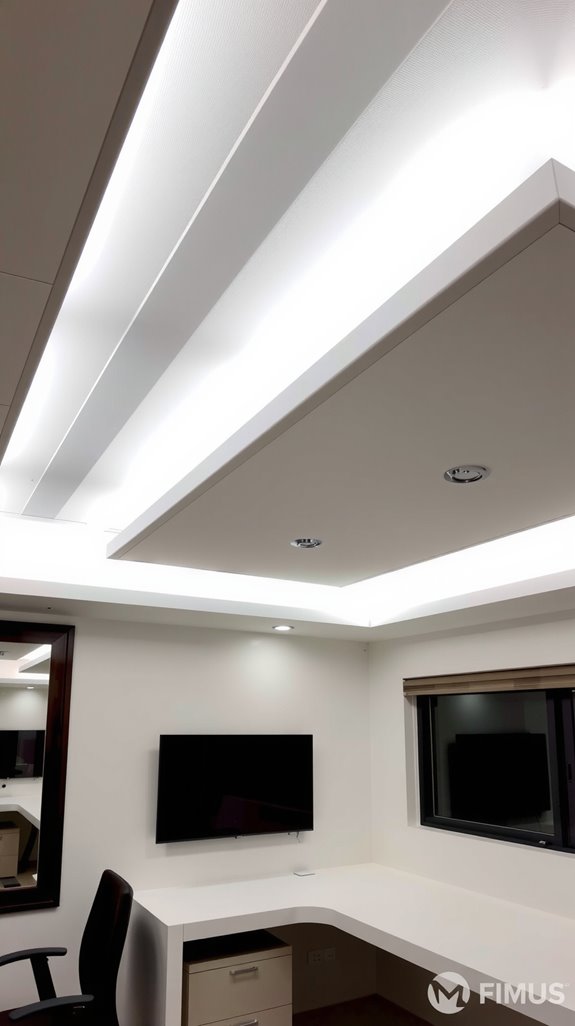
Where tray ceilings define zones, cove lighting defines mood. A cove ceiling hides LED strips inside a recessed ledge, bouncing light off your walls and ceiling instead of blasting it into your eyes.
No glare, no harsh shadows, just even, calm illumination that actually helps you think.
Tunable white LEDs let you dial between 4000K for sharp focus and 2700K when the day winds down. Aluminum extruded channels dissipate heat cleanly.
Add acoustic lining inside the soffit cavity and you’ll drop ambient noise by 3.5 dB. Less noise, better light, your cabin does more without looking like it’s trying.
Recessed LED False Ceilings That Keep Your Cabin Calm and Focused
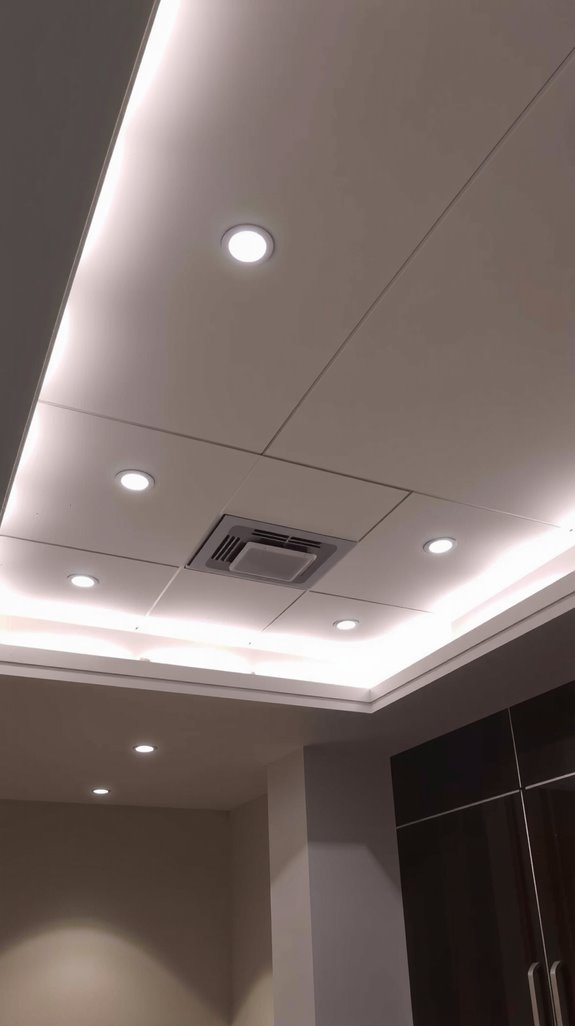
Recessed LEDs sit flush with your false ceiling, meaning there’s nothing hanging down to catch your eye mid-thought. No dangling pendants, no exposed bulbs, just a clean, uninterrupted plane overhead.
Most housings run 10, 15 mm slim, so shallow plenums aren’t a problem. Space them every 0.8, 1.2 m for even coverage across a standard 2.7 m ceiling.
Aim for 4000K, 5000K color temperature; that range keeps you alert without frying your eyes. Add dimming controls and you’ve got a “focus” preset ready without touching a single visible switch.
Stable, flicker-free output means fewer headaches, literally.
Acoustic False Ceilings for Cabins Near Noisy Open Offices
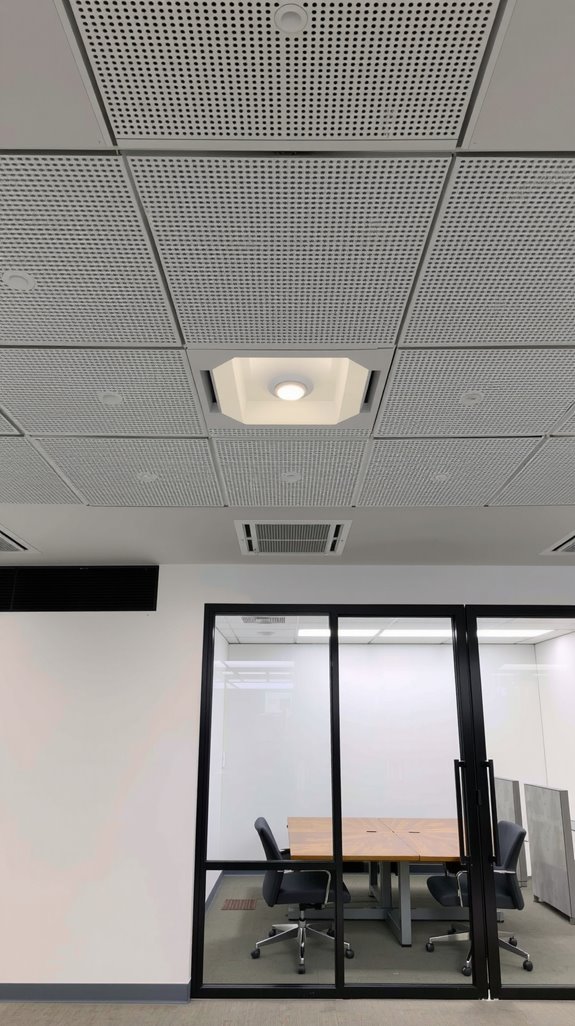
If your cabin sits next to an open office, sound is already your biggest problem.
Mineral fiber tiles like Zentia’s Obsidian, rated at 0.95 αw, absorb broad-frequency noise before it reaches you. That number means 95% of sound energy gets absorbed, not bounced back.
Full wall-to-wall coverage matters most. Gaps around downlights and air vents undo everything, so use acoustic-rated backboxes on every recessed fitting.
Pair your ceiling with solid-core doors and full-height partitions. The ceiling handles flanking paths through the plenum, but it can’t work alone.
Every component earns its place.
Gypsum and Wood Hybrid Ceilings That Balance Polish With Character
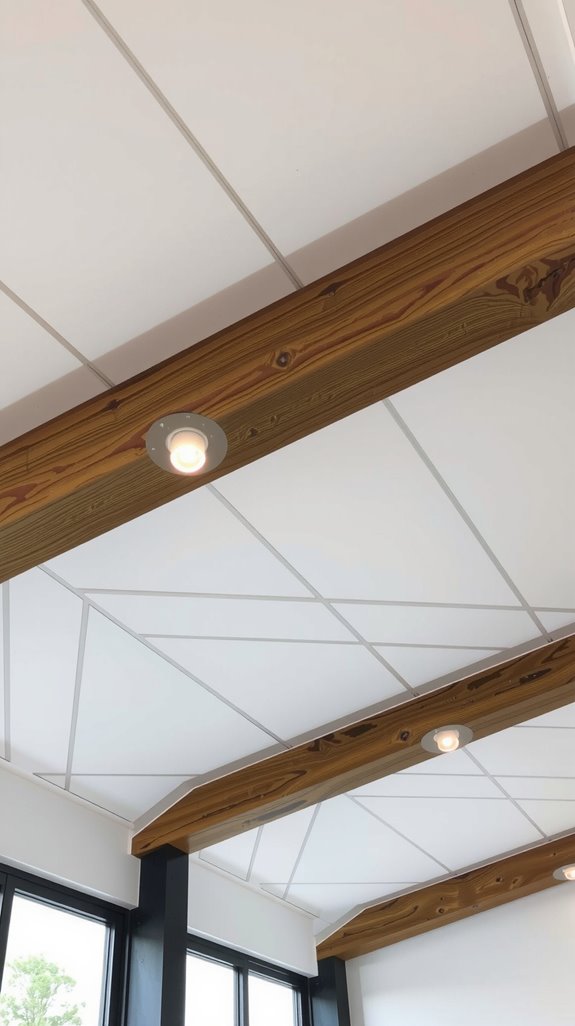
Two materials doing opposite jobs is the cleanest way to describe a gypsum and wood hybrid ceiling. Gypsum handles the clean, smooth backdrop while wood brings texture and warmth. Together, they prevent your cabin from looking like a hospital room or a log cabin. You get both.
The wood layer, whether solid planks, veneer, or laminate battens, also absorbs sound and acts as a thermal insulator between the original ceiling and the false one. That means less echo and a cooler room without touching the HVAC settings.
Add hidden LED strips between both layers and you’ve got depth, not just a ceiling.
Minimalist False Ceiling Styles for Professional Office Cabins
Minimalist false ceilings follow 3 core rules: clean lines, hidden infrastructure, and nothing on that surface that doesn’t earn its place.
You’re looking at smooth gypsum board with a level 5 finish, meaning zero texture, zero shadows, zero excuses. HVAC vents, wiring, and lighting all disappear behind it.
For lighting, use trimless flush-mount LEDs so there’s no visible rim breaking the plane.
Perimeter cove lighting at 3000K to 3500K adds a soft ambient glow without harsh shadows.
Add two subtle parallel grooves to introduce order, thats your design.
Don’t add anything else.
False Ceiling Materials Ranked by Cabin Budget
Budget decides material. About $0.96 per sq. ft., PVC panels and basic POP designs handle most cabin needs without drama.
PVC resists moisture and termites at around $0.60–$1.02 per sq. ft. installed. POP runs about $0.72–$1.20 per sq. ft., but it needs skilled labor, or you may see cracks within a year.
Mid-range budgets of about $1.20–$2.99 per sq. ft. open up moisture-resistant gypsum board and wooden veneer panels starting around $1.80 per sq. ft.
Both look intentional rather than accidental. You’re paying for longevity not just aesthetics.
Choosing the Right False Ceiling for Your Cabin’s Dimensions
Cabin dimensions, height and floor area together, decide which false ceiling design actually works and which one just makes the room feel like a storage closet.
If your cabin sits between 9 and 10 feet tall, stick with a single-layer gypsum ceiling. Go taller than 11 feet, and tray or multi-layer designs actually make sense.
Under 100 square feet keep it plain; a 1-foot by 1-foot grid panel handles lighting without crowding the eye.
Mid-size cabins between 100 and 200 square feet handle a central geometric pattern well.
Bigger executive spaces above 250 square feet can split ceiling levels to zone the desk, meeting, and lounge areas cleanly.