A CNC router can cut up to 1,000 intricate patterns per hour, which explains why false ceilings have gone from plain plaster to seriously detailed overhead art.
You’ve got more material options than you think, MDF, PVC, wood, and glass all behave differently under the blade.
The right choice depends on your room, your budget, and honestly, how much drama you want above your head. Stick around because the differences matter more than most designers admit.
MDF, PVC, Wood, or Glass: Which CNC Ceiling Material Is Right for You?
When it comes to CNC false ceilings, the material you pick matters more than the pattern.
MDF is the go-to for painted interiors; it’s smooth, affordable, and cuts cleanly into geometric or floral jali designs. Skip it in bathrooms, though; it swells.
PVC handles moisture well and installs faster, but it looks exactly like what it is, plastic.
Solid wood costs more and adds real warmth and grain. Glass brings light transmission no other material can match.
Match the material to the room’s conditions first, then worry about which pattern looks good. Choosing the wrong material can lead to warping, cracking, or higher maintenance costs down the line.
How Much Does a CNC False Ceiling Actually Cost?
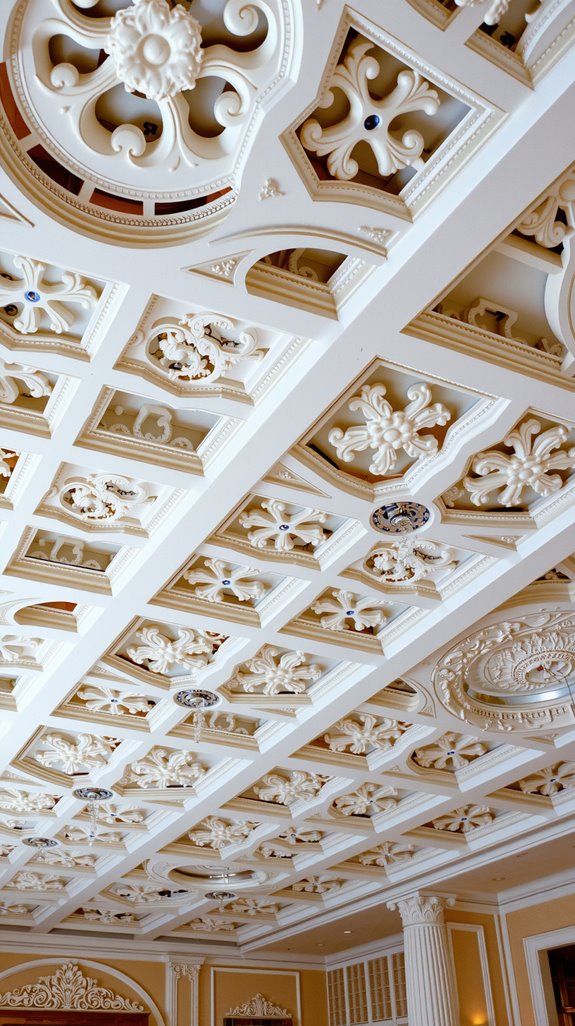
Costs for CNC false ceilings span a wider range than most people expect.
PVC panels start around $0.48–$0.72 per sq. ft., while glass designs can hit $7.19 per sq. ft. MDF, the most common choice, runs about $1.44–$2.40 per sq. ft. for materials alone.
Add labor at about $0.42–$0.96 per sq. ft., depending on your city. Bigger city rates can run 20–30% higher than smaller cities.
A 200-square-foot living room with MDF CNC coverage typically costs around $359–$719 total, and intricate jali patterns can add another 20–40%, so simple designs save real money.
SEE THIS: 11 Latest Gypsum Board False Ceiling Design Ideas (Budget to Premium).
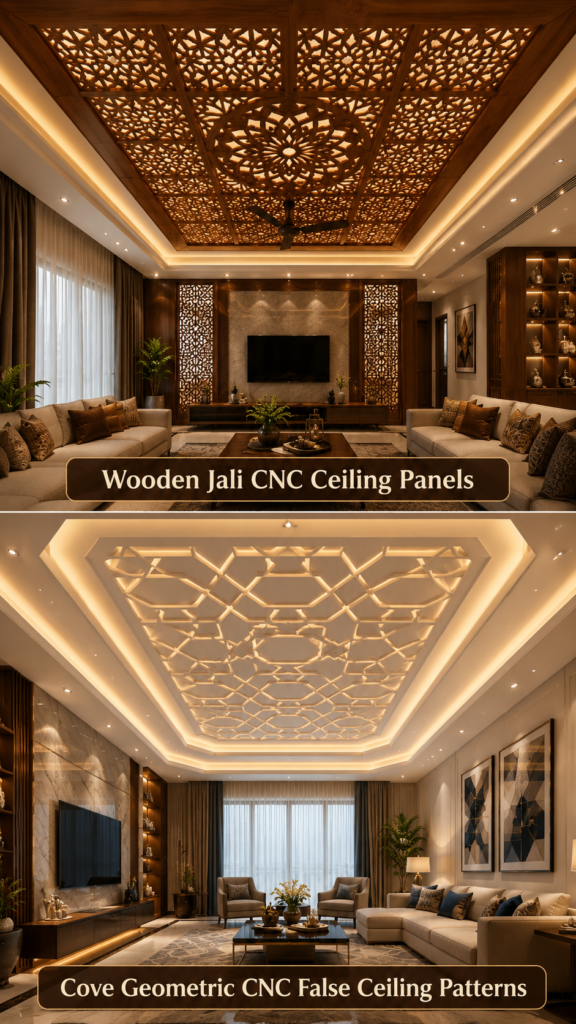
Wooden Jali CNC Ceiling Panels That Give Any Room a Regal Look
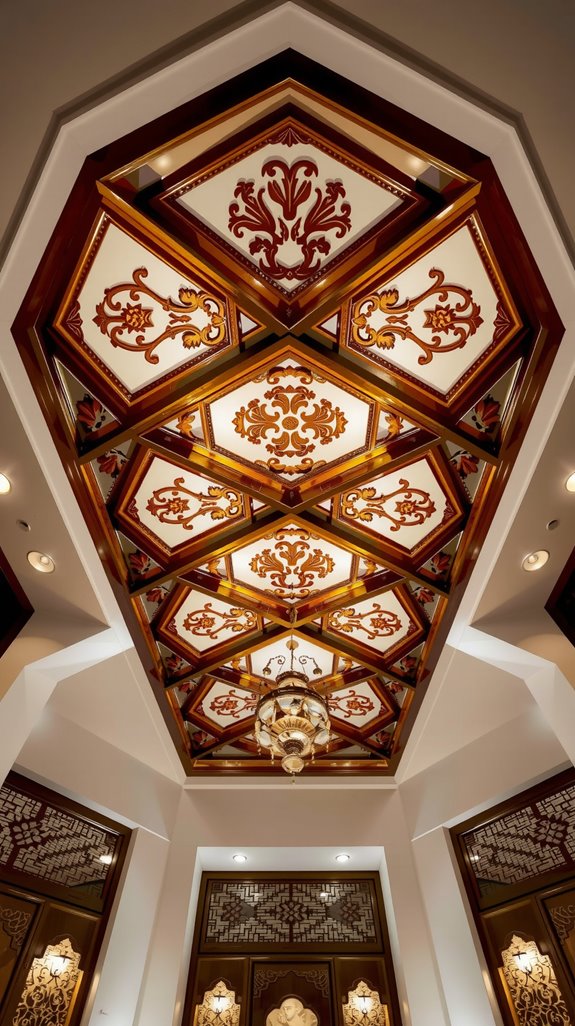
Once you’ve sorted the budget, it’s worth knowing where most of that money actually goes, and wooden jali panels are often the answer.
These CNC-cut lattice panels pull from Mughal-era Mashrabiya screens, reworked for modern false ceilings. Most use MDF instead of solid wood, cheaper, easier to cut, and honestly just as sharp-looking.
A dark brown stain polish gives you the traditional feel. White CNC patterns on glass backed by rich brown wood create a clean antique contrast.
Center the panel, drop a chandelier through it, and the ceiling does all the work. MDF boards can also be shaped into full 3D ceiling panels when you want to push the design further.
MORE IDEAS: 28 Latest False Ceiling Designs That Make Every Room Look Custom-Built (Living Room, Bedroom, Kitchen & More).
Geometric CNC False Ceiling Patterns for Modern and Minimalist Interiors
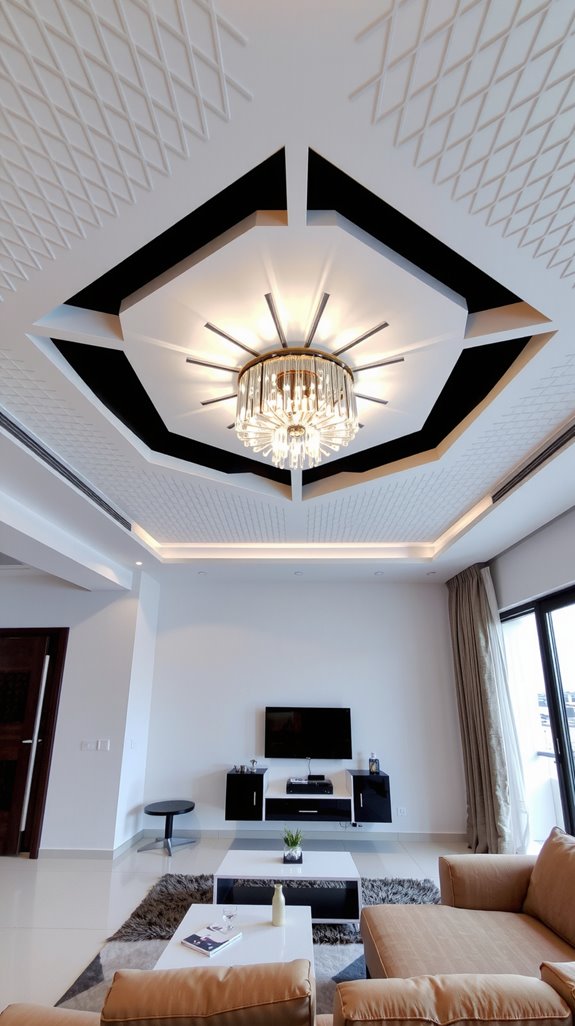
Geometric CNC ceiling patterns are exactly what they sound like, repetitive shapes like hexagons, triangles, and chevrons cut by a computer-controlled router with tolerances as tight as ±0.1mm.
That precision means your joint lines stay seamless across an entire ceiling span without visible gaps or misalignment.
You can choose matte white MDF for a clean, shadow-free finish or birch plywood with clear matte lacquer if you want subtle warmth.
Drop recessed LED strips into the geometric channels and you’ll visually push the ceiling higher.
For square rooms, hexagonal tessellation works especially well because it avoids pulling your eye in any single direction. In 2026, false ceiling costs typically range from about $1.44 to $2.99 per sq. ft., though premium finishes and layered designs can push that higher.
SEE THIS: 10 Farmhouse Style False Ceiling Designs for Kitchen Spaces!
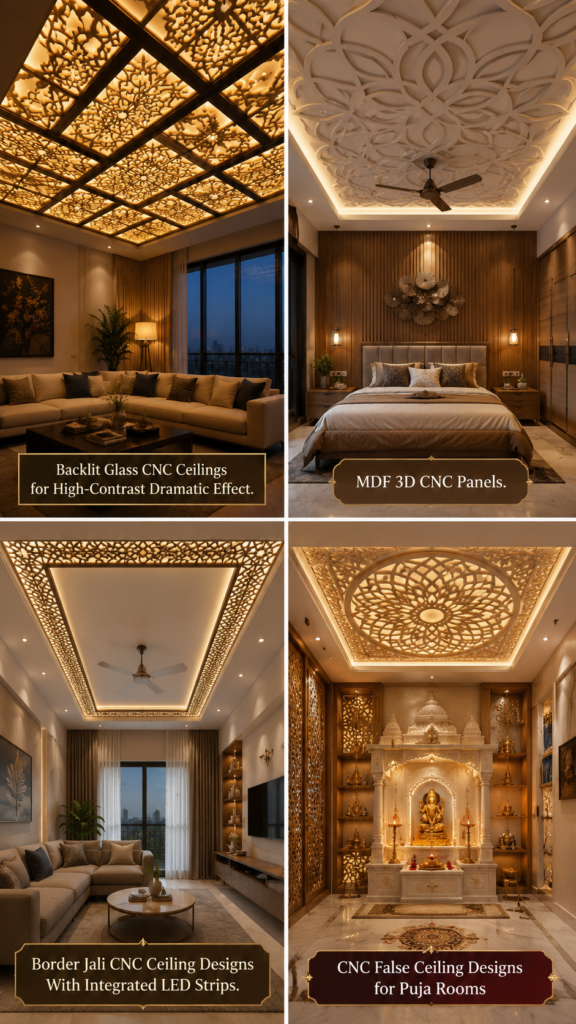
Backlit Glass CNC Ceilings for High-Contrast Dramatic Effect
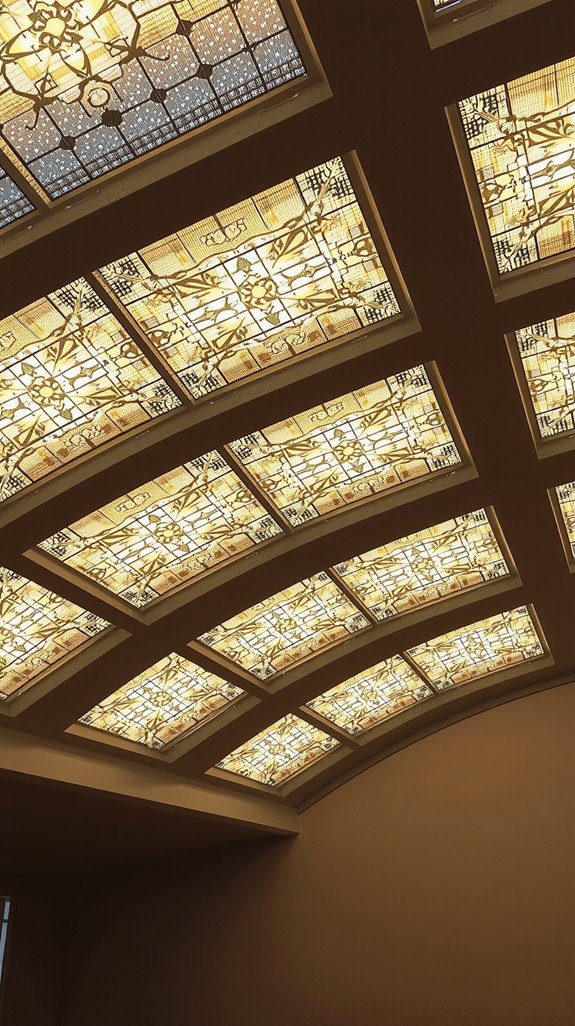
Solid MDF and plywood patterns are sharp, but if you want a ceiling that actually glows, backlit glass takes that idea somewhere else entirely.
You’ll need tempered or laminated glass for safety, and low-iron glass specifically, because standard glass has a green tint that ruins your LED colors.
Keep a void of 100 to 150 millimeters between the slab and glass so light disperses evenly.
Frosted glass eliminates hotspots by diffusing the LEDs into one clean wash.
Pair that with tunable white LEDs shifting from 2700K to 6500K and you’re controlling the room’s entire mood from one dimmer. For living areas, we recommends targeting 150 to 300 lux, a threshold backlit ceiling features can meaningfully contribute to without additional lamp sources.
SEE THIS: 13 False Ceiling Designs for Office Cabin (Clean & Professional Look)!
MDF 3D CNC Panels That Add Real Depth to Ceilings
MDF panels take the flat ceiling problem and carve it away, literally. CNC routers cut precise three-dimensional relief patterns, think Ravello, directly into 3/4-inch MDF boards.
The depth isn’t faked with texture paint. It’s real geometry, repeated exactly across 48-by-96-inch panels. You can paint them any color on-site, since MDF accepts most paints well with primer.
Just remember they’re dense, so your framing needs to handle the load. Let them acclimate 48 hours before install.
The result reads as architecture, not decoration, which is a meaningful distinction when you’re staring at a ceiling.
SEE THIS: 12 False Ceiling Designs With Mirror Elements (Reflective & Luxurious)!
Border Jali CNC Ceiling Designs With Integrated LED Strips
Where a plain ceiling ends, a border jali begins. This CNC-cut perimeter frame runs 18 to 24 inches wide along the ceiling edge, leaving the center clean for a chandelier or pendant light.
Behind the jali sits a 2 to 3 inch cove hiding LED strips on aluminum profiles. The aluminum acts as a heat sink, so chips don’t overheat and create dark spots.
A diffused acrylic sheet between the LEDs and the cutouts spreads light evenly.
Choose 4000K cool white for sharp geometric patterns. Go 2700K warm white for florals; the light does the talking.
CNC False Ceiling Ideas for Living Rooms vs. Bedrooms
Once you’ve sorted out your border jali and LED strip placement, the next question is whether that thinking even applies to every room. It doesn’t.
Living rooms need bold, expansive CNC patterns that anchor large seating layouts, often as full-ceiling MDF coverage finished in high-gloss Duco paint.
Bedrooms work differently. A single CNC panel sized to your bed dimensions, say 6×6 feet, creates a cozy overhead zone without overwhelming the room.
Swap dramatic cove lighting for LED strips tucked inside jali voids producing soft shadow play instead of direct glare. Same technique, completely different intention.
CNC False Ceiling Designs for Puja Rooms: Motifs and Placement Tips
Puja rooms are the one space where your ceiling design actually carries symbolic weight, not just aesthetic value. A CNC-cut lotus, Om, or mandala in MDF or teak isn’t just decoration; it marks the sacred zone directly above your deity.
Center the panel above the main idol for maximum visual impact. Backlit acrylic panels with LED strips create a soft, diffused glow without harsh shadows.
Avoid oversized motifs in compact mandirs; a fitted CNC panel inside the niche works better. Keep the finish matte or warm gold; glossy surfaces catch light awkwardly during evening rituals.
PVC CNC Ceiling Designs Built for Kitchens and Bathrooms
Kitchens and bathrooms are basically hostile environments for most ceiling materials. Humidity, grease, and temperature swings make short work of gypsum and MDF.
PVC, a synthetic plastic, is 100% waterproof and non-porous, so mold and mildew don’t get a foothold. CNC routing cuts it to 0.1 mm precision, meaning your Jali or lattice pattern stays sharp and symmetrical across every panel.
You can also integrate ventilation grilles directly into the design, hiding ductwork above. Just keep PVC panels away from stove flues; anything past 60°C warps them fast.