Your mandir’s ceiling is doing more work than you think. It sets the mood before a single prayer starts.
The right false ceiling, whether it’s carved POP (Plaster of Paris), warm teak panels, or backlit gypsum board, can turn a corner of your home into something that actually feels sacred.
Each material has trade-offs worth knowing and the details ahead will change how you look at that blank overhead space.

Classic POP Mandir False Ceiling Designs With Carved Motifs
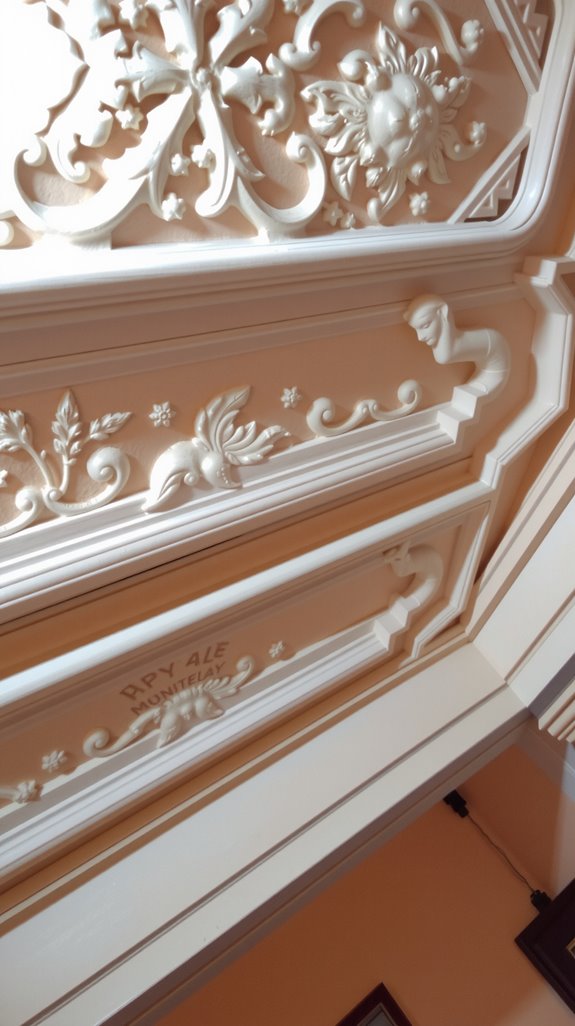
When it comes to mandir ceilings, Plaster of Paris, or POP, is the go-to material because you can carve it into almost anything while it’s still wet.
Lotus flowers, layered petals, Om symbols, and mandala patterns are carved directly into the surface or pressed using pre-cast molds. You’ll also see jaali patterns borrowed straight from temple architecture.
For central medallions, star-shaped radial designs work well especially if you’re mounting a pendant light underneath.
Creeper and vine motifs in shallow relief add detail without crowding the space. It’s ornate without turning your prayer room into a museum exhibit. Some classic POP designs also feature a double tier flower pattern with cove lighting to elevate the overall ambiance of the space.
SEE THIS: Latest False Ceiling Designs for Bedroom (Cozy + Modern Styles)!
Wooden Panel Mandir Ceiling With Etched Spiritual Symbols
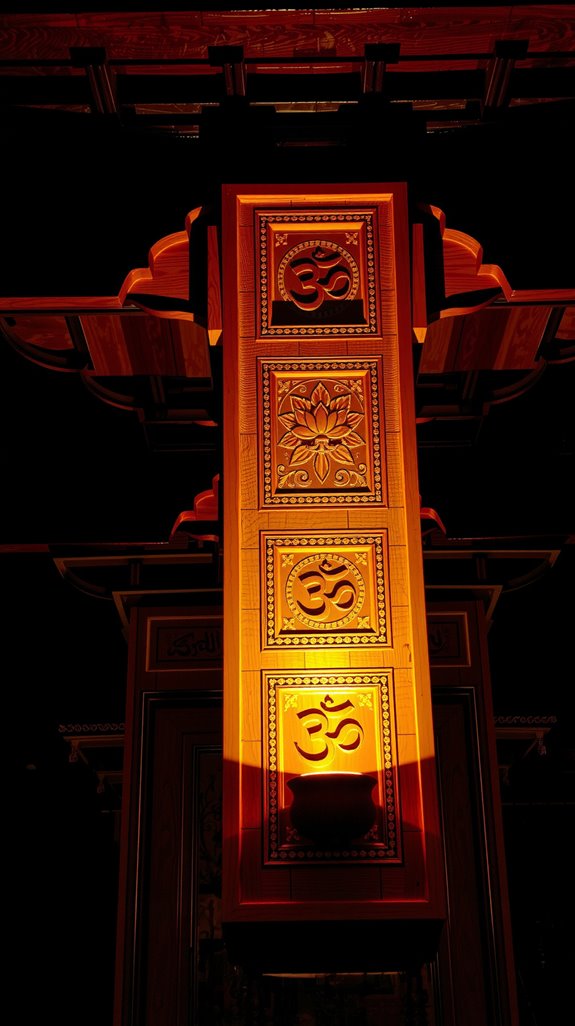
Wood brings something POP cant fake, warmth. Solid walnut or mahogany panels give your mandir ceiling that temple-like heaviness that painted plaster just won’t.
CNC routing, basically a computer-guided carving machine, lets craftsmen etch Om symbols, lotus patterns, or Trishul motifs with sharp, repeatable precision across every panel.
Backlit panels do the heavy lifting atmospherically. Warm LED strips tucked behind etched cutouts create a soft halo around the symbols. Dimmable controls let you shift from bright puja lighting to something quieter.
Fire-retardant coating and occasional polishing keep the wood looking intentional, not neglected. Custom pooja units can come with a warranty up to 10 years covering both materials and craftsmanship, so that finish stays protected long after installation.
SEE THIS: 10 Latest False Ceiling Designs for Hall with 2 Fans (Balanced Layout Ideas That Actually Work!
PVC Panel False Ceiling for Small Pooja Rooms
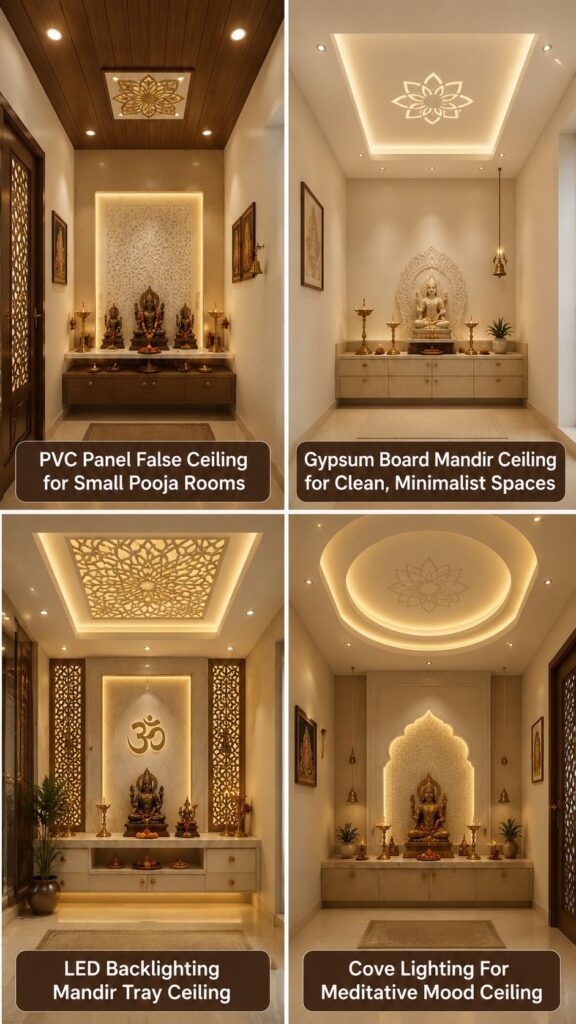
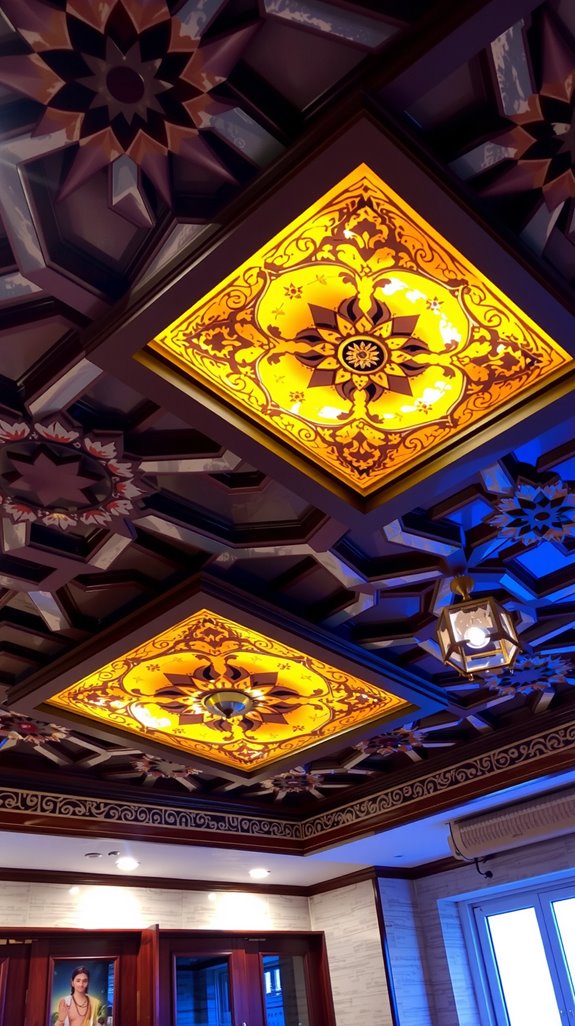
PVC, short for polyvinyl chloride, is basically plastic sheeting that moonlights as a ceiling material, and it handles small pooja rooms better than most people expect.
It’s lightweight, waterproof, and laughs at incense humidity. Plain sheets start at about $0.12–$0.24 per sq. ft., while wood-finish panels run around $0.30–$0.54 per sq. ft.
A shallow 3,5 inch ceiling drop keeps headroom intact. You can tuck LED strips, exhaust ducts, and wiring inside the hollow panels without visible clutter, and there are no complicated installation steps that require a specialist.
Skip high-heat lamps though; PVC warps under direct heat, which nobody wants near their deity shelf. For better ritual ambiance, pair your PVC ceiling with dimmable LED strips that let you control light intensity during prayers without harsh glare overhead.
MORE IDEAS: 28 Latest False Ceiling Designs That Make Every Room Look Custom-Built (Living Room, Bedroom, Kitchen & More).
Gypsum Board Mandir Ceiling for Clean, Minimalist Spaces
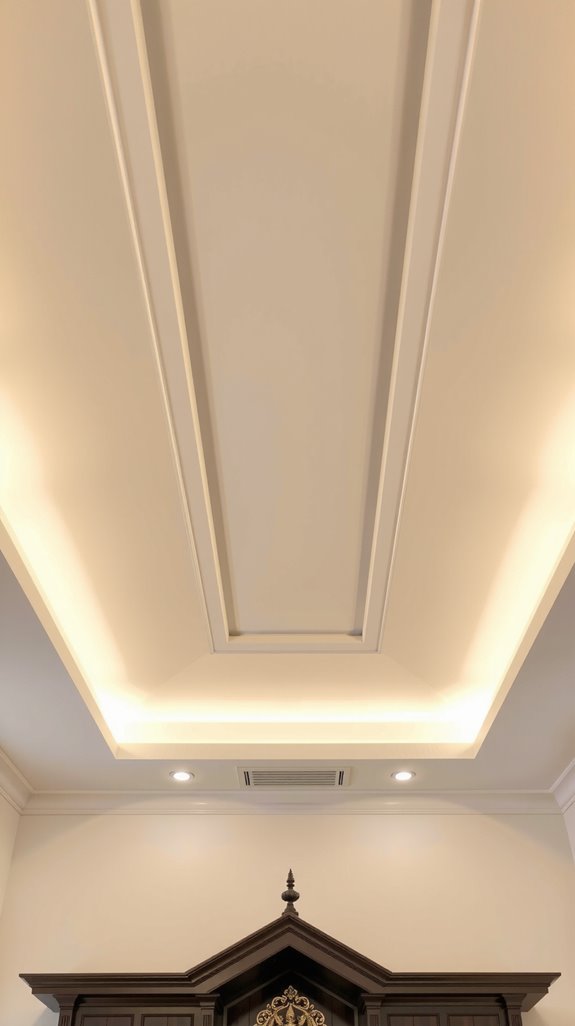
Gypsum board is basically compressed calcium sulfate pressed into flat panels, and it swaps PVC’s plasticky finish for something that feels genuinely architectural.
It’s lightweight, fire-resistant, and joints disappear under taping compound, giving you a smooth, monolithic surface.
For a pooja room, a 3-to-5-inch tray drop keeps the ceiling from feeling low. Recess a COB downlight directly above the idol, then run 2700 K LED strips along the tray perimeter for a soft halo.
A narrow 1.5-inch slot with a black baffle hides the exhaust fan, making it virtually invisible from below.
Total false ceiling work usually runs about $0.90–$1.44 per sq. ft. Gypsum board is also faster to execute than POP, making it a practical choice when you need the pooja room ready without extended construction timelines.
SEE THIS: 11 False Ceiling Designs With Hidden Lighting for a Luxury Look!
Why a Marble-Finish Pooja Room Ceiling Feels Instantly Divine
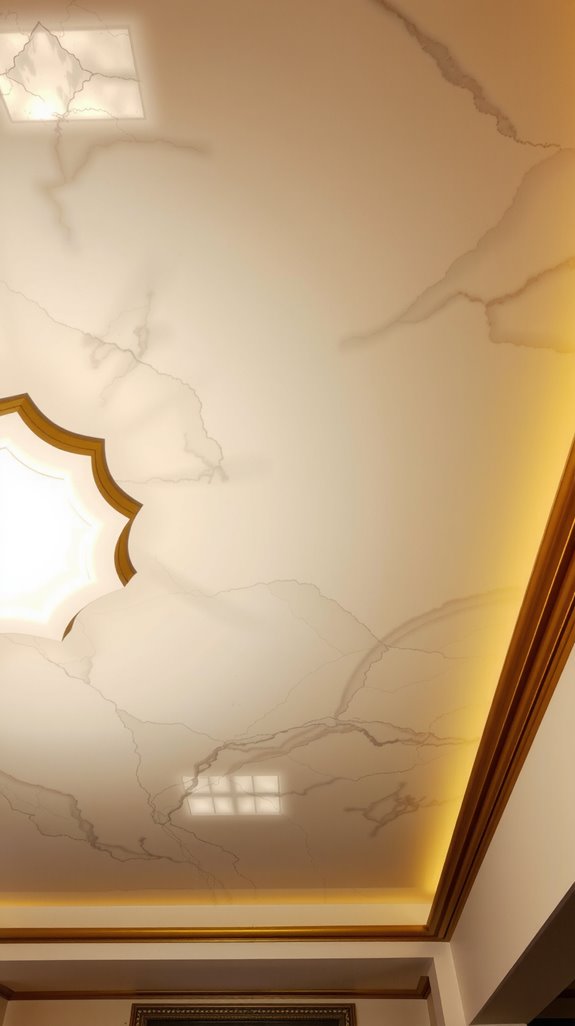
Few ceiling materials carry as much symbolic weight as marble, and that’s not just poetic license, it’s 3,000 years of temple architecture doing the heavy lifting.
White marble’s thermal mass keeps it naturally cool, so prolonged prayer sessions stay comfortable without cranking the AC. Polished surfaces scatter light softly, eliminating harsh shadows that flat gypsum can’t avoid.
Laser-cut marble panels let you etch Om, lotus, or Kalash motifs with surgical precision, and pairing them with recessed LED strips creates a backlit, almost floating effect.
White marble also ticks every Vaastu box because apparently divine approval matters too. For a more layered look, concealed LED strips can further highlight surface textures and sacred carvings, reinforcing the sanctity of the space.
SEE THIS: 13 LED Strip False Ceiling Designs That Create Ambient Lighting Layers!
How Concealed LED Backlighting Transforms a Mandir Tray Ceiling
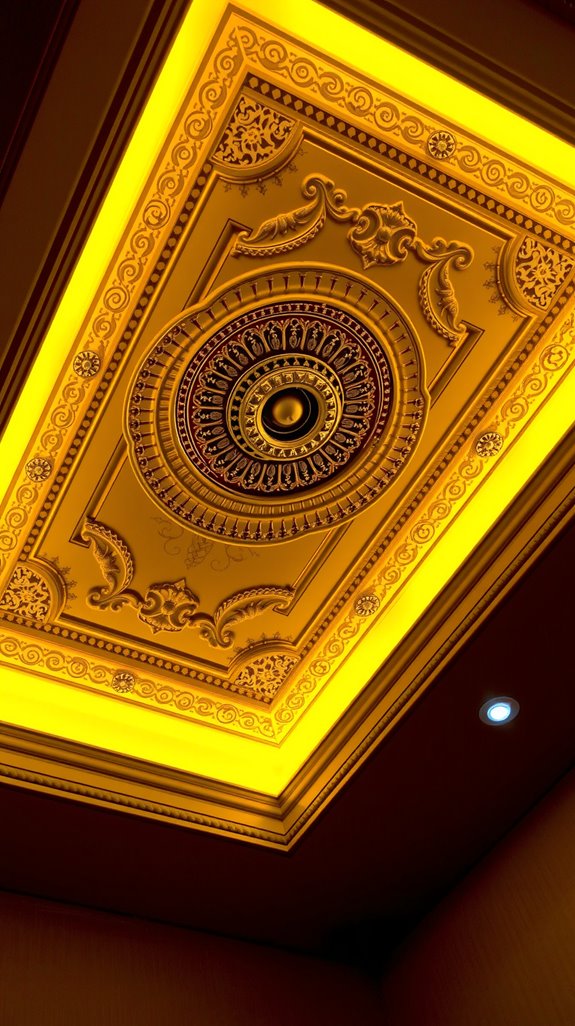
Tuck an LED strip behind a tray ceiling’s recessed lip, and the light it throws is indirect, meaning it bounces off the ceiling plane before it reaches your eyes, so there are zero harsh shadows cutting across the idol.
Illuminance at idol level lands between 150-250 lux, enough clarity without turning your brass deity into a disco ball.
Use 2700 K warm-white LEDs with a CRI above 90, and gold idols, fresh marigolds, and silk textiles all render in accurate, vibrant color. Dimmable drivers let you drop to soft meditation light or bump up to 300 lux for scripture reading.
SEE THIS: 10 False Ceiling Designs for Puja Room (Calm + Spiritual Vibes)!
Create a Meditative Mood With Cove Lighting in Your Pooja Room Ceiling
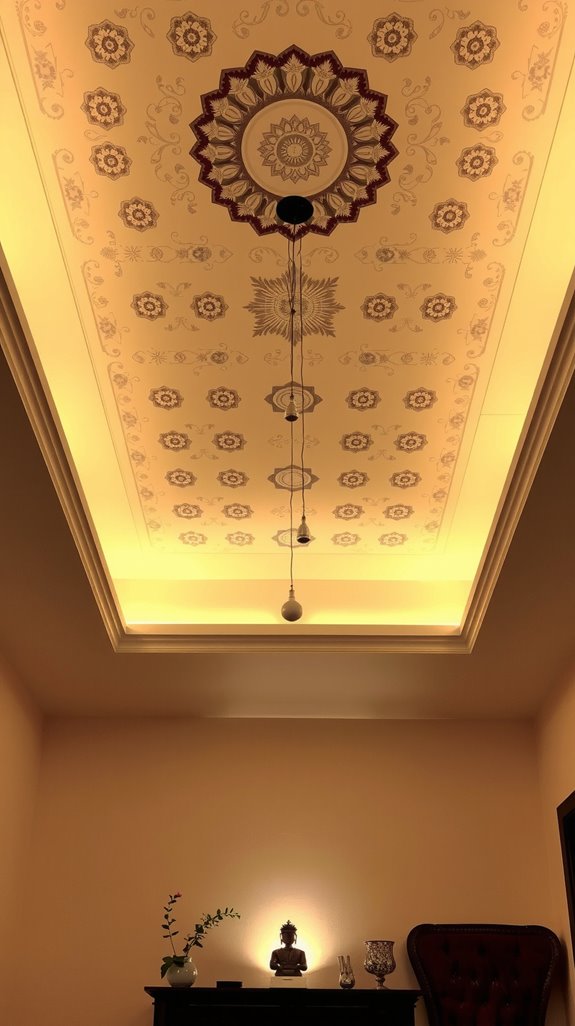
While a tray ceiling puts the LED strip right behind a recessed lip, a cove takes a slightly different approach. It hides the light source inside a ledge, dropped soffit, or shallow channel built along the perimeter of the ceiling or directly above the altar.
The light bounces off the ceiling instead of hitting your eyes directly. In an 8-ft room, a 2.3 inch drop does the job without making anyone duck.
Aim for 2200K, 3000K at 150, 250 lux on the idol surface. That range keeps the space calm without turning your pooja room into a cave.
Backlit Om and Mandala Focal Points for Your Mandir False Ceiling
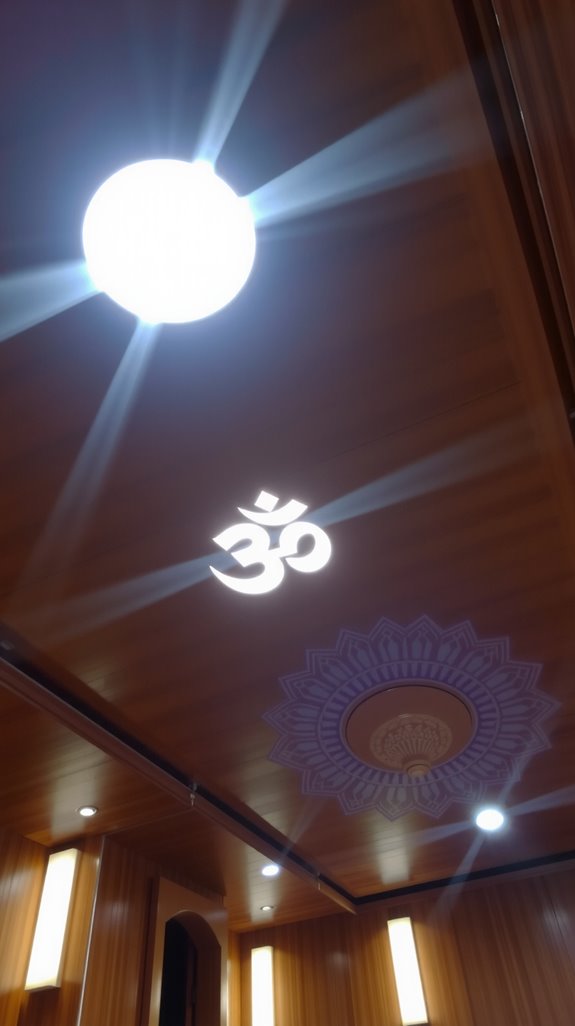
A backlit Om or mandala cut into your false ceiling does something a plain surface never can; it gives your eyes a destination.
Position it directly above your altar, centered in a tray ceiling between 8 and 10 feet high. Use gypsum board or MDF with CNC-routed cutwork, then back it with warm white LED strips at 2700K to 3000K.
A frosted opal acrylic diffuser sheet between the LEDs and the panel eliminates hot spots. Add a dimmable driver so you can lower the brightness during evening aarti without fumbling for excuses about the lighting being “atmospheric.”
Skylight-Inspired Pooja Room Ceiling With Frosted Glass Cutwork
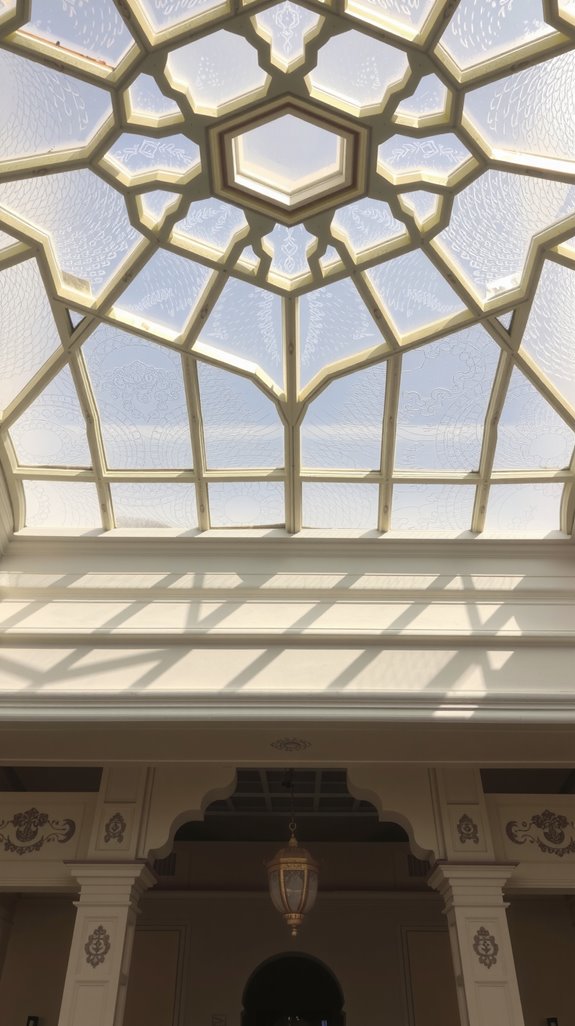
If you’ve ever sat in a dimly lit pooja room wishing it felt less like a closet and more like a temple courtyard, a skylight-inspired false ceiling is the fix.
You recess a tray into moisture-resistant POP, mount daylight LEDs at 4000K to 5000K above it, then seal 4mm to 6mm frosted toughened glass below.
Between the structural ceiling and false ceiling, you need 6 to 8 inches of cavity for even light spread.
Drop a laser-cut MDF or acrylic panel beneath the glass featuring lotus, jali, or Om patterns, and those motifs cast crisp shadows directly onto your mandir walls.
Layered Tray Mandir Ceiling Designs With Golden Accent Lighting
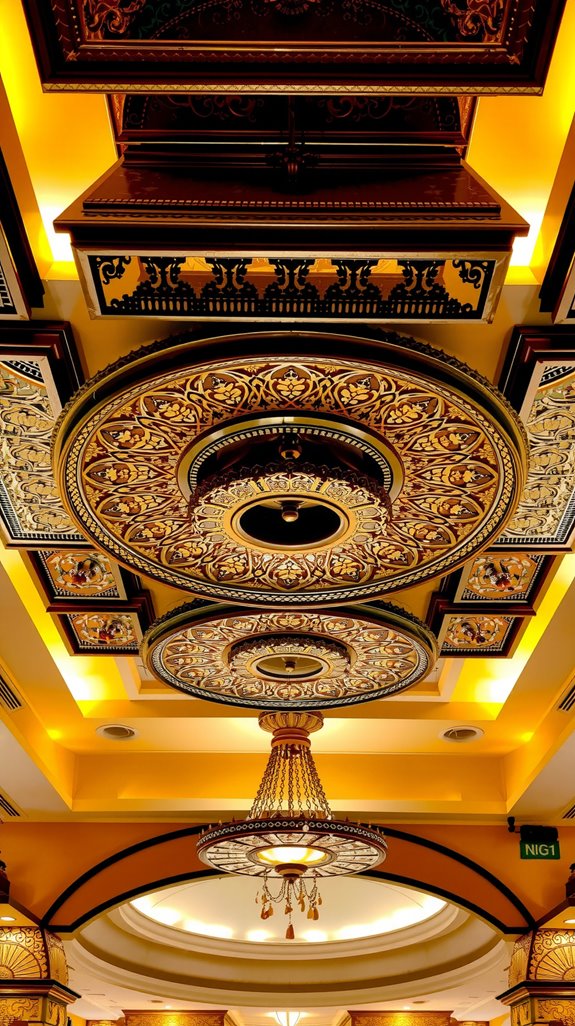
Tray ceilings work by recessing a central panel into the main ceiling plane, creating stepped levels that frame your altar like a crown.
Each descending border hides wiring, AC vents, and ducts inside the steps. Use moisture-resistant gypsum board, which runs roughly $12-$25 per square foot, to handle incense smoke and humidity without sagging.
Tuck 2700K,3000K warm LED strips into the recessed ledges for a soft halo that looks intentional, not installed.
Add a gold-anodized cove profile on the step edges to sharpen reflections. A 15,25° adjustable spotlight aimed at your idol completes the layered effect cleanly.
How to Combine Wood, POP, and Marble in One Mandir Ceiling
Combining wood, POP, and marble in one mandir ceiling sounds ambitious until you realize each material has a specific job.
POP handles the tray layers and curved edges. Wood adds warmth through CNC-cut panels or rafters inlaid into the POP frame. Marble, usually a circular medallion or laser-cut jaali, sits at the center above the idol.
You’ll need concealed metal framing inside the POP to carry the marble’s weight. Silicone adhesive handles the expansion gaps between materials.
Cool white POP, medium-teak wood, and Makrana marble together build a visual hierarchy without a single drop of paint.