Working from home sounds great until your bedroom becomes a disaster zone of laptops, chargers, and coffee cups. You dont need a separate room to fix this.
With around 25 to 50 square feet of smart planning, you can create a workspace that doesn’t make your bedroom feel like a cubicle.
Fourteen specific ideas follow, ranging from a $79 IKEA fold-down desk to a custom bay window build-out, each solving a different small-space problem.
Key Takeaways
- Tuck a desk into a corner or alcove to save floor space while maximizing available surface area without crowding the room.
- Use a wall-mounted fold-down desk to reclaim floor space instantly when the workspace is not in use.
- Add a ceiling-mounted curtain or folding screen to visually separate the work zone from the sleeping area.
- Convert an underutilized closet into a hidden office using a floating desktop requiring at least 24 inches of depth.
- Use an area rug and an accent wall to visually define the workspace without consuming additional physical space.
Tuck Your Bedroom Office Desk Into a Corner to Save Floor Space
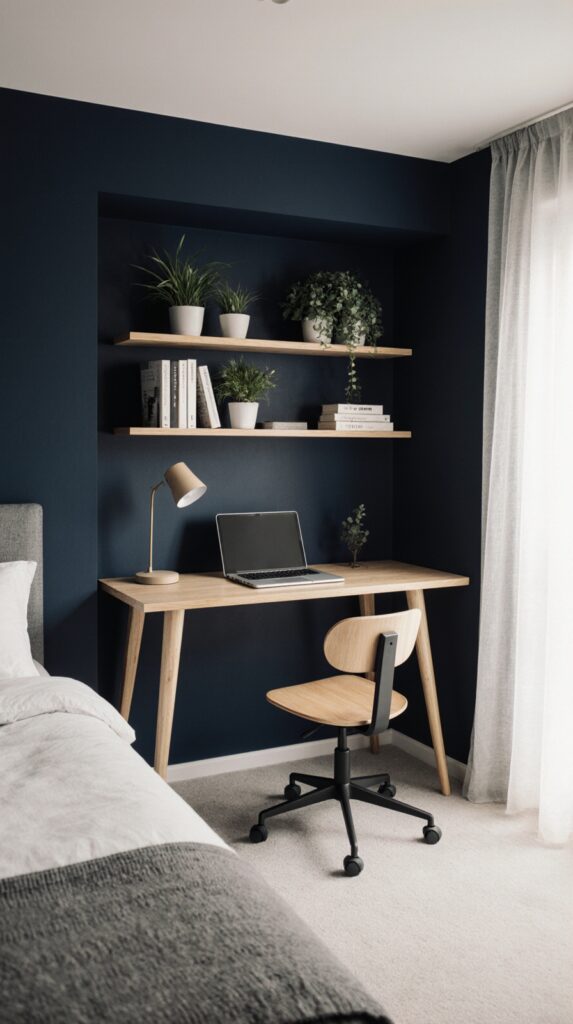
Tucking your desk into a corner is one of the simplest ways to reclaim floor space in a small bedroom.
An L-shaped corner desk gives you more continuous surface area than a straight desk of similar size, without pushing further into the room. That matters when you’re working with 10 by 10 feet or less.
More surface area, same footprint—an L-shaped desk earns its place in a small room.
Corner placement keeps the central floor open for your bed and walking path, which cuts down on that suffocating, furniture-everywhere feeling.
It’s not a design trick—it’s just using the edges your room already has instead of ignoring them. Corners and alcoves are often overlooked, but creative repurposing of these areas can carve out a focused, effective workspace without consuming the limited square footage you actually need.
Place Your Desk by the Window for Natural Light
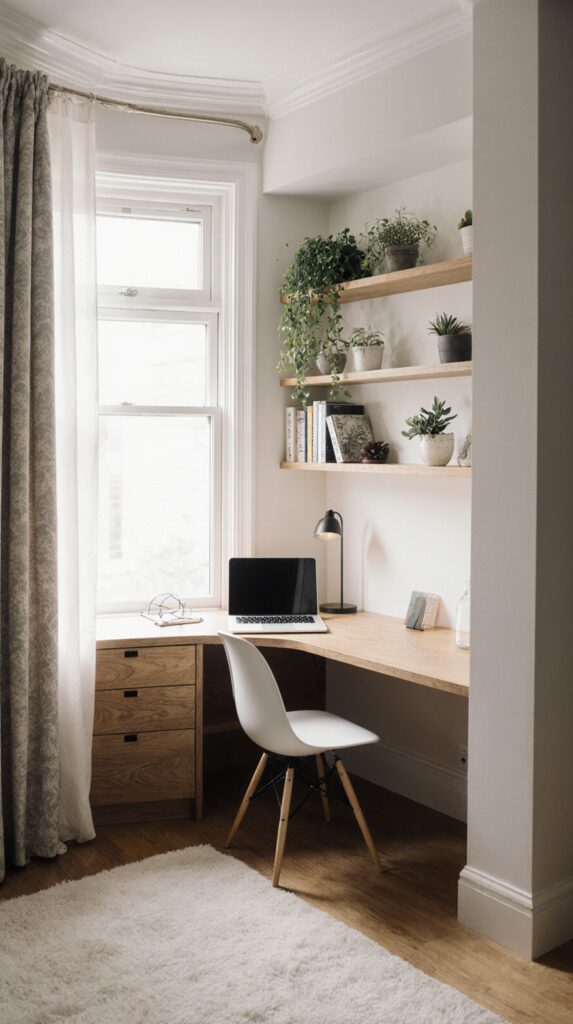
Once you’ve claimed your corner, look at what’s right next to it—your window.
Positioning your desk beside it boosts illuminance, the total light hitting your work surface, and cuts eye strain fast.
Aim for 500–750 lux during work hours. Don’t face the window directly—side lighting wins every time. For a streamlined look, a floating shelf desk keeps floor space open while staying close to the light source.
| Setup | Benefit | Fix |
|---|---|---|
| Side-lit desk | Reduces glare | Rotate 90° to window |
| Front-facing monitor | Screen reflections | Add roller shade |
| Overhead-only lighting | High contrast shadows | Layer task lamp |
| Window behind screen | Harsh backlighting | Reposition or use sheers |
Build a Desk Into a Bay Window or Alcove
A bay window or alcove gives you three walls and a built-in sense of purpose—it’s practically begging to become a desk.
Keep the desktop between 20–28 inches deep so you’re not cramped and the light still reaches you. Leave 4–8 inches on each side for trim and blinds.
Mount continuous wood cleats into wall studs along the back and sides to float the surface cleanly. Use solid wood or matte laminate—glossy finishes turn sunny windows into interrogation lighting.
Pull your chair back 30 inches and you’ve got a dedicated workspace that costs you zero extra floor space. Keep the desk a few inches from the window frame to allow for airflow and cleaning.
Fit a Compact Desk Between Existing Bedroom Furniture
Everything in your bedroom’s already there—you just need to measure what’s between it.
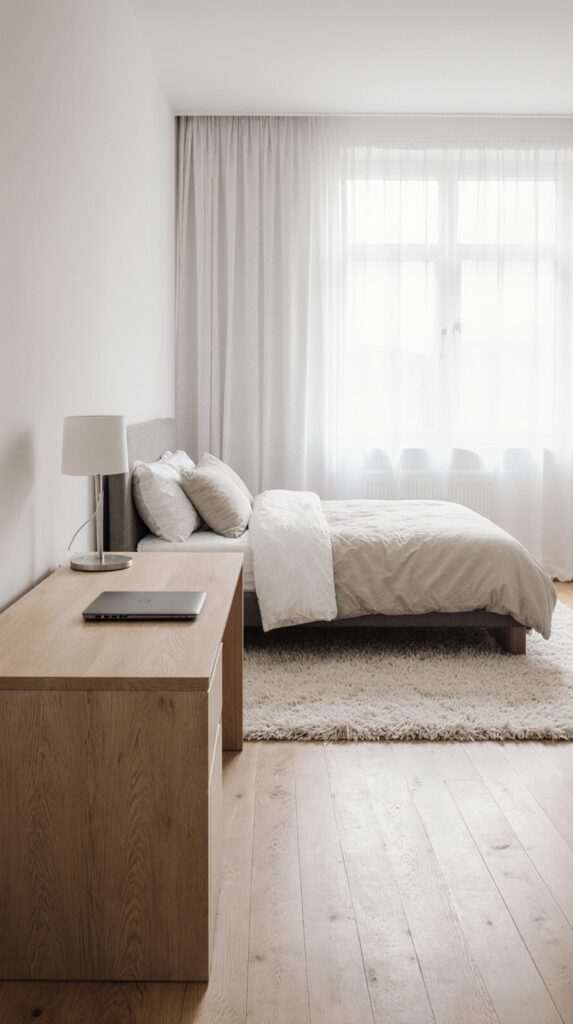
Check the gap between your bed and dresser first. You need at least 24–30 inches for a walkway, so anything wider is fair game for a slim desk, typically 12–18 inches deep.
Floating desks help maintain a minimalist aesthetic while keeping valuable floor space open.
- Pick a narrow writing desk or ladder desk that leans against the wall.
- Use a wall-mounted fold-down desk to reclaim floor space instantly.
- Match desk height to your dresser top for a clean horizontal line.
- Place the desk centrally to keep drawer access clear.
- Tuck your chair fully under when you’re done.
SEE THIS: 12 Boho Earthy Bedroom Ideas for Creative Women Who Love Texture, Plants, and Personality!
Add a Room Divider to Separate Sleep and Work Zones
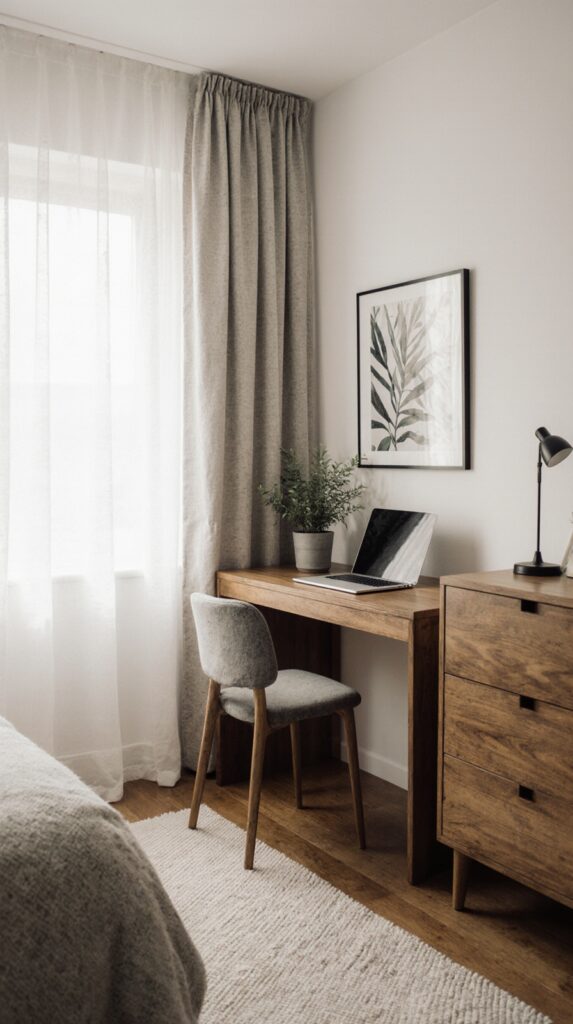
Sharing one room with your bed and your monitor is fine until your brain stops knowing which mode it’s in. A room divider fixes that by blocking the sightline between your desk and your pillow.
Your brain genuinely uses visual cues to switch between work mode and sleep mode. Cut off the view, and it’s easier to do both well. A ceiling-mounted curtain track costs under $50 and closes completely.
An open bookshelf turned perpendicular to the wall divides the room while storing files. Either option needs to leave a 24-to-30-inch walking path on both sides. Folding screens are another flexible option that can be moved or reconfigured as your needs change.
Use an Area Rug or Accent Wall to Mark Your Work Zone
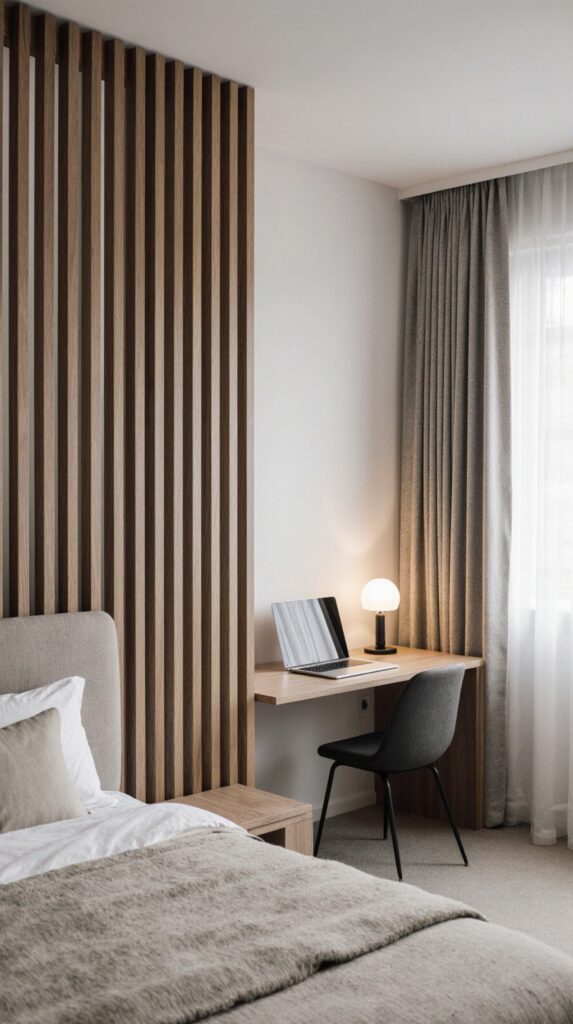
Two simple tools—an area rug and an accent wall—can split a shared bedroom-office into zones your brain actually respects.
- Place a low-pile wool or sisal rug under your desk and chair to define the work footprint.
- Choose light or mid-tone colors so the small room breathes.
- Paint the desk wall a darker, more saturated shade to anchor the workspace.
- Add wood slat panels or subtle wallpaper for texture without eating floor space.
- Match one accent color between the rug and wall to tie the zone together.
Floating screens or bookshelves can also serve as natural dividers to reinforce the boundary between your sleep and work zones.
Your brain reads boundaries. Give it something real to read.
Turn a Closet Into a Hidden Home Office
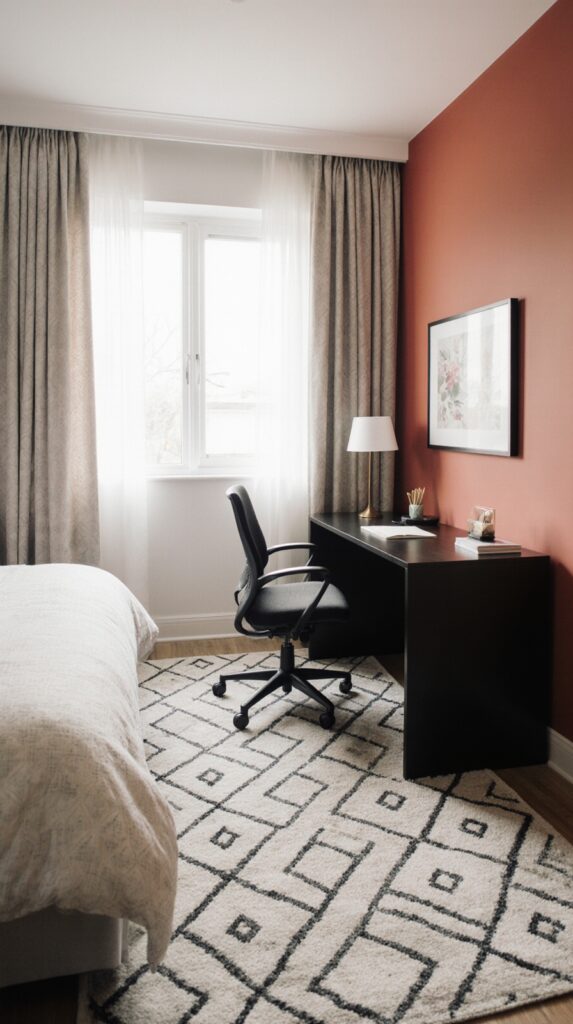
If your closet’s collecting dust and forgotten gym equipment, it’s already halfway to being a functional home office.
Measure the interior width, depth, and height first. You need at least 24 inches of desk depth for a monitor and keyboard.
Before you buy a single bracket, grab a tape measure. That closet needs 24 inches of depth, minimum.
Mount a floating desktop on sturdy brackets spanning the full closet width. Add LED strips under upper shelves for task lighting.
Paint the interior a light, high-LRV color so it doesn’t feel like a cave.
When you’re done working, slide the bifold doors shut. Nobody sees the cables, the clutter, or the spreadsheet you’ve been avoiding.
SEE THIS: 11 Luxury Bedroom Ideas for Women 35–65+ Who Want a Hotel-Style Look on a Real-Life Budget!
Install a Fold-Down Wall Desk That Disappears After Hours
Not every bedroom has a closet worth converting, but almost every bedroom has a bare wall. A fold-down wall desk mounts flush against it and drops open when you need a surface, then folds flat when you don’t.
Models around 24 inches wide by 16 inches deep give you enough room for a laptop without eating your floor space.
Look for these features before buying:
- Smooth lift-down or drop-leaf hardware for daily use
- Built-in shelves or cubbies inside the desk
- Plywood or wood-and-metal construction for stability
- Neutral finishes like white or natural wood
- Stud-mounted installation for real load support
Choose a Bedroom Office Desk With Built-In Storage
When a fold-down desk doesn’t cut it, a desk with built-in storage does the heavy lifting.
Look for models with pedestal drawers, file drawers sized for letter or legal folders, and overhead cabinets. That combination keeps paperwork, cables, and supplies off the surface and out of sight.
Combination desk-and-bookcase units stack vertical shelving above the work surface, adding floor-to-ceiling storage without expanding the footprint. Closed cabinet fronts reduce visual clutter, which matters in a bedroom where you’re also trying to sleep.
One desk replacing two or three separate furniture pieces is a straightforward win for any small room.
Mount Your Monitor on the Wall to Free Up Desk Space
A monitor stand takes up more desk real estate than you’d think—most run 8 to 12 inches deep—and swapping it for a wall mount hands that space back to you.
A full-motion arm lets you pull the screen close while working, then push it flat against the wall when you’re done.
- Fixed mounts save the most space but lock your angle
- Full-motion arms offer tilt, swivel, and extension
- VESA patterns (75×75 mm or 100×100 mm) must match your monitor
- Mount into studs for anything over 15 pounds
- Vertical stacking preserves horizontal desk width for your laptop or notebook
Use a Bookcase as Both a Divider and Storage Solution
Two bookcases back-to-back do something a single desk organizer never could: they split one small bedroom into two rooms without touching the walls.
Face one side toward your desk for files, cables, and tech accessories. Face the other toward your bed for books or a clothing basket, which quietly eliminates the need for a separate dresser.
Keep open shelves at roughly 60–70% of the total space so light still travels between zones. Anchor the unit to wall studs.
A freestanding bookcase loaded with reference books tips at the worst possible moment, and that moment is always 2 a.m.
Store Work Supplies Under the Bed to Keep Things Tidy
Most beds sit 7 to 13 inches off the floor, and that gap is basically a free storage room you’re ignoring.
Most beds sit 7 to 13 inches off the floor — that gap is free storage you’re completely ignoring.
Measure your clearance first, then grab low-profile rolling bins that slide out without scraping walls.
Here’s what works best under there:
- Clear plastic bins for instant visual ID
- Lockable document boxes for contracts or sensitive files
- Flat accordion file cases for organized paperwork
- Wheeled drawers for daily-access supplies
- Moisture-resistant hard-sided bins near exterior walls
Label the front edge of every bin.
Put daily tools on the sides, archived files toward the center.
Match Your Desk to the Bedroom Color Palette
Once your under-bed storage is sorted, the desk itself becomes the next thing your eye lands on, and a bad color choice will make it stick out like a filing cabinet in a spa.
In small rooms, go lighter. Light wood, soft white, or warm natural finishes reduce visual weight better than espresso or black.
Match undertones before matching colors. Warm walls like beige or cream pair with wood tones. Cool gray or blue walls pair with cooler finishes.
Keep the desk within two lightness steps of your walls. Big contrast fragments small rooms fast.
Limit Desk Accessories So the Room Still Feels Like a Bedroom
Every accessory you add to a desk in a shared bedroom pulls the room one step closer to feeling like a home office with a bed shoved in it.
Keep only what you actually use daily visible, and store everything else out of sight.
- Use a compact desk with built-in drawers
- Switch to a wireless keyboard and charging pad
- Choose one lamp that handles both task and ambient lighting
- Store files and chargers in closed bins or baskets with lids
- Corral pens and small tools into a single tray
Less stuff out means the room reads as bedroom first.