It’s funny how a queen bed and a tiny bedroom seem destined to collide, yet they can actually work beautifully together. You don’t have to sacrifice comfort just because your room is small.
From smart bed placement to storage tricks you probably haven’t tried, there are real solutions that make a difference.
What works best depends on a few key factors you’ll want to know before moving anything around and it’s worth taking the time to figure them out.
Key Takeaways
- Position the queen bed against the longest wall to maximize floor space and allow symmetrical placement of bedside furniture.
- Corner bed placement frees 8–12 square feet by eliminating circulation needs on two sides of the bed.
- Wall-mounted sconces and shelves replace bulky furniture, saving 2–4 square feet of valuable floor space per item.
- Under-bed storage provides roughly 16.5 cubic feet of space using shallow bins or vacuum-seal bags for seasonal items.
- Maintain at least 24 inches of clearance on walking sides and 36 inches at the foot for comfortable access.
Position Your Queen Bed Against the Longest Wall First
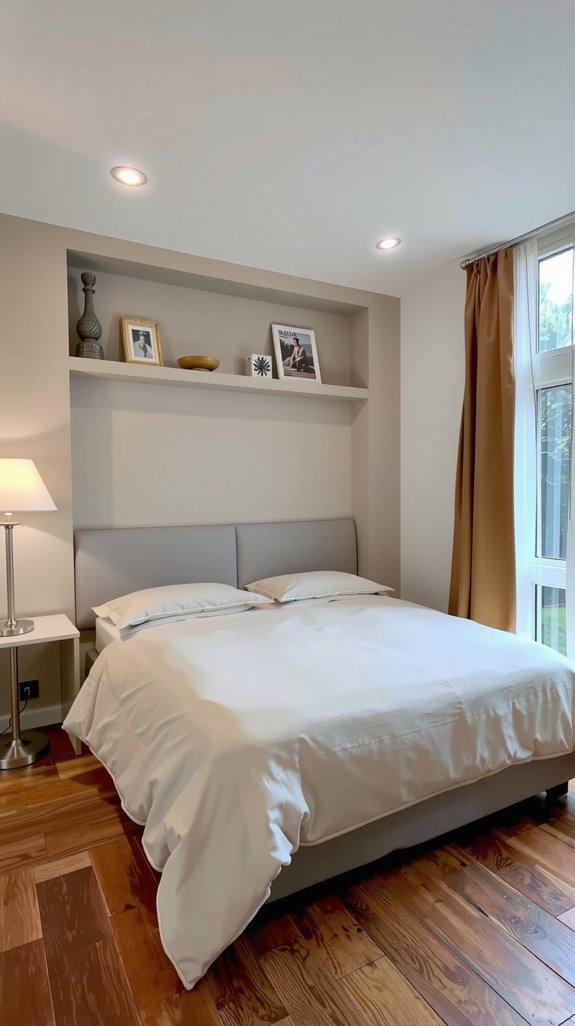
When you’re working with a tiny bedroom, the single most impactful decision you’ll make is where to position your queen bed — and the answer is almost always the longest wall.
Placing your headboard there instantly opens up more usable floor space in front of the bed, giving you clear walking paths on at least one side. It also reduces those awkward dead corners that eat up space without serving any purpose.
You’ll find furniture arrangement gets easier too, since adjacent walls stay free for dressers or shelves. Better flow, better balance, better function — one placement decision delivers all three.
This positioning also creates natural symmetry and balance, making room for bedside tables on either side without the layout feeling forced.
How Much Clearance Does a Queen Bed Actually Need?
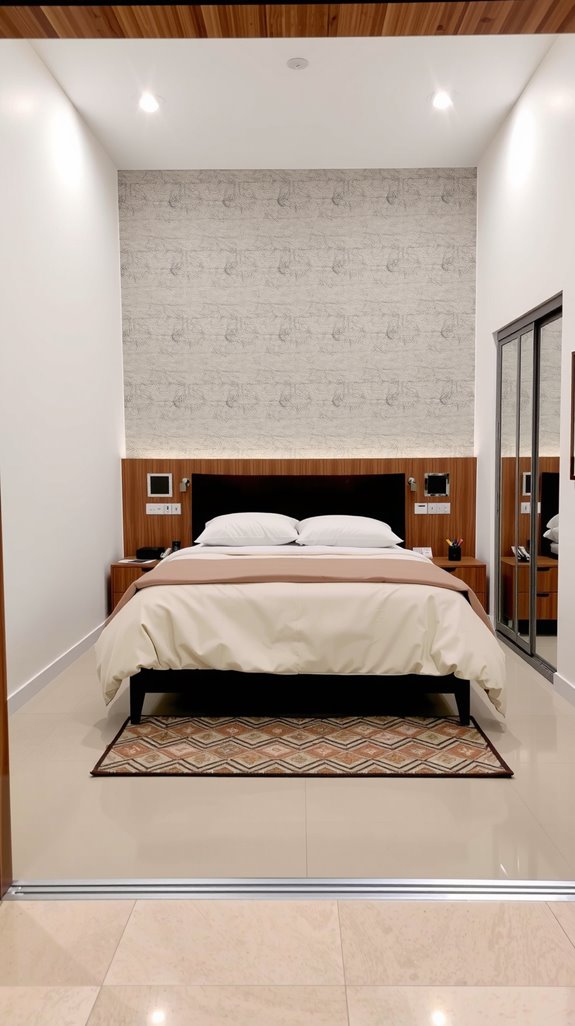
Once you’ve pushed your queen bed against the longest wall, you’ll still need to think carefully about how much open floor space remains on the other sides.
You should aim for at least 24 inches of clearance on the sides you walk daily, but 30 inches is more comfortable, especially if two people are sharing the bed and moving around at different times.
At the foot of the bed, 24 inches is the bare minimum, though 36 inches gives you enough room to open dresser drawers or move through without constantly squeezing past the frame.
A standard queen bed measures 60 inches wide and 80 inches long, so factoring those fixed dimensions into your clearance planning from the start prevents costly layout mistakes later.
Minimum Clearance Requirements
Before anything else gets planned, there are 3 clearance numbers you need to know for a queen bed: 24″, 30″, and 36″.
Twenty-four inches is your absolute minimum — tight but workable on accessible sides and at the foot. Thirty inches gives you comfortable daily movement without feeling squeezed. Thirty-six inches is ideal, especially at the foot where you’re dressing or opening closet doors.
Drop below 24″, and you’re not really walking anymore — you’re squeezing. In a tiny bedroom, you’ll likely mix these numbers strategically, using 30″ where traffic flows and accepting 24″ where access is occasional.
Navigating Tight Pathways
| Pathway Location | Recommended Clearance |
|---|---|
| Each walking side | 24–30 inches |
| Foot of bed | 36 inches |
| Closet door swing | 24–30 inches |
| Bedroom door arc | 30–36 inches |
Prioritize the foot-of-bed zone first—it’s your primary daily traffic lane. For overall planning, remember that absolute minimum clearance around the bed starts at 24 inches, though 30 inches makes daily movement noticeably easier.
Balancing Space and Comfort
Knowing the exact clearance your queen bed needs makes the difference between a room that works and one that constantly frustrates you.
A standard queen mattress measures 60″ wide by 80″ long, so you’re already working with a substantial footprint. Experts recommend 30″ on each accessible side and at least 36″ at the foot, especially when a dresser or closet shares that wall.
You can survive with 24″ minimums, but expect sideways shuffling and awkward bed-making.
Aim for a 10′ x 12′ room as your baseline, and you’ll have genuinely comfortable, functional space rather than just a bed that technically fits.
Why Corner Placement Frees Up More Space Than You Think
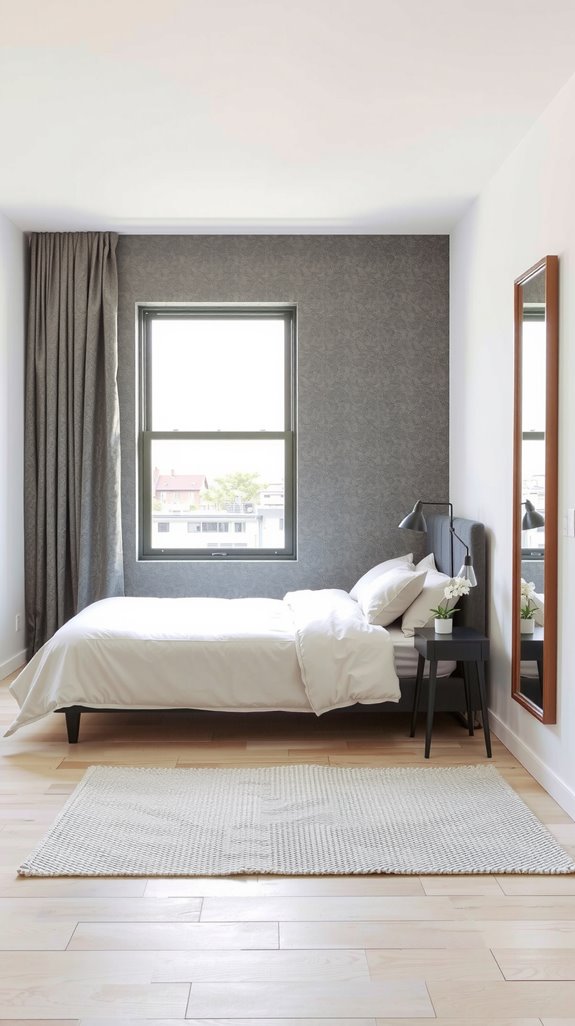
When you push your queen bed into a corner, you immediately eliminate the need for circulation space on two sides instead of just one, which can reclaim anywhere from 8 to 12 square feet in a small room.
That freed floor runs in a continuous stretch from the door to the opposite wall, so the room feels more open and easier to move through rather than feeling like you’re maneuvering around a giant island.
You’ll also find that a single, clear pathway to the open bed side simplifies how you actually use the room day to day, cutting down on the awkward side-stepping that a centered bed forces on you.
The corner layout also creates a natural wall to place a narrow desk or dresser without disrupting the open flow you’ve created.
Corner Bed Circulation Benefits
Placing your queen bed in a corner might seem like a small adjustment, but it’s one of the smartest circulation moves you can make in a tiny bedroom.
It pushes the bulk of your furniture mass out of your main walking paths, giving you that recommended 24–36 inches of clear movement space. You’ll also eliminate awkward pinch points caused by centered beds flanked by nightstands.
| Bed Position | Circulation Benefit |
|---|---|
| Corner | Opens 24–36″ walking path |
| Centered | Creates dual pinch points |
| Corner | Doors open fully without obstruction |
| Centered | Limits wardrobe/drawer clearance |
| Corner | Consolidates furniture into one quadrant |
Under-Bed Storage Solutions That Replace Half Your Dresser
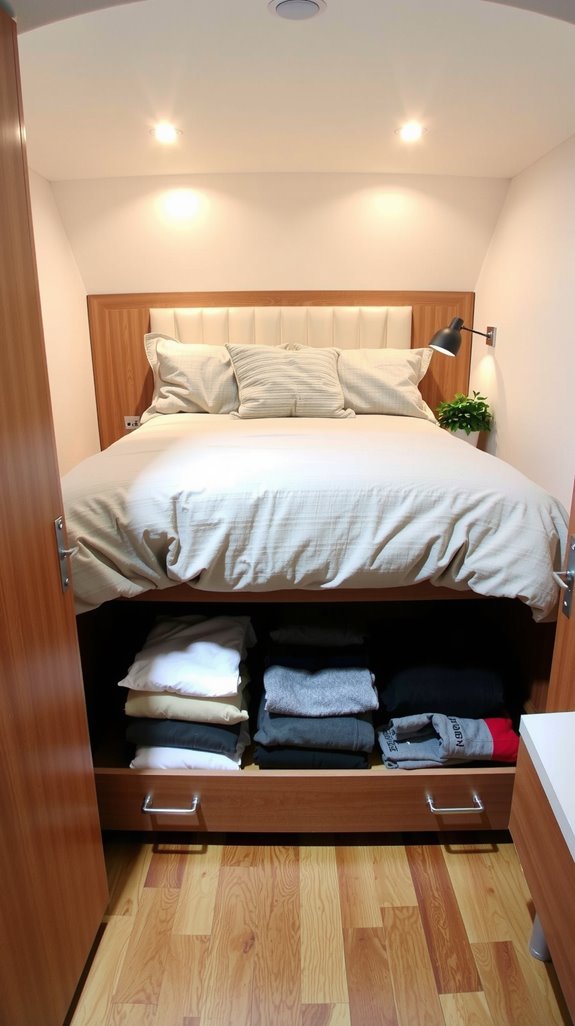
The space beneath your queen bed is hiding roughly 16.5 cubic feet of storage — enough to match or even replace half of a standard dresser.
Soft zippered fabric bins work best for clothes and linens because they flex into tight clearances easily. For harder items, grab shallow plastic bins sized between five and eight inches tall.
Fabric bins flex into tight spaces; rigid items need shallow plastic bins no taller than eight inches.
Use vacuum-seal bags for off-season clothes to cut bulk by up to 75%. Add wheeled drawers for daily-wear items so access stays quick and easy.
Measure from the floor to your side rail first — not the mattress — to guarantee your bins actually fit.
Storage Headboards That Work Harder in a Small Bedroom
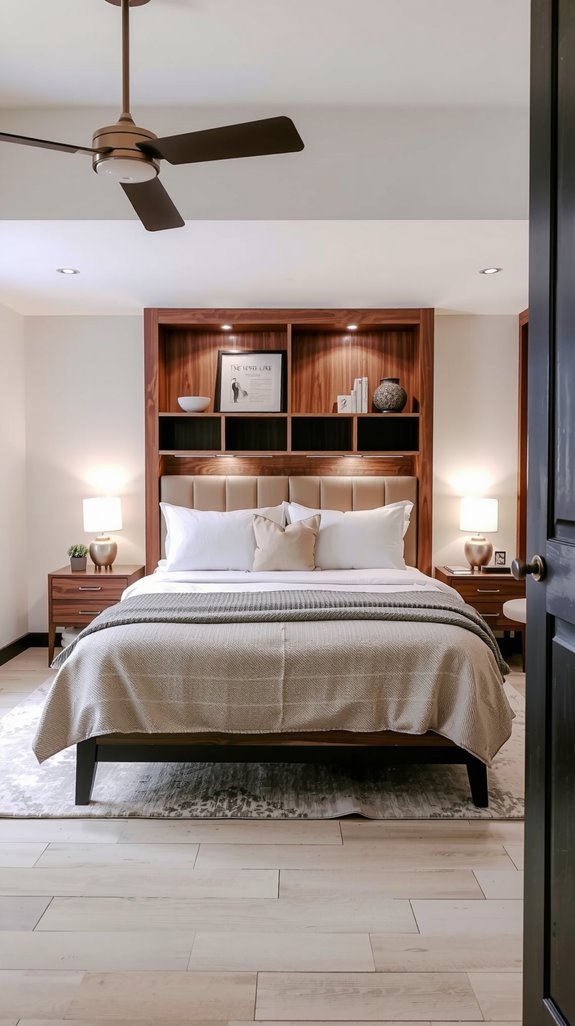
Your headboard is pulling double duty the moment you swap a plain panel for a storage version — and in a queen bedroom with limited floor space, that trade-off is massive.
A smart storage headboard can genuinely replace multiple furniture pieces at once. Here’s what to look for:
- Multiple compartments — aim for 5–7 cubbies to separate books, devices, and essentials
- Shallow depth — around 20 cm keeps items reachable without crowding walkways
- Closed cabinet sections — dust-protected storage hides clutter instantly
- Weight capacity — solid shelves supporting 50+ lbs handle real everyday loads
Wall-Mounted Shelves Instead of Bulky Nightstands
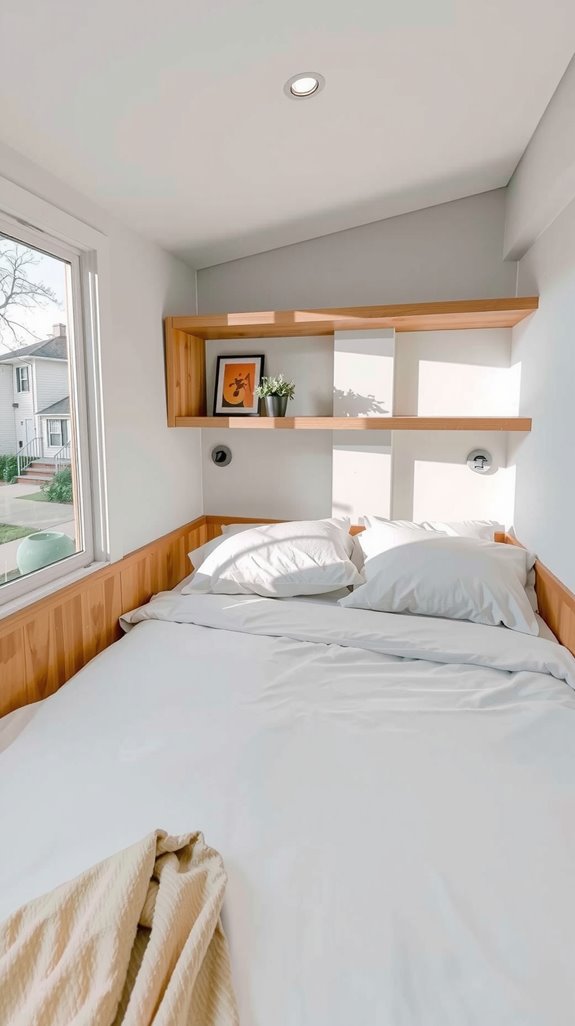
Once your headboard is doing more work, it makes sense to look at the next obvious space-waster sitting beside your bed — the nightstand.
A typical nightstand eats up 2–4 square feet of floor space per side, which matters enormously in a tiny room. Wall-mounted shelves solve this instantly.
Mount them around 24–26 inches from the floor so you can reach everything comfortably from bed. Choose shallow shelves, roughly 6–10 inches deep, to keep the visual bulk minimal.
Look for options with built-in cord cutouts for phone charging. You’ll gain clear floor space without sacrificing your bedside essentials.
Tall Wardrobes Beat Wide Dressers in Tiny Bedrooms
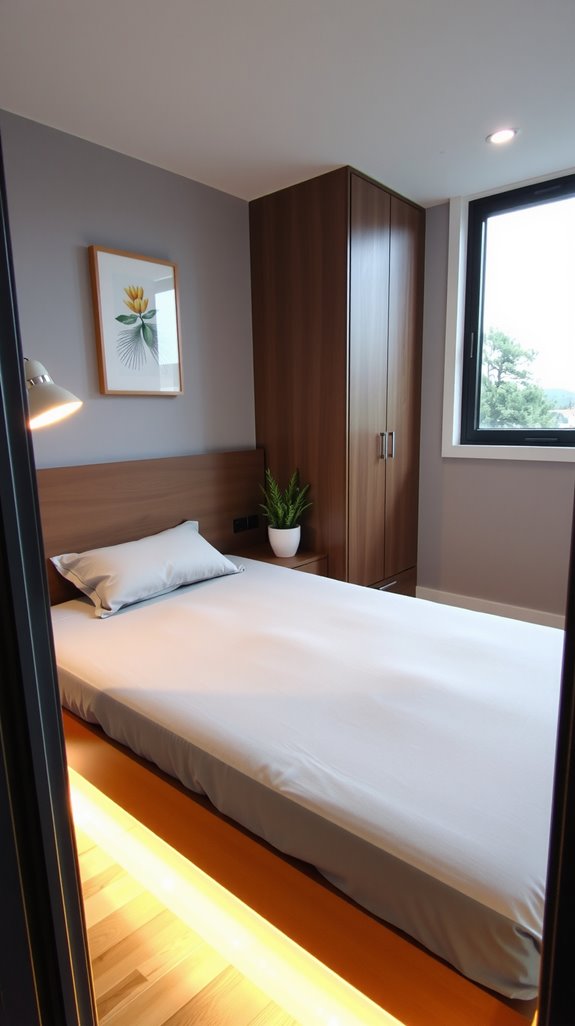
When you’re working with a queen bed in a tiny bedroom, swapping a wide dresser for a tall wardrobe is one of the smartest moves you can make.
A tall wardrobe pulls your storage upward instead of outward, so you’re not sacrificing precious floor space just to keep your clothes organized.
You’ll get a slim profile that tucks into corners or narrow wall sections, plus a surprisingly high storage capacity with hanging rails, shelves, and drawers all packed into one vertical unit.
Height Over Floor Space
When floor space is already stretched thin by a queen bed, going vertical is one of the smartest storage moves you can make. Tall wardrobes deliver serious capacity without stealing precious walking room.
Here’s why height wins:
- A 65″ tall unit holds 5–7 drawers in roughly half the footprint of a wide dresser.
- Full-height wardrobes capture wasted upper wall space for bedding and seasonal items.
- Narrow profiles fit corners and door-adjacent walls where wide dressers simply can’t go.
- Less width means drawer fronts stay clear of walkways, preserving that recommended 30″ circulation zone.
Light Colors That Make a Small Bedroom Feel Bigger
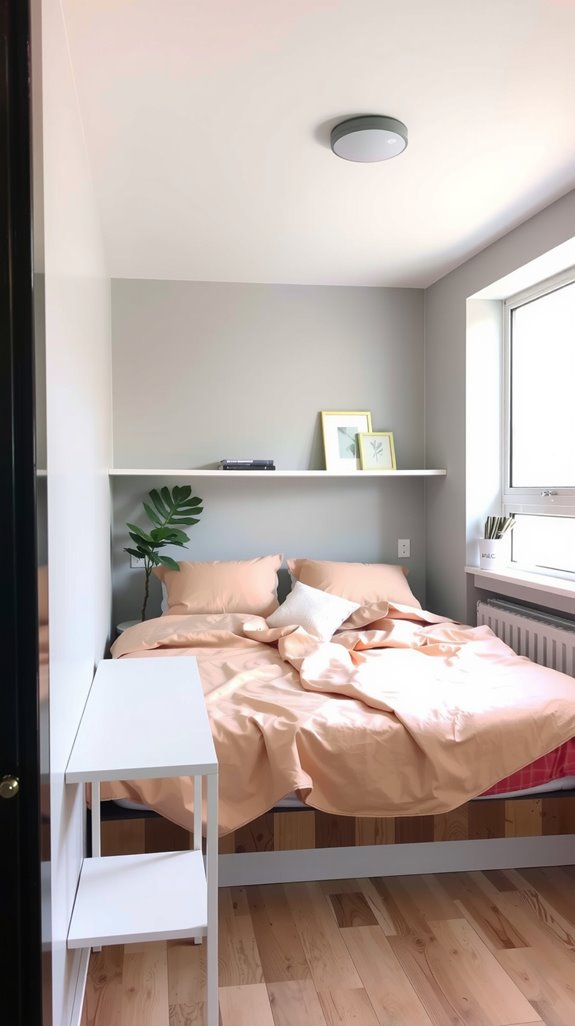
One of the easiest and most impactful changes you can make in a tiny bedroom is choosing the right paint color.
Light shades with high LRV values bounce light around, making walls feel farther away. Try these top choices:
- Soft white or off-white – opens the space instantly
- Warm beige or greige – adds coziness without heaviness
- Pale blue or mint – visually recedes, creating breathing room
- Light gray – clean, modern, and endlessly versatile
Keep your trim, large furniture, and ceiling in similar tones to reduce contrast and make everything feel seamlessly bigger.
Where to Put a Mirror in a Tiny Bedroom
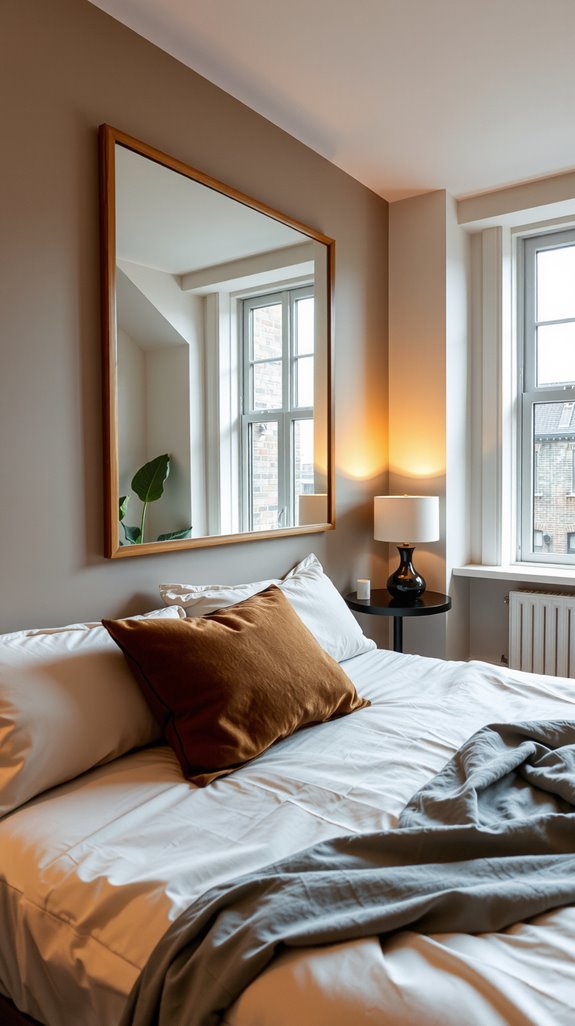
Mirrors are one of the most powerful tools you’ve got for making a tiny bedroom feel bigger, brighter, and more functional — but placement makes all the difference.
Hang one opposite a window to bounce daylight around, or lean a full-length mirror near your dresser to create a dedicated dressing zone without extra furniture.
| Placement | Best For | Key Benefit |
|---|---|---|
| Opposite a window | Light-starved rooms | Doubles natural brightness |
| Beside the dresser | Dressing efficiency | Eliminates bulky furniture |
| Closet doors | Tight layouts | Expands space without wall use |
| Side wall | Sleep comfort | Avoids restless Feng Shui reflections |
Floating Sconces That Free Up Space Around Your Queen Bed
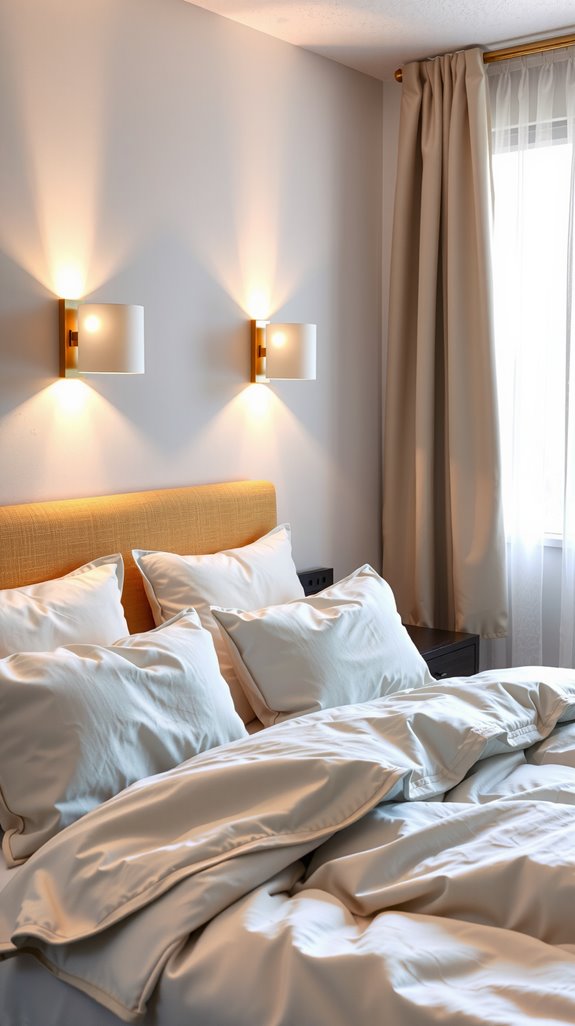
Swapping out table lamps for wall-mounted sconces is one of the smartest moves you can make in a tiny bedroom with a queen bed, because it completely frees up floor and surface space that bulky nightstands would otherwise eat up.
Mount your sconces roughly 30 to 36 inches above the top of your mattress and position them 6 to 12 inches from the bed’s edge so you can reach the switch without stretching or climbing over anyone.
For style, swing-arm sconces give you the most flexibility since you can direct the light exactly where you need it, whether you’re reading, or just winding down.
Why Wall Sconces Work
When your bedroom is small and your bed is a queen, every inch of surface space matters—and that’s exactly where wall sconces earn their keep.
Mounting lights on the wall gives you four real advantages:
- Clears nightstand surfaces completely
- Eliminates bulky lamp bases and tangled cords
- Draws your eye upward, making the ceiling feel taller
- Puts focused reading light exactly where you need it
You’re not just swapping one light for another.
You’re reclaiming space, reducing visual clutter, and making your room feel bigger without moving a single piece of furniture.
| Placement Reference | Recommended Range |
|---|---|
| Floor to fixture center | 60–66 inches |
| Above mattress top | 24–30 inches |
| From headboard edge | 12–18 inches |
| From bed edge | 6–12 inches |
How to Add a Desk Without Shrinking Your Small Bedroom
Adding a desk to a tiny bedroom with a queen bed might feel impossible, but 3 smart placement choices can make it work without eating up precious floor space.
First, try positioning a narrow desk (around 16–20 inches deep) at the foot of the bed, treating both pieces as one connected furniture block.
Second, replace one nightstand with a compact desk-nightstand hybrid, giving you a work surface without adding footprint.
Third, tuck a shallow desk inside a closet alcove to keep your workspace visually hidden when you’re done.
Solid Colors and Subtle Patterns Keep Bedding Visually Light
When it comes to a tiny bedroom with a queen bed, your bedding choices carry more visual weight than you might expect. The right approach keeps your room feeling open instead of cramped.
- Choose light neutrals like white, soft gray, or beige as your main bedding color.
- Limit patterns to one piece, like your duvet.
- Pick small-scale, low-contrast prints that read as texture from a distance.
- Keep 80% of your bedding in one color temperature family.
This layering strategy prevents your queen bed from feeling like a bulky centerpiece dominating your small space.
The Right Area Rug Size to Anchor a Queen Bed
Choosing the right area rug size can completely transform how your queen bed sits in a small bedroom—either anchoring it beautifully or making the whole space feel off-balance.
For tight rooms, a 5′ x 8′ rug works well when positioned under the bottom two-thirds of your bed, extending past the foot. A 6′ x 9′ rug is the sweet spot if you’ve got slightly more floor space, giving you roughly 24″ of coverage on each side.
Avoid anything smaller than 5′ x 8’—it won’t visually anchor a queen bed and will make your room feel incomplete.
Which Pathways to Keep Clear Around Your Queen Bed
Once you’ve got your queen bed placed, the real test is whether you can actually move around it without bumping into something every morning.
Keep these four pathways clear:
- Bed to door — maintain 30–36 inches for safe, direct access
- Bed to closet — keep 30–36 inches so doors can swing freely
- Bed to dresser — allow 30–36 inches to open drawers comfortably
- Both bed sides — avoid anything below 24 inches, which creates dangerous pinch points
Clear pathways reduce trip hazards, especially during nighttime movement when you’re half-asleep and not paying attention.