False ceilings, also called dropped ceilings, don’t have to turn a kid’s room into a theme park to feel interesting.
You can add depth, lighting, and even storage without the room screaming “circus tent.”
The 14 designs here stay under control while still giving kids something worth looking up at. Some use pastels, others use acoustic baffles or fiber optic lights and a few hide storage in plain sight.

Sky Blue Kids’ Room Tray Ceiling With Cloud Silhouettes
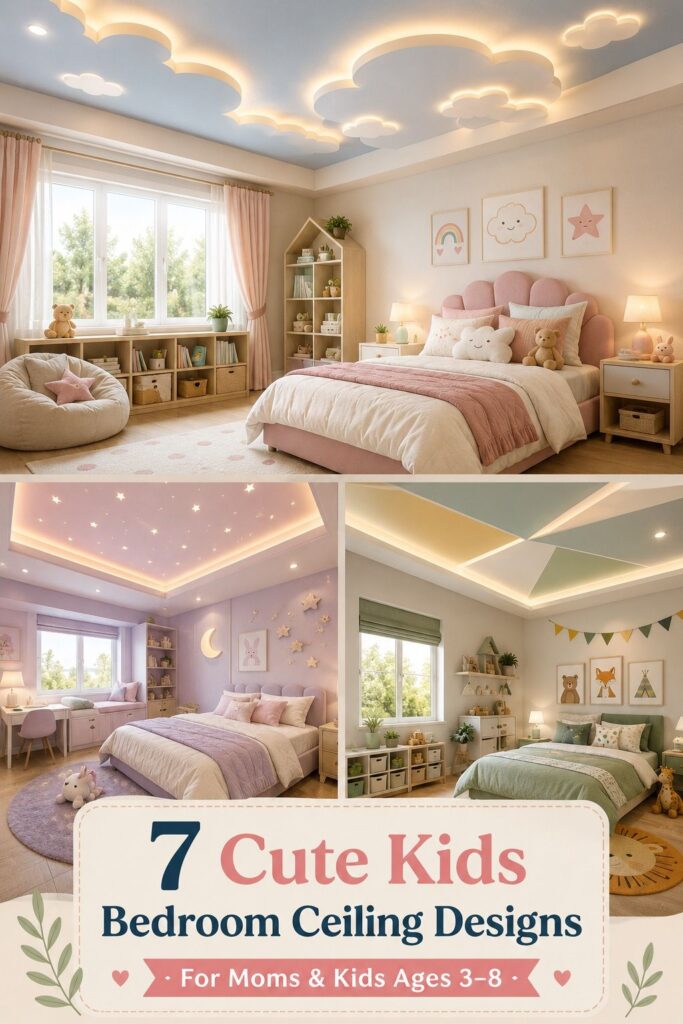
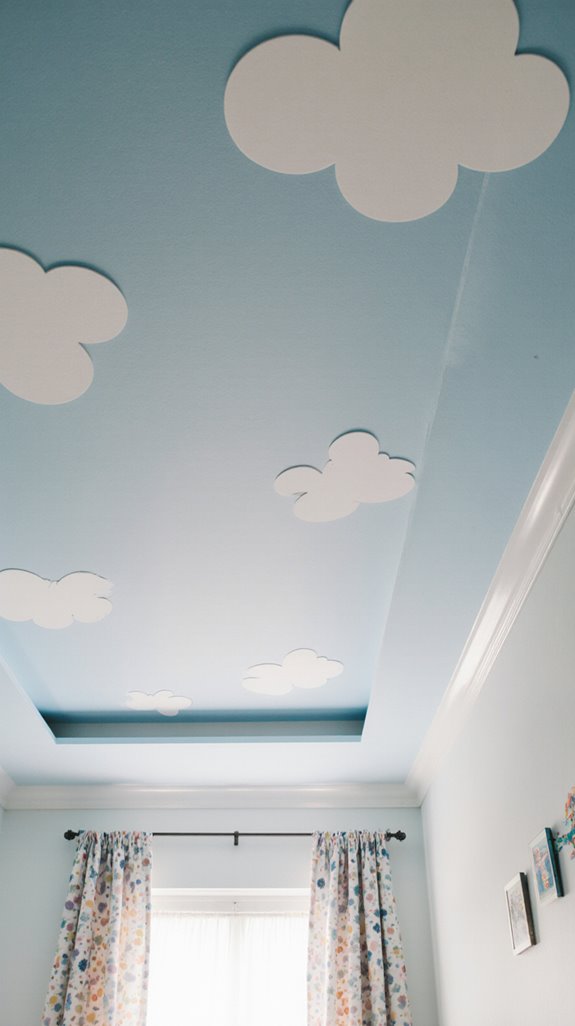
A sky blue tray ceiling is basically a recessed box built into your ceiling, framed by a lower perimeter border that draws the eye upward to a higher central panel painted in soft blue.
You’ll need at least 9 feet of ceiling height, since the tray itself drops 4 to 8 inches.
Cloud silhouettes are cut from POP, Plaster of Paris, and mounted flush against that blue field. Their irregular, organic edges keep things playful without looking chaotic.
Hidden LED cove lighting sits inside the tray lip casting a soft glow that makes the clouds appear to float rather than just sit there.
SEE THIS: Latest False Ceiling Designs for Bedroom (Cozy + Modern Styles)!
Single-Level Tray Ceilings With Radiused Corners for a Softer Room
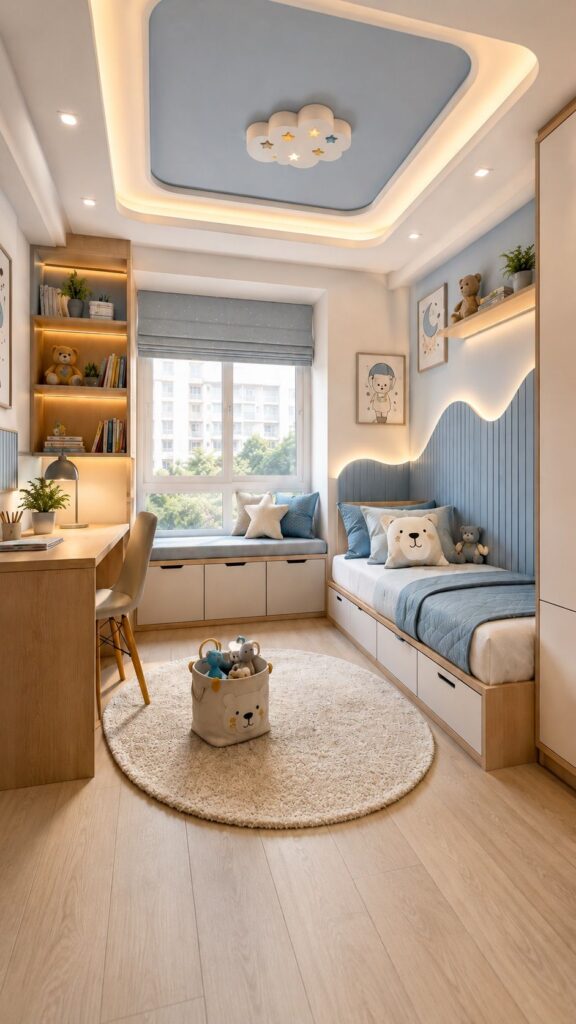
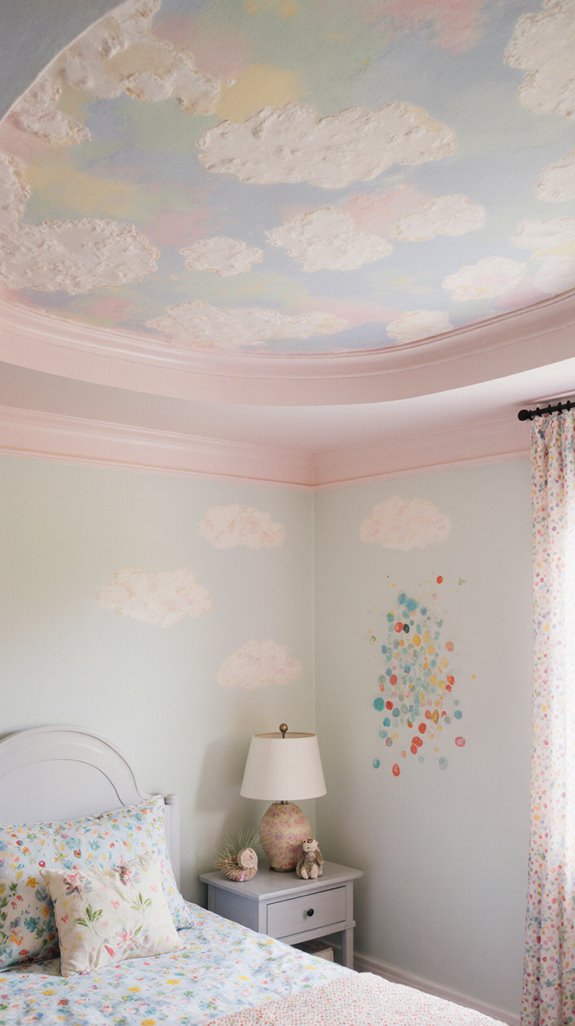
Where sharp 90-degree angles make a room feel like a cardboard box, radiused corners soften that effect by curving the tray’s perimeter edges instead.
Installers bend flexible ¼-inch gypsum board over pre-fabricated metal tracks, creating corners with a 6-to-12-inch radius. That curve isn’t decorative fluff; research links softer architectural lines to lower cortisol levels.
Your ceiling needs at least 8 feet of height, since the tray border drops 4 to 6 inches. Keep the border between 12 and 24 inches wide, or you’ll accidentally crush the room’s visual height instead of opening it up.
You can also swap in LED strip colors seasonally to shift the mood without touching the structure.
MORE IDEAS: 28 Latest False Ceiling Designs That Make Every Room Look Custom-Built (Living Room, Bedroom, Kitchen & More).
Two-Tone Tray Ceilings With Pastels Contained in the Recess
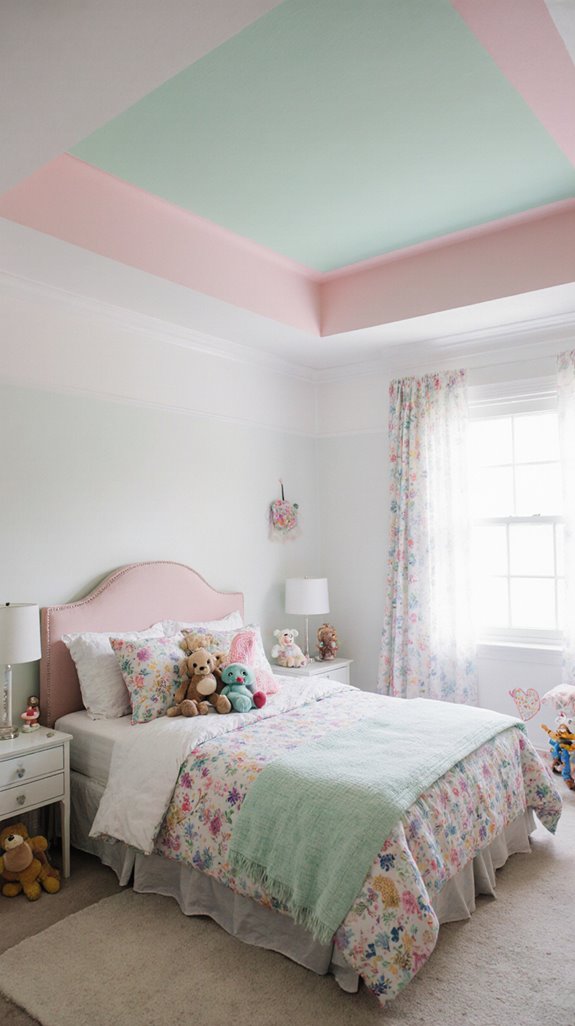
Two-tone tray ceilings work by splitting the ceiling into two painted zones: a recessed central panel in one color and a surrounding border in another.
You’re containing the color to the recess, so the walls stay calm and the room doesn’t feel like it swallowed a crayon box.
Blush pink with a crisp white border works from nursery through tween years without a repaint. Soft sage paired with ivory reads gender-neutral and grounded. Keep your recess in matte or eggshell finish and your border in satin white.
The contrast feels intentional rather than accidental, which matters more than most people will admit. This approach also lowers lofty ceilings, creating a cozier feel without adding visual noise to the rest of the room.
SEE THIS: 12 False Ceiling Designs for Small Bedrooms That Feel Bigger Instantly!
The Shallow Dome Ceiling Centered Above the Bed
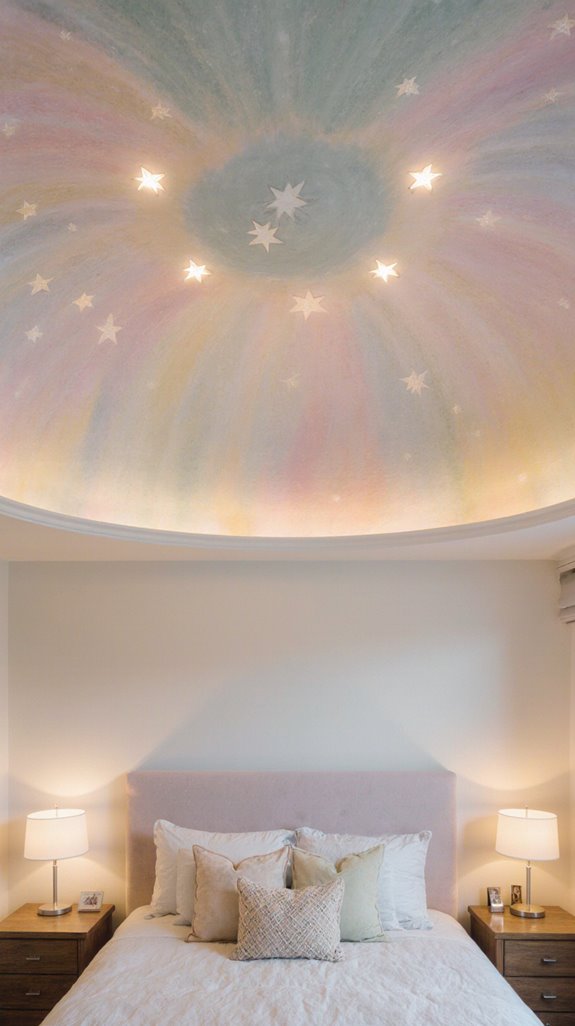
Domes don’t have to be dramatic. A shallow dome centered over the bed rises only a few inches to about a foot, just enough curve to feel intentional without eating into headroom.
Use smooth gypsum board and finish it in the same matte white as your walls, maybe a half-shade lighter on the ceiling. Tuck LED strips at 2700K into the perimeter cove for soft, indirect light, then add one centered flush-mount on a dimmer for reading.
No recessed downlights aimed at a reclining face. The curved shape quietly removes harsh overhead angles, which actually helps kids settle down faster. Beyond aesthetics, the gypsum board material also conceals wiring and cables cleanly within the dome structure.
Light Wood Veneer Kids’ Room Ceilings That Add Warmth
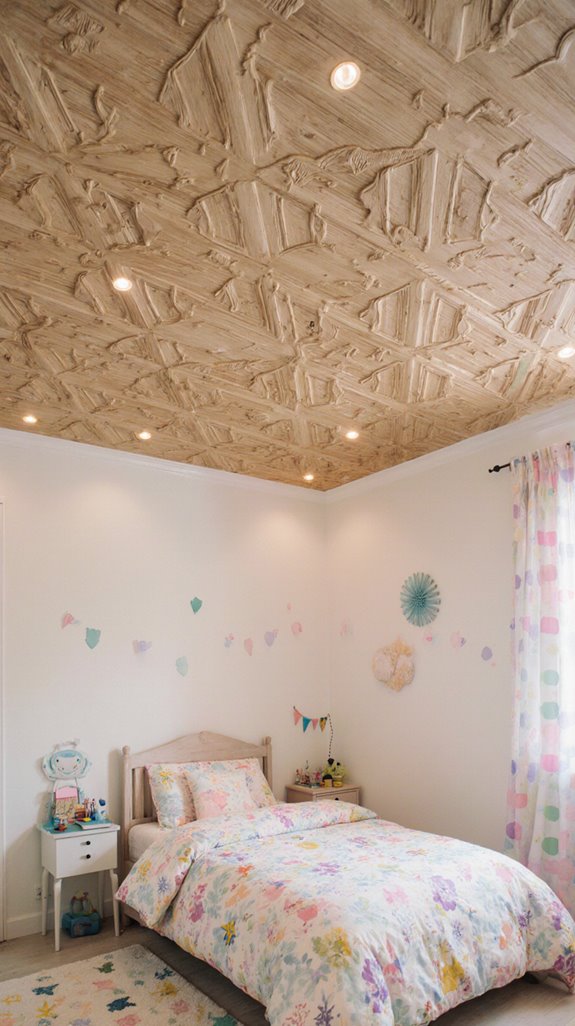
Wood on a ceiling sounds like a lot, but light veneer, think maple, birch, or ash, keeps the room bright while adding actual warmth instead of the painted-flat nothing most kids stare at from bed.
Veneer is basically a thin wood slice, 0.5, 1.5 mm, bonded to moisture-resistant MDF for stability. It won’t warp when humidity shifts, unlike solid wood. A clear matte lacquer keeps the pale tone intact.
Slat layouts with 10, 20 mm gaps let you run LED strips between them at 2700, 3000K, which is warm gold, not office-white. The whole ceiling stays wipeable, dimmable, and surprisingly calm.
A minimum 9-foot ceiling height is recommended before committing to this kind of layered wood installation so the room doesn’t feel compressed once the framework drops.
Perforated Gypsum Panels That Look Subtle and Kill Room Echo
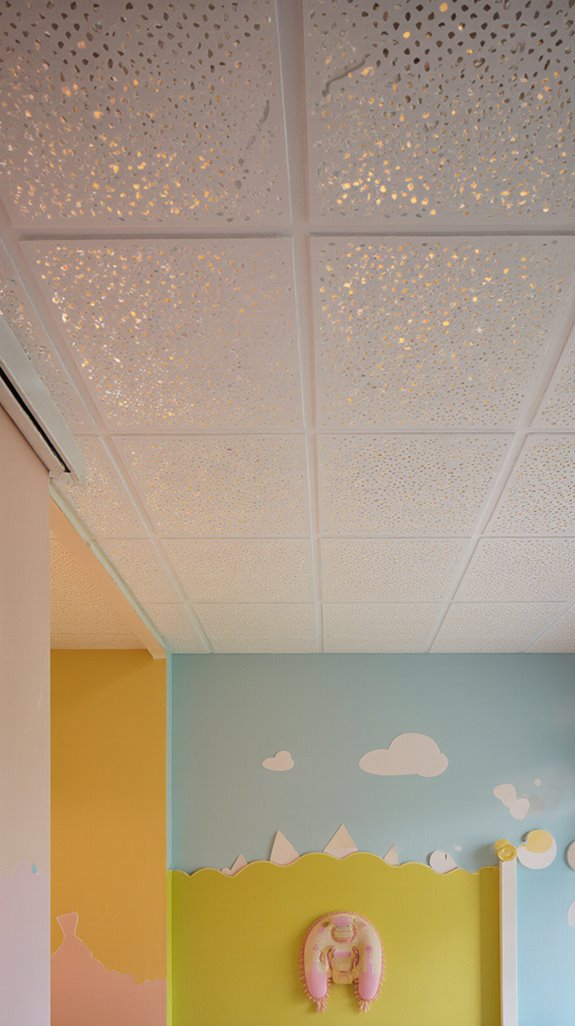
Pale birch veneer handles warmth, but it does nothing for the racket a kid generates at full volume.
Perforated gypsum panels fix that. Thousands of micro-holes absorb sound waves, cutting flutter echo and reverberation with an NRC rating between 0.50 and 0.70.
Brands like Gyptone Big Boards and Rigitone deliver those numbers without looking industrial. From standing height, the perforations are nearly invisible.
You get a clean white ceiling that coordinates with any wall color. Pair it with a recessed LED cove and the light becomes the feature, not the ceiling. These panels are also made from natural materials, making them environmentally safe for children’s spaces.
Quieter room, zero visual drama.
Cove Lighting That Replaces Harsh Overhead Glare
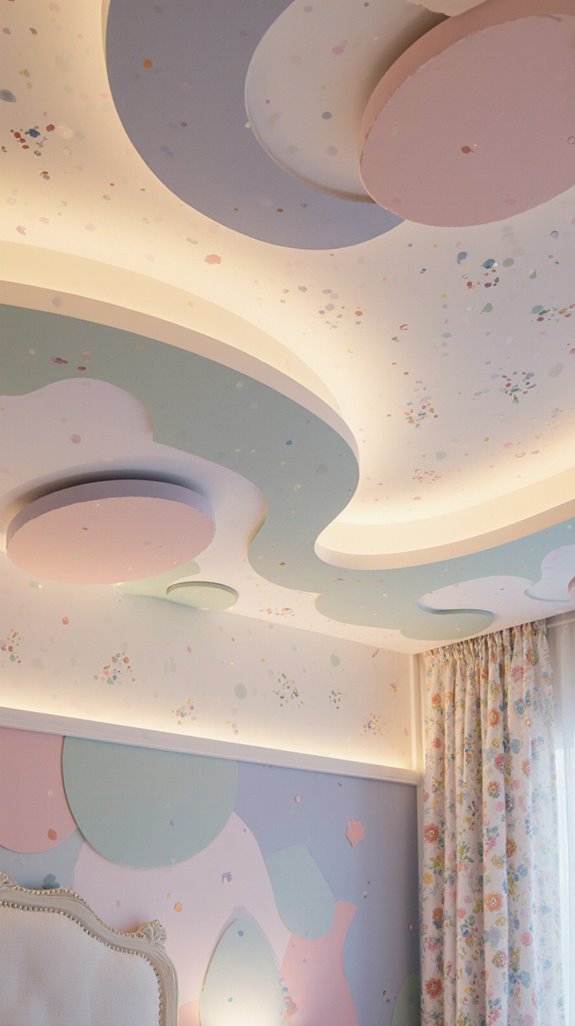
Harsh overhead lights turn a kid’s bedroom into an interrogation room, so cove lighting solves this by bouncing illumination off the ceiling instead of firing it straight down at your eyes.
You hide LED strips inside a recessed ledge, and the light reflects off the ceiling as one soft, even glow. Your child can lie on the floor and never stare directly into a single diode.
Use high-CRI 90+ LED strips so wall murals and toys show their actual colors.
Keep the cove ledge at least 3 inches deep, or the ceiling gets weirdly bright in one stripe. For best results, your room should have a minimum 9-foot ceiling height to give the cove enough vertical space to diffuse light properly.
Smart RGBW Downlights That Switch Back to Clean White
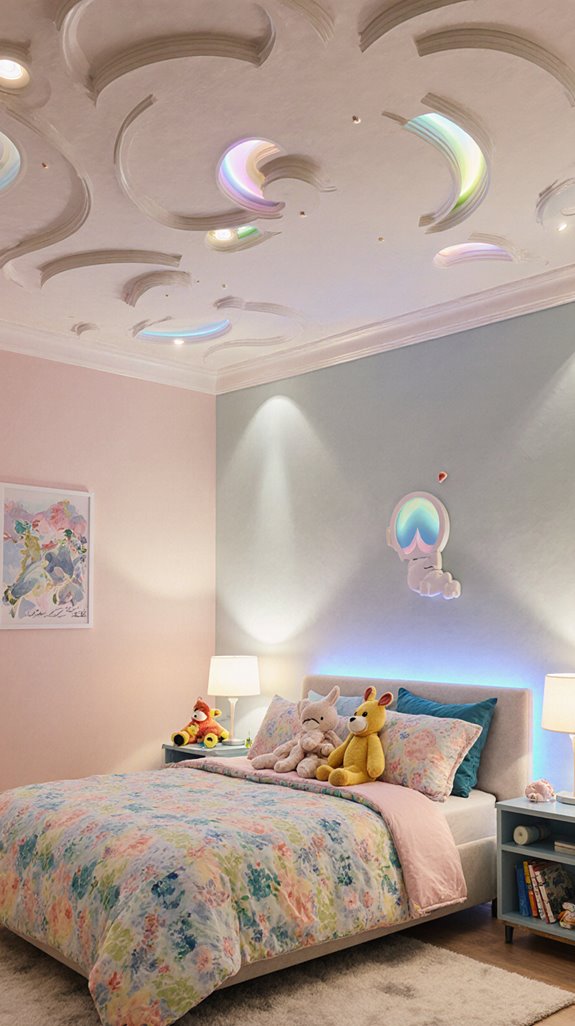
RGB lights look impressive for about ten minutes before your kid wants the ceiling back to normal.
That’s exactly why RGBW downlights exist. The W stands for a dedicated white diode, separate from the color channels, so you get actual clean white instead of a murky pastel compromise.
Most units cover 2700K warm white through 6500K daylight handling homework and wind-down from one fixture.
Scene presets let anyone hit a single button to recall that white setting instantly. Scheduling handles the switch automatically, moving from play colors to neutral white at whatever time you program.
Fiber Optic Star Fields for a Calm Nighttime Ceiling
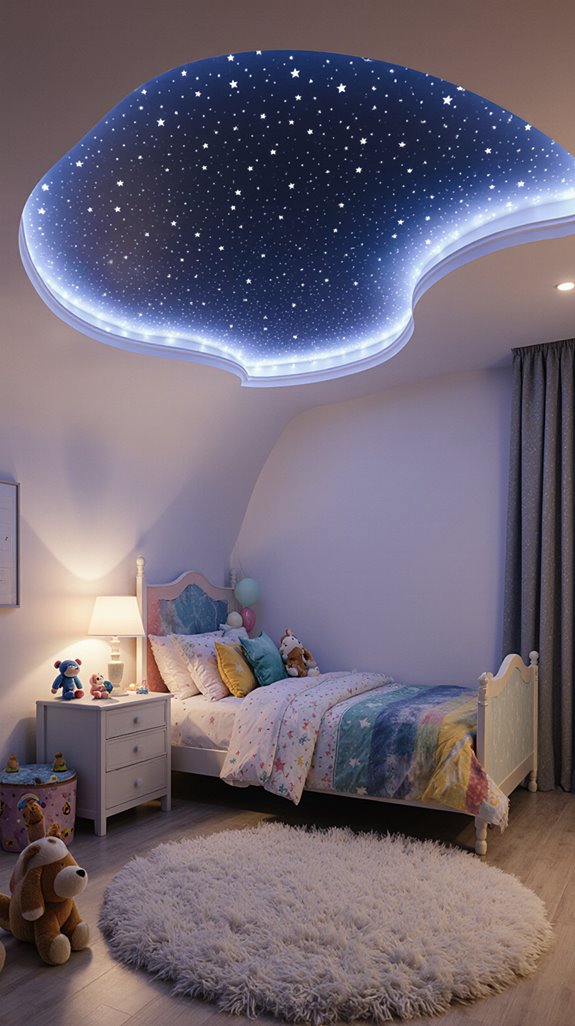
Hundreds of tiny fiber optic points in a dark ceiling do something RGB color-cycling never quite manages: they actually calm kids down at bedtime.
A 600-strand kit runs about $369 and covers roughly 169 square feet. You’ll thread individual strands through drilled holes in black-painted MDF or foam board, then glue each one in place with black silicone.
Trim the protruding ends at slightly different angles and leave a few millimeters proud of the surface; that small detail creates a soft glow instead of a harsh dot.
Budget around $500, $550 total and 8, 16 hours of your weekend.
Moon-Phase Cut-Outs Backlit to Glow Without Feeling Childish
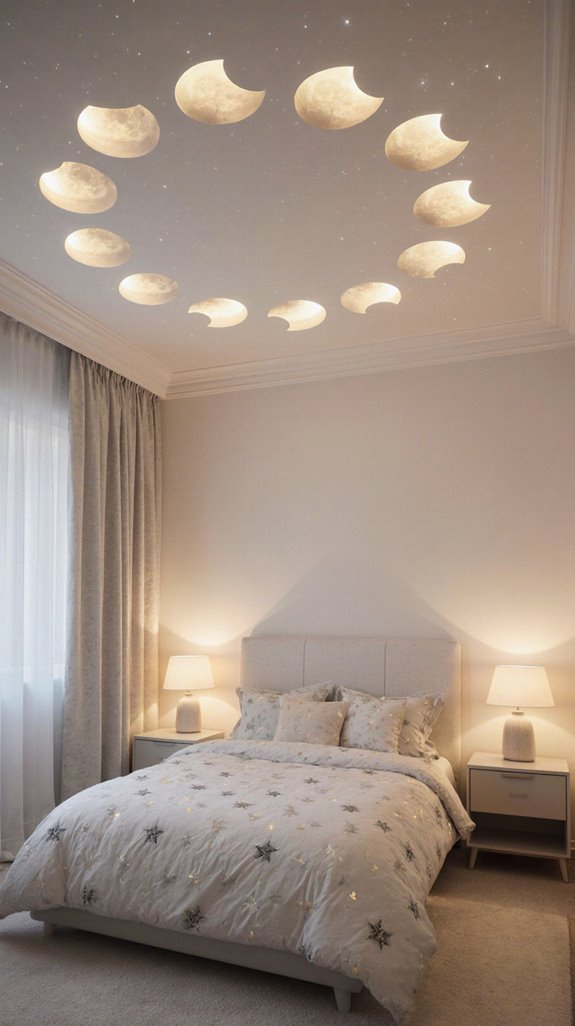
Moon-phase cut-outs pull off something most kids’ ceiling ideas can’t: they look just as good in a teenager’s room or a guest bedroom as they do above a seven-year-old’s bed.
You carve lunar shapes, crescent, quarter, gibbous, full, into 9,12 mm gypsum board, then backlight each cavity with dimmable LED tape set between 2700K and 4000K.
Keep the glow between 200 and 400 lumens per cut-out. Finish the surrounding ceiling in charcoal or midnight blue matte paint and the whole thing reads as intentional, not nursery-adjacent.
CNC routing keeps edges sharp, which is what separates sophisticated from craft-project.
Minimalist Glow-in-the-Dark Stars on a Matte Ceiling
The minimalist glow-in-the-dark ceiling works because it doesn’t try too hard.
Paint your ceiling deep blue or charcoal matte, which kills light reflection and makes the room feel deeper than it is. Keep your star count under fifty points total, enough to suggest a sky, not a birthday party.
Strontium aluminate paint glows up to ten hours and looks plain white in daylight so nobody’s staring at dots all afternoon. A full DIY kit runs under ₹2,000, including stencils and brushes.
Concentrate placement toward one corner. That single decision separates a sophisticated design from a chaotic one.
Wavy Acoustic Baffle Ribbons for a Kid’s Room That Also Look Like Art
Most acoustic solutions for kids’ rooms are either ugly foam wedges or invisible drywall treatments that do nothing interesting.
Wavy acoustic baffle ribbons are neither. You hang them from the ceiling using cable systems or slotted Unistrut channels at varied heights, and they immediately read as intentional art. The undulating geometry shifts shadow patterns as light changes throughout the day.
Polyx™ Wave Baffle ribbons are made from recycled PET fiber, carry an NRC of 0.65, and meet Oeko-Tex® Standard 100 safety certification. They absorb mid-to-high frequency noise while making a small room feel taller.
Function disguised as sculpture.
A Dropped Ceiling Over a Child’s Study Corner With Task Lighting
Dropping 6 to 12 inches of ceiling over a child’s study corner does something walls can’t: it carves out a focus zone without closing off the room.
Keep the footprint roughly desk-size plus a 12-inch margin on each side. Paint it the same matte white as the main ceiling so it doesn’t visually press downward.
Tuck recessed dimmable LEDs inside the panel for shadow-free desk light. Tunable-white fixtures shifting from 4000K to 2700K handle homework and wind-down without swapping bulbs.
The cavity also hides wiring, and mineral wool insulation keeps lighting hum out of homework time.
Hidden Storage Trays That Keep the Room Uncluttered
Once you’ve carved out that focused study nook below a dropped ceiling panel, the cavity sitting above the rest of the room is doing absolutely nothing, and that’s a waste.
Install pull-down storage trays on soft-close hydraulic pistons, basically slow-moving shelves that descend smoothly via a hidden push-latch. Each tray handles up to 3 kg, enough for books, small toys, or seasonal items.
Use 9mm gypsum or PVC foam panels to keep weight low. A 4,6 inch ceiling drop fits shallow trays without making the room feel compressed.
Rotate toys monthly and the room stays genuinely calm, not just tidy-looking.