Your kitchen entrance is doing a lot of work, and a plain flat ceiling isn’t helping.
A false ceiling, a secondary layer installed 6 to 12 inches below the original, can turn that awkward threshold into something intentional.
Think POP arches, wooden slat canopies, or cove-lit borders that actually define where one space ends and another begins. Eleven specific designs ahead, each solving a different layout problem.
POP Arched False Ceilings That Frame the Kitchen Entrance
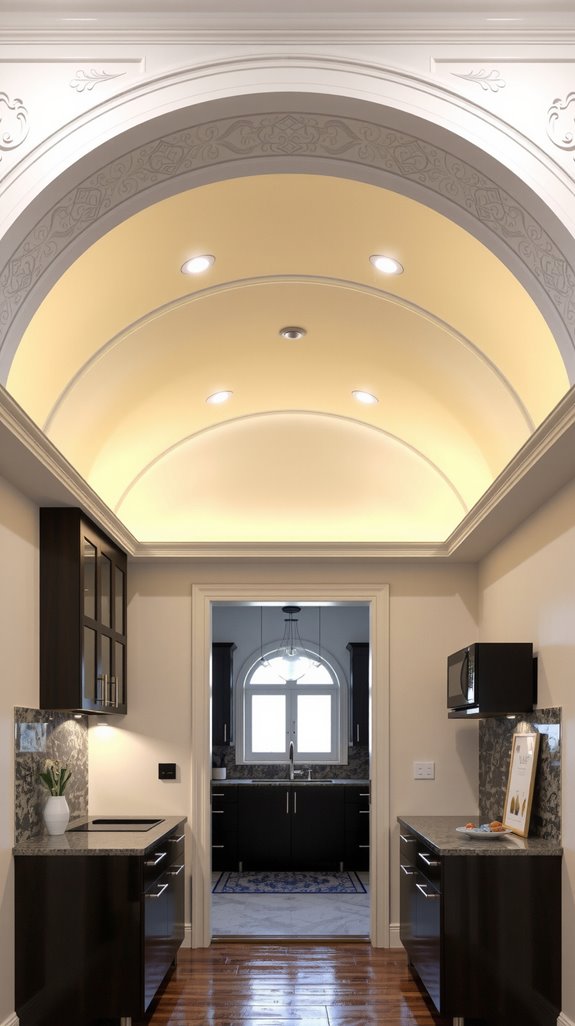
A POP arch false ceiling, POP stands for Plaster of Paris, a gypsum-based material that sets hard and holds its shape, turns a plain kitchen opening into a defined passage zone without adding a door or partition.
The arch softens your door frames’ rigid lines, making the entry feel welcoming rather than just functional.
Because the arch extends into the ceiling plane, it becomes a three-dimensional architectural feature, not just a decorative hole in the wall.
You get a clear visual boundary between kitchen and dining areas while keeping the layout open, cohesive, and free of bulky room dividers. Modern style without heaviness is precisely what makes POP arches a practical choice for transitions between zones.
Curved False Ceiling Edges for a Softer Kitchen Entrance
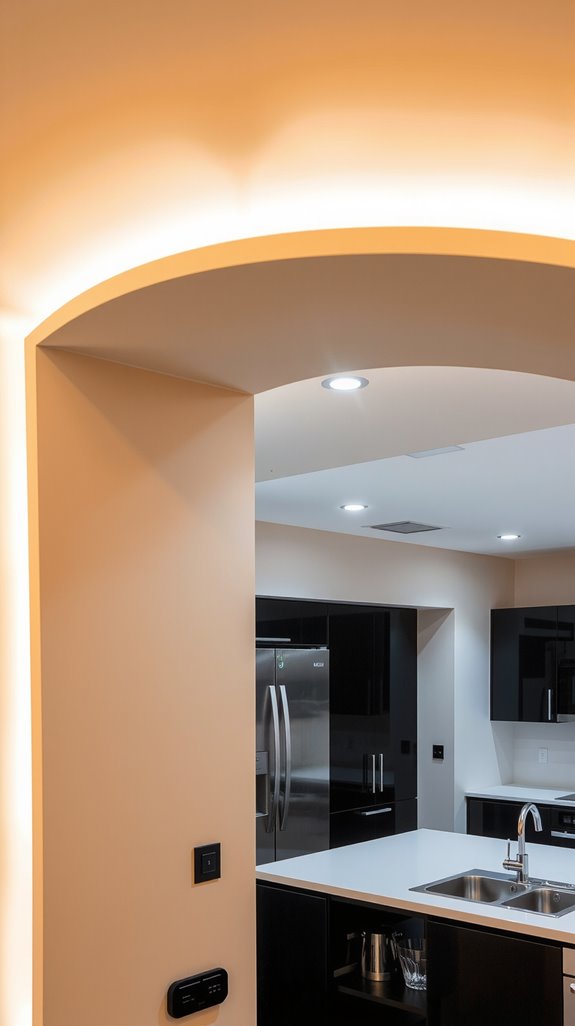
Where a square doorframe chops space into hard blocks, a curved false ceiling edge eases that cut with a sweeping arc, typically a 300 to 600 mm radius depending on your opening width.
You’re not removing a wall, you’re just softening its announcement. Plaster of Paris works well here since its lightweight and moulds cleanly into shallow coves.
Powder-coated aluminium framing suits tighter budgets without sacrificing crispness. Add a concealed warm-white LED strip inside the curve, and that arc pulls double duty as quiet night lighting.
Curved surfaces also collect less dust than sharp corners, which your future self will appreciate. Neutral colors like whites and pastels work particularly well with curved ceiling edges, as they reinforce the illusion of a larger room.
MORE IDEAS: 28 Latest False Ceiling Designs That Make Every Room Look Custom-Built (Living Room, Bedroom, Kitchen & More).
Raised and Dropped Ceiling Layers That Mark Where the Kitchen Begins
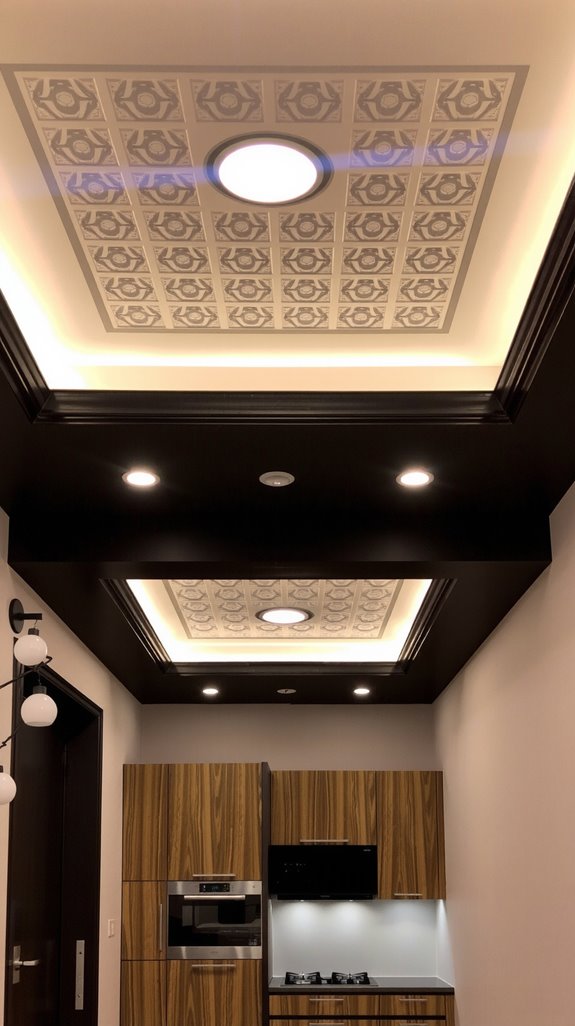
Curved edges soften a doorframe, but sometimes you want the ceiling itself to draw a hard line between rooms. Raised and dropped ceiling layers do exactly that.
A dropped bulkhead, basically a boxed-out section of false ceiling, lowers the plane over your kitchen edge by roughly 12 to 18 inches, signaling a zone change without needing a wall.
Pair it with a raised tray inside the kitchen threshold and you get two distinct levels. That height shift also hides HVAC ducts and exhaust runs.
Use PVC panels in humid zones; gypsum boards work fine elsewhere. For best results, your space should meet the minimum ceiling height of 9 feet before committing to this kind of layered installation.
SEE THIS: 9 Modern Kitchen False Ceiling Designs (Minimal + Functional Styles)!
Wooden Slat False Ceiling Canopies Above the Kitchen Entrance
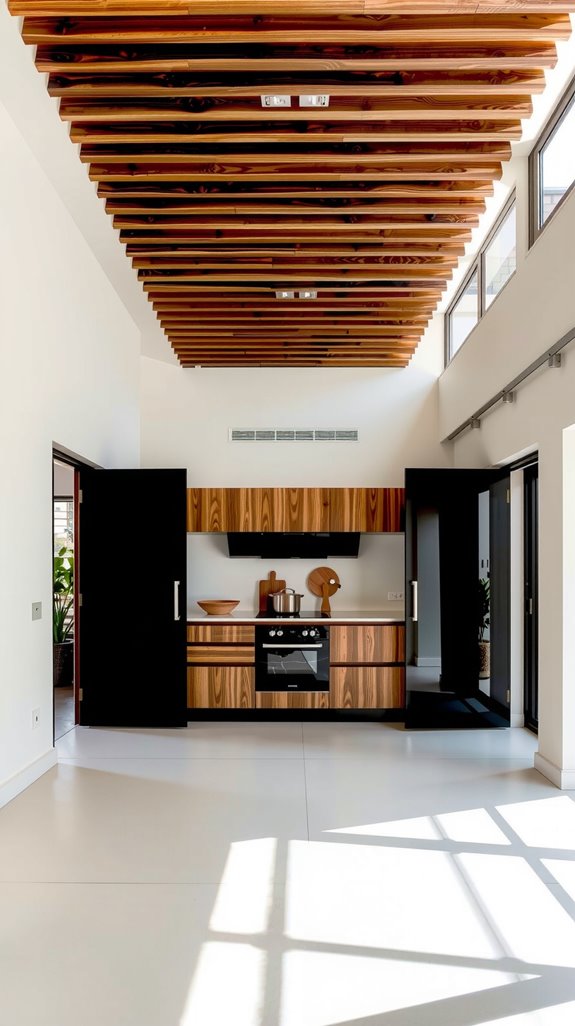
Wooden slats suspended overhead do something a solid dropped ceiling can’t; they mark the kitchen entrance while keeping the space breathing.
Oak or walnut beams, typically spaced two to four inches apart, create a visual threshold without blocking airflow or light. You’re fundamentally telling guests “the kitchen starts here” without building an actual wall.
Tuck LED strip lighting above the slats and you get ambient glow plus the bonus of hiding ventilation ducts behind the framework.
Match the slat finish to nearby cabinetry and the whole change reads as intentional rather than accidental carpentry. The slat design can even extend from ceiling to floor, functioning as a see-through partition that defines separate zones while preserving an open feel.
SEE THIS: 13 False Ceiling Designs for Office Cabin (Clean & Professional Look)!
Cove Lighting False Ceiling Borders at the Kitchen Entrance
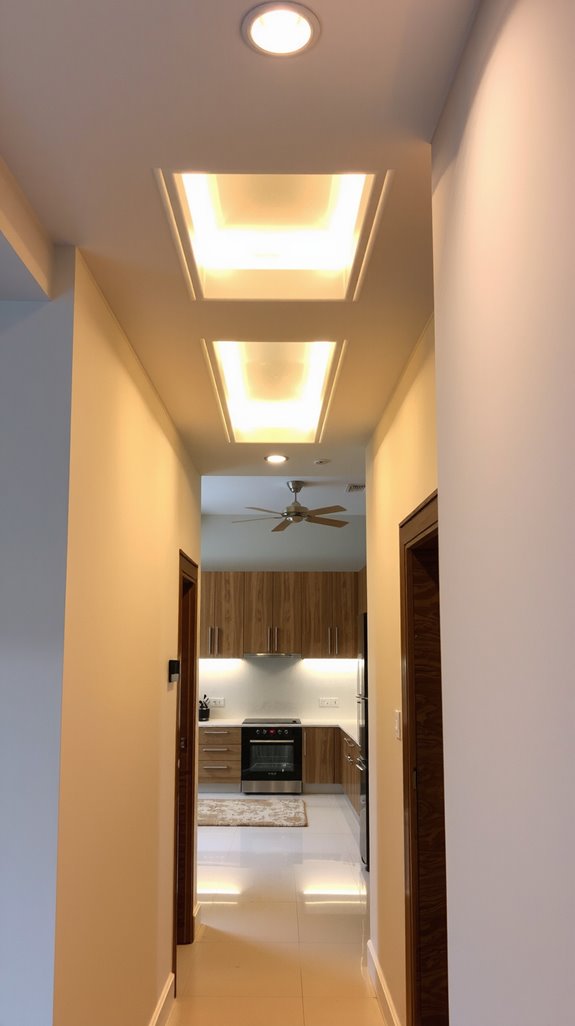
Cove lighting borders work by cutting a recessed channel, usually 6 to 12 inches deep, into the perimeter of a gypsum or POP false ceiling and tucking LED strips inside it.
Light bounces upward or downward along the ceiling edge, creating a soft glow without blinding anyone mid-cooking. You’ll need at least 9 feet of ceiling clearance before attempting this, since the false ceiling drop eats 6 to 12 inches.
For warm ambiance, choose 2700, 3000K LEDs; for task-heavy kitchen zones, go 4000K. Dimmable systems let you dial brightness down at night, which your electricity bill quietly appreciates.
SEE THIS: 11 False Ceiling Designs With Hidden Lighting for a Luxury Look!
Minimalist Tray False Ceilings for Clean Kitchen Entry Transitions
When cove lighting feels like too much drama for a kitchen entry, a minimalist tray ceiling is the quieter fix.
It’s a recessed section cut into the ceiling, usually 3 to 6 inches deep, built from gypsum board with a level-5 drywall finish so smooth it looks machine-made.
You leave an 18 to 24-inch border around the perimeter, keep the shape rectangular, and paint everything the same matte white.
Hide LED strip lighting inside the inner edge; that soft upward glow defines the threshold without announcing itself.
Clean, functional, done.
SEE THIS: 10 Latest False Ceiling Designs for Hall with 2 Fans (Balanced Layout Ideas That Actually Work!
Recessed Spotlight Grids Inside the Kitchen Entrance False Ceiling
A recessed spotlight grid is just a set of downlights arranged in a symmetrical pattern inside a dropped gypsum or POP false ceiling panel, flush with the surface so nothing sticks out.
It sits directly above your kitchen entry zone, creating a clean visual border between your dining or living area and the kitchen.
Space your lights 3 to 4 feet apart so overlapping light cones kill harsh shadows. Use 4000K cool white LEDs with 36 to 60-degree beam angles.
Keep fixture depth under 100mm if your plenums tight. Add a dimmable driver and you’ve covered both midnight snacks and bright meal prep.
Geometric POP False Ceiling Panels at the Kitchen Doorway
Recessed spotlights give you clean, even light, but they don’t give the doorway any visual weight on their own.
That’s where geometric POP panels come in. POP stands for Plaster of Paris, a lightweight, fire-resistant material you can mold into hexagons, chevrons, or interlocking diamond patterns.
It cures smooth and takes paint cleanly. Layering these panels above the kitchen entrance adds actual depth and perceived height to a usually tight space.
You’re fundamentally building a three-dimensional frame that tells anyone walking in: this is where the kitchen starts, no partition needed. The ceiling does the talking.
Contrasting Paint Finishes That Define the Entry Ceiling Frame
Paint does more heavy lifting than most people give it credit for. A luminance contrast ratio of at least 1:3 between your frame border and the surrounding ceiling field makes the entry visually pop. You don’t need moulding.
A semi-gloss or satin finish on the frame against a flat ceiling field creates separation through sheen alone, which works especially well in kitchens under nine feet. Warm beige or terracotta frames signal welcome, cool greige or slate blue signals “now we’re cooking.”
Semi-gloss also resists grease better than flat paint, saving you a ladder climb every few months.
Moisture-Proof False Ceiling Options for Humid Kitchen Entrances
Kitchen entrances sit right at the edge of two worlds, the dry living space and the steam-producing cooking zone, so the ceiling material you pick there matters more than almost anywhere else in the home.
PVC panels are fully waterproof and won’t warp, swell, or rot. If you want a wood look without the wood problems, WPC panels deliver that.
Moisture-resistant gypsum boards like Gyproc Duraline use silicone additives and fiberglass reinforcement to handle humidity.
Which False Ceiling Style Suits Your Kitchen Height and Layout?
How high your ceiling sits and how your kitchen is shaped will determine almost everything about which false ceiling style actually works in that space.
Under 9 feet, keep it flat or use a narrow POP border with concealed LED strips, avoid anything layered. At 9 feet and above, you’ve got room for tray ceilings or two-level plus-minus designs. Open kitchens benefit from a dropped section that visually splits the kitchen from the living area.
Small kitchens need a border-run ceiling with the center left open. L-shaped and U-shaped layouts work best with a central rectangular panel above the island.