Your puja room ceiling is doing the least amount of work in the space right now. A bare slab or a coat of white paint doesn’t exactly set the tone for daily worship.
False ceilings, decorative dropped frameworks typically installed 8 to 12 inches below the original slab, change that fast.
The right design adds light control, acoustic softness, and visual depth. Ten options ahead, ranging from $1.80 to $14.37 per square foot.

Classic Temple-Style Puja Room Ceiling With Dome Carvings and Heritage Detail
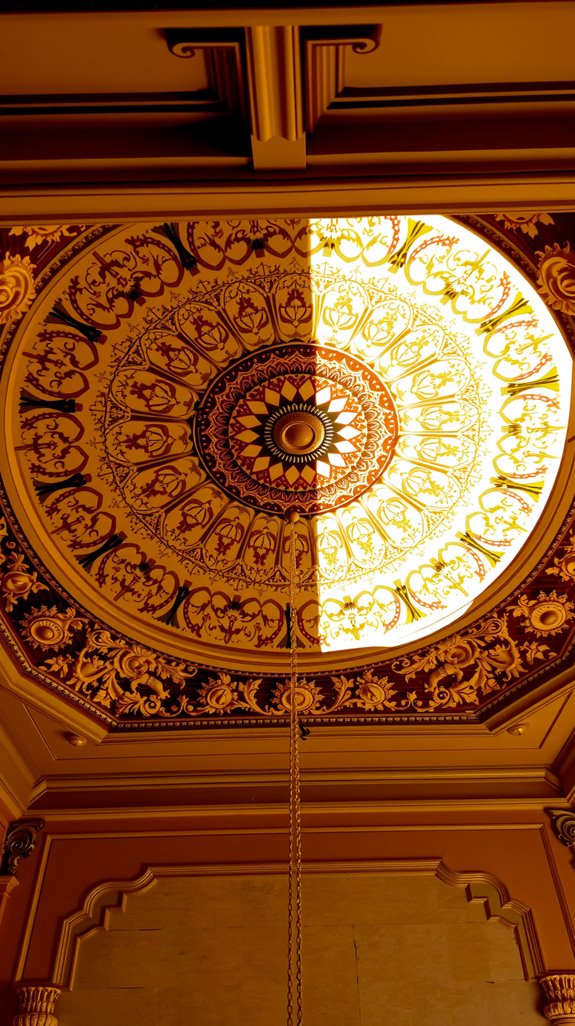
A classic temple-style puja room ceiling borrows its look from the shikhara, the tapered tower you see crowning Hindu temples. You recreate that profile using layered POP rings or stepped gypsum trays stacked into a shallow dome.
Keep the depth between 2 and 3 inches on an 8-foot ceiling, or you’ll be ducking during aarti. Center the dome directly above your deity for proper spiritual alignment.
Carve lotus or Om patterns into the dome face using CNC routing. Run a jaali border, the perforated lattice trim, along the rim to echo authentic temple ceiling changes without importing an actual temple.
Position a mandala medallion at the center of the dome face, ideally sized to one-third the room width, to anchor the spiritual focal point of the entire composition.
SEE THIS: Latest False Ceiling Designs for Bedroom (Cozy + Modern Styles)!
Minimalist POP Ceiling Designs That Hold Their Spiritual Weight
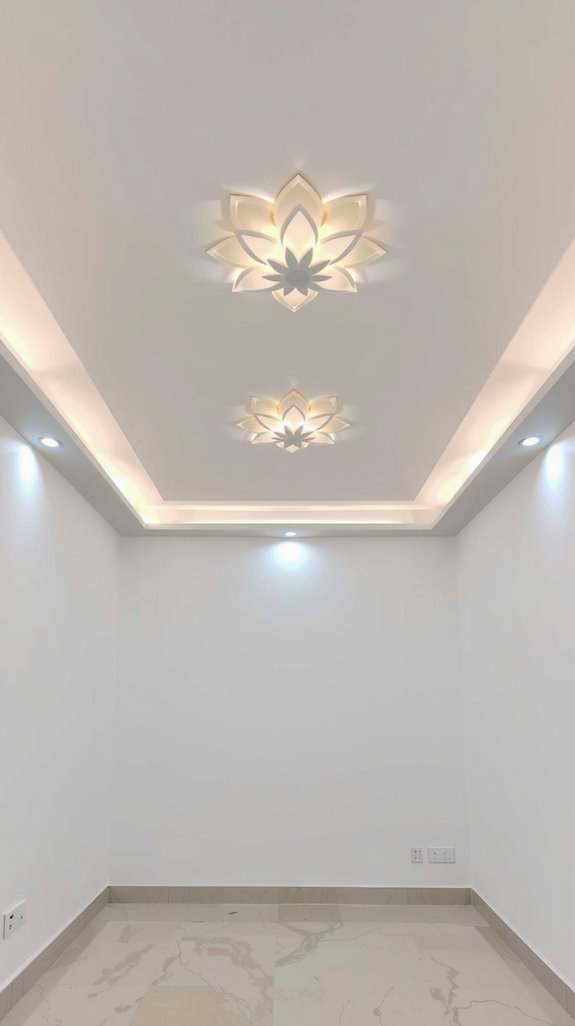
When you strip away the carvings and the jaali borders, you’re left with something that actually takes more skill to pull off: a minimalist POP ceiling that still feels sacred.
A single tray border, 3.5 inches deep, frames your idol area without competing with it. Matte white or cream keeps compact pooja rooms feeling open.
One centered pendant light does the heavy lifting. Cut a clean “Om” or lotus motif into the POP slab, backlight it with 2700K LEDs at CRI 90 or higher and you’ve got a soft halo effect that costs less than intricate jaali ever would. Position your spotlights at a 15–25° angle to the idol to avoid direct glare washing out the motif during rituals.
SEE THIS: 10 Latest False Ceiling Designs for Hall with 2 Fans (Balanced Layout Ideas That Actually Work!
Puja Room Tray Ceiling With Cove Lighting for a Divine Glow
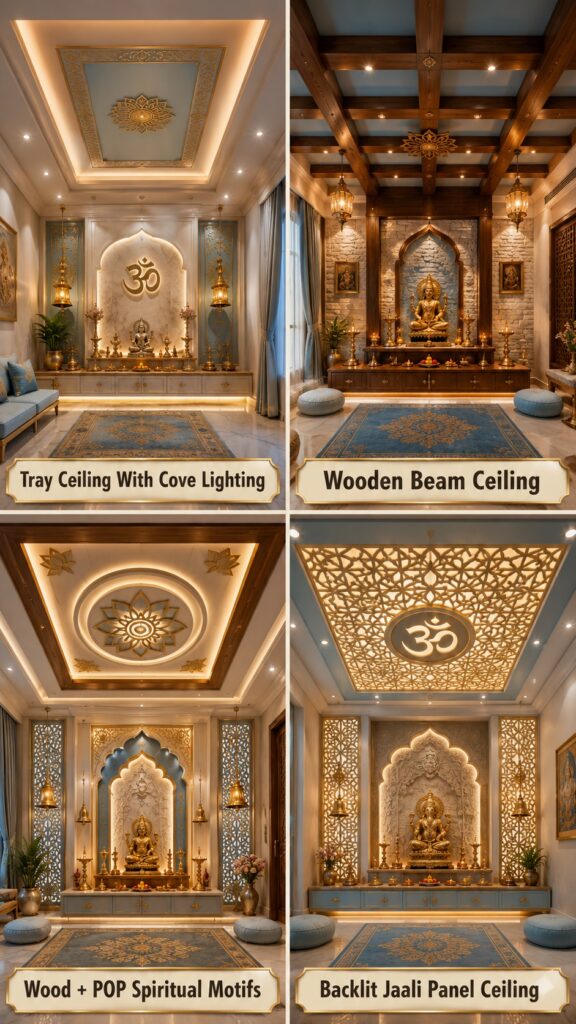
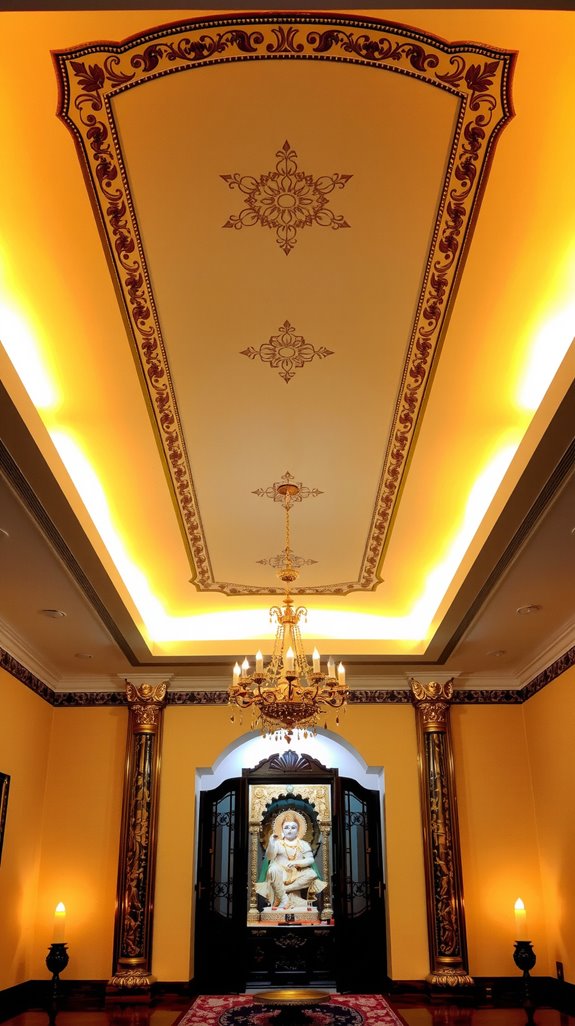
Tray ceilings work on a simple principle: the center drops down 80,100 mm while the surrounding border stays higher, giving your puja room a layered, framed look without adding a single carved element.
Hide LED strips along the inner ledge, 50,80 mm from the wall, and the light bounces upward in a soft, shadowless wash.
Use 2700K,3000K warm white LEDs with CRI 90+ so your brass idols and marigolds look exactly as vivid as they should.
Finish the recessed panel in semi-matte POP with a subtle gold metallic layer and the cove glow does the rest quietly. For small puja zones, a 4 x 4 layout keeps the tray ceiling proportional and prevents the layered border from feeling heavy in rooms with ceilings below 2.6 m.
MORE IDEAS: 28 Latest False Ceiling Designs That Make Every Room Look Custom-Built (Living Room, Bedroom, Kitchen & More).
Lighting Layers That Make a Puja Room False Ceiling Feel Sacred
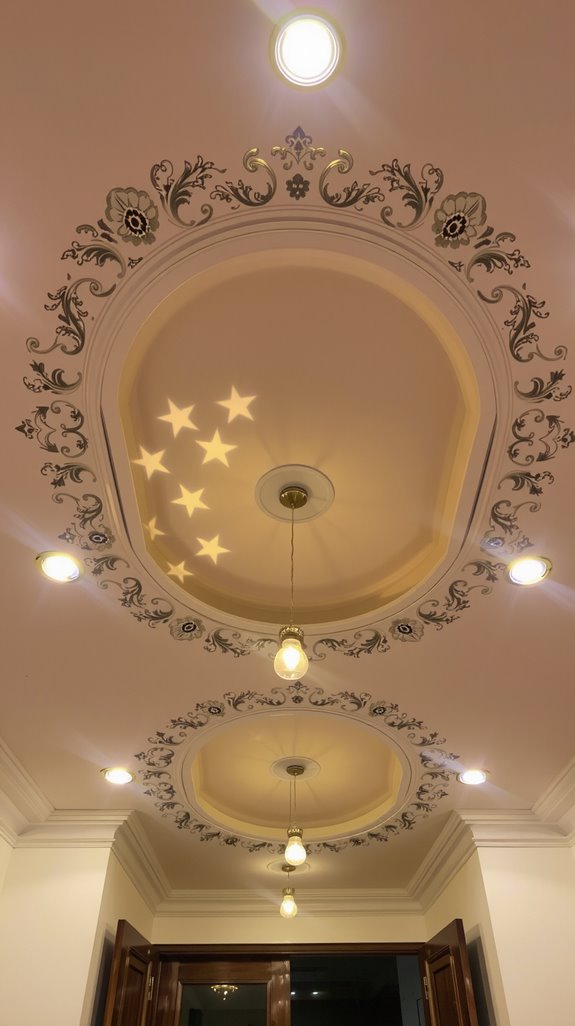
Lighting a puja room isn’t about flooding the space with brightness; it’s about stacking three distinct layers that each do a specific job.
Your ambient base sits between 50-100 lux, using warm white LED strips at 2700-3000K tucked into ceiling coves. That soft glow sets the calm.
Next, accent lights hit 200-300 lux directly on the deity, narrow-beam, high-CRI spotlights rated 90 or above, angled off-axis so polished brass doesn’t blind you.
Finally, task lighting at 150-200 lux handles aarti and scripture reading. Use dimmable, flicker-free drivers so each layer adjusts independently without fighting the others.
Concealed LED strips work particularly well here, as they can highlight wood texture and sacred artefacts simultaneously without introducing a competing light source.
SEE THIS: 11 False Ceiling Designs With Hidden Lighting for a Luxury Look!
Wooden Beam Puja Room Ceiling for Earthy, Rustic Warmth
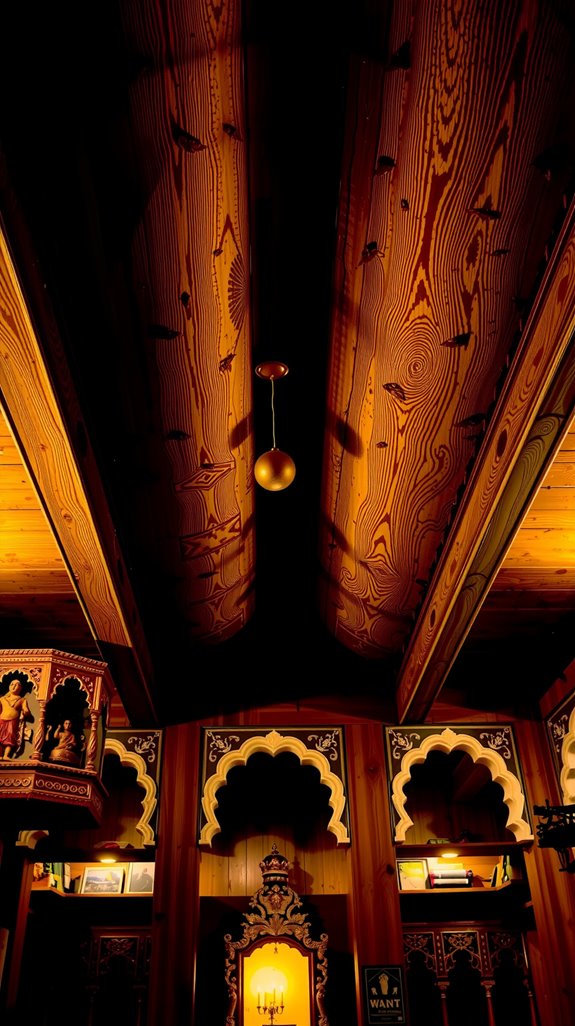
Solid wood beams are one of those ceiling choices that pull double duty: they look good and they actually improve how a puja room feels to sit in.
Wood naturally dampens sound, cutting the echo that hard surfaces create. That quiet matters during meditation.
Teak and sheesham both handle humidity well, which incense smoke will test daily. A dark-finished beam complements brass idols without competing with them.
Conceal warm LED strips along the beam edges to highlight the grain. Over time, the wood develops a patina; it doesn’t age poorly, it just gets more itself.
For a cohesive finish, pairing wood beams with POP elements lets you incorporate spiritual motifs like lotus carvings or Om symbols directly into the ceiling design.
SEE THIS: 13 LED Strip False Ceiling Designs That Create Ambient Lighting Layers!
Wood and POP Ceilings Layered With Spiritual Motifs
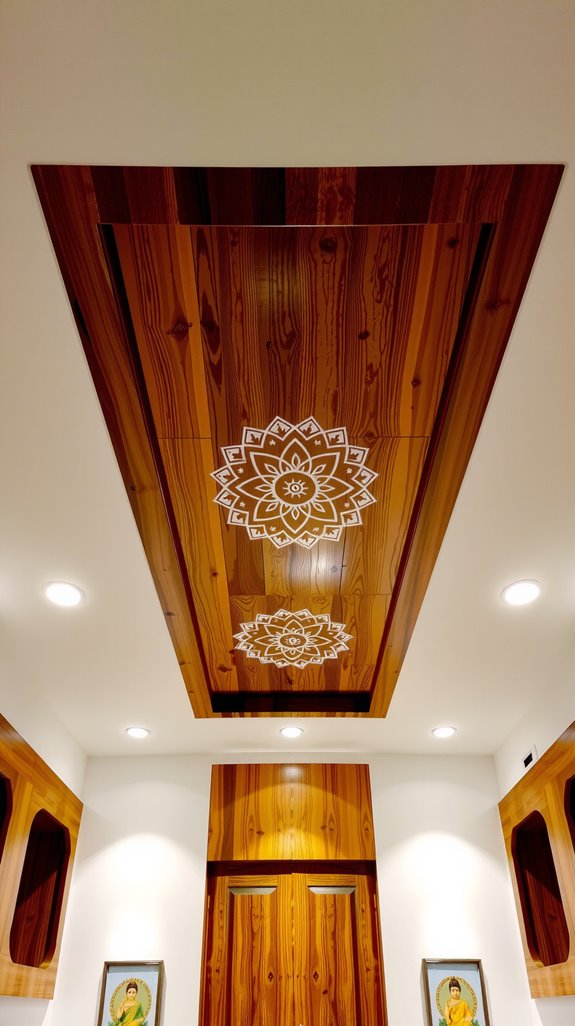
Combining 2 materials, POP (plaster of paris) and wood, lets you build a ceiling that does what neither material can pull off alone.
POP holds crisp raised detail, like an Om symbol or lotus, while wood adds warmth that POP simply can’t fake. A tray-style POP base with wooden inset panels creates a layered, multi-level look that pulls the eye upward.
Embed 2700K LED cove strips between the two layers and your carved motifs get a soft halo glow.
Use MR-grade plywood or teak with a matte polyurethane coat to handle incense smoke without looking dingy.
SEE THIS: 11 Mandir False Ceiling Designs for Home Temples!
Backlit Jaali Panel Ceiling With Sacred Symbol Cutouts
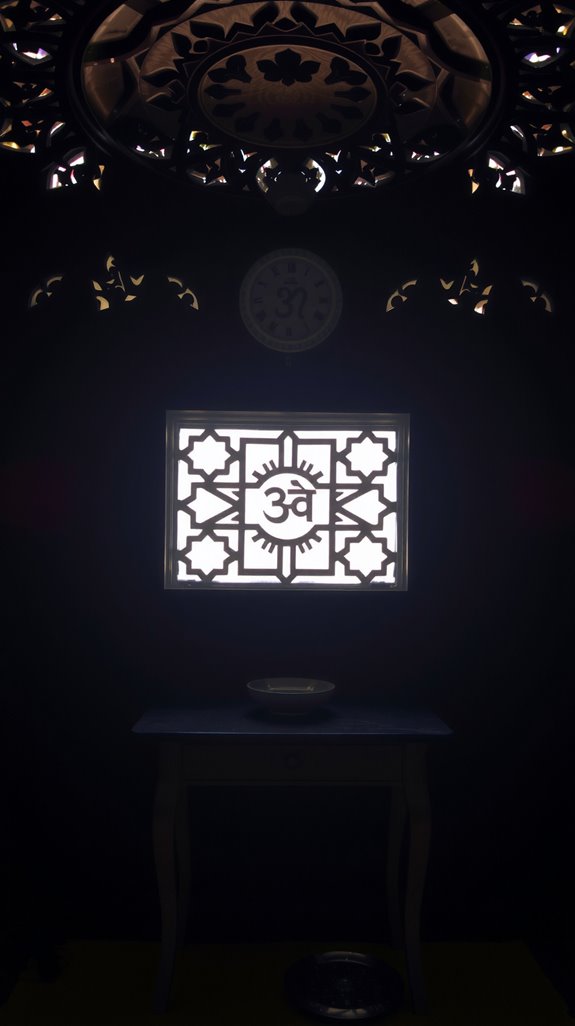
A jaali panel ceiling turns flat overhead space into a light-filtering screen of sacred geometry. You pick a cutout symbol, Om, lotus, or shankha, and CNC-route it into MDF, which cost about $4.19–$5.99 per square foot with backlighting included.
Mount warm white LED strips rated 2700K, 3000K behind a frosted acrylic diffuser, set back 50, 75 mm from the panel. That gap kills hotspots. Keep LED density between 60, 120 LEDs per metre and add a dimmable driver so you’re not stuck at full brightness during quiet morning prayers.
Seal all cutout edges with PU lacquer to block dust buildup.
Mandala and Lotus Ceiling Designs for Puja Rooms
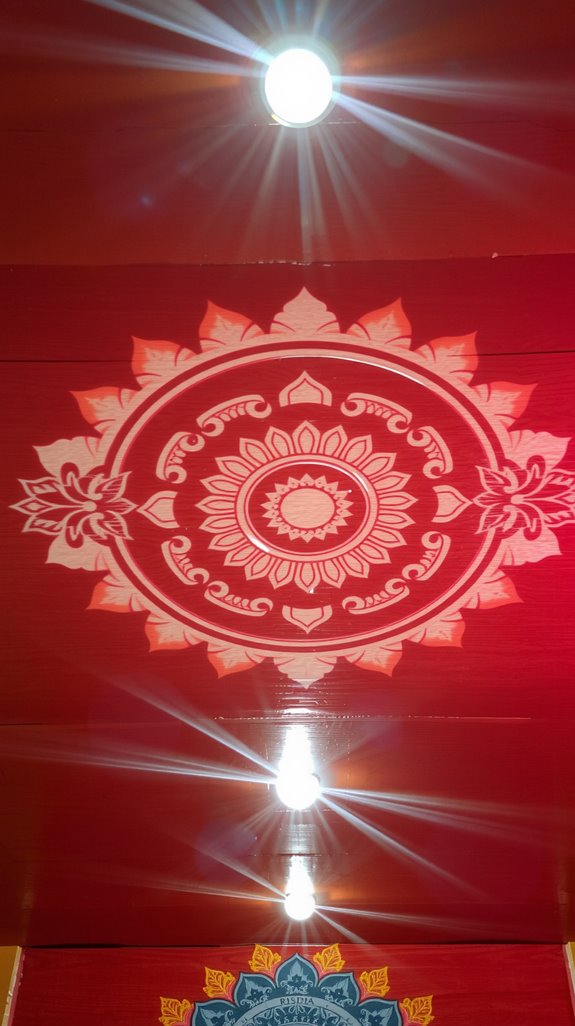
Where jaali panels filter light through cutouts, POP, plaster of paris, carves it into three-dimensional form. A mandala or lotus motif pressed into POP sits roughly 20,25 mm deep, shallow enough to avoid dramatic shadows but present enough to read clearly from below.
Size it at 60,65% of your room’s narrower dimension and align the center with your idol. Tuck linear LEDs into the mandalas groove segments for backlit glow, but leave one quadrant unlit; that contrast keeps the pattern visually alive.
Use 2700,3000K warm light at 50,100 lux ambient so the ceiling supports worship without competing with it.
Stained Glass Puja Ceiling That Casts Colorful Sacred Light
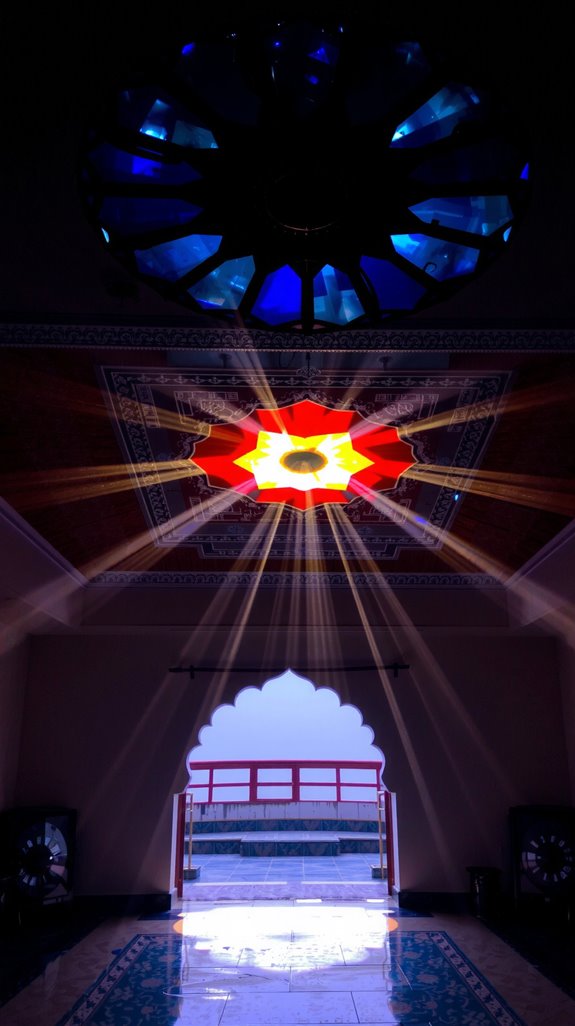
Stained glass ceilings do one thing no other material can: they throw colored light downward onto your idol and floor, turning the room itself into the visual event.
Set leaded panels, glass pieces joined by copper foil, into a gypsum false ceiling with a 2,3 inch recessed housing. Backlight them with 2700K LEDs. Gold tones suggest divinity; blue calms the space.
Traditional motifs like Om, lotus, or Tanjore-style figures translate surprisingly well into colored glass. Dim to 150 lux for meditation, raise to 300 lux for reading.
Apply anti-static coating annually; incense soot finds glass faster than you’d expect.
False Ceiling Cost Breakdown by Material and Design Complexity
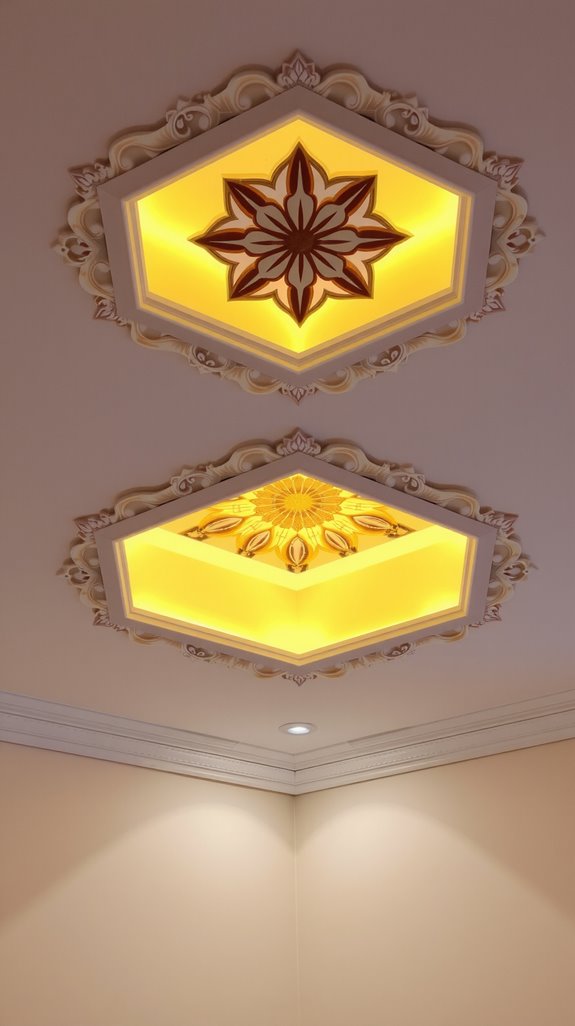
Before you approve any quote, it helps to know what each material actually costs per square foot.
Basic gypsum tray ceilings run $12, $25, including labor. Add dimmable LED strips and drivers and you’re spending another $60, $150.
Engineered wood coffers jump to $22, $45 per sq ft, and solid wood trim inflates that by 30, 50%. Custom laser-cut jaali panels cost $150, $400 each depending on complexity.
Brass L-profiles add $4, $10 per linear foot. Ventilation integration runs $180, $500, or 20, 30% more if you’re retrofitting.
Moisture-resistant gypsum boards in humid spaces tack on $2, $4 per sq ft extra.