Mirror false ceilings aren’t just decorative, they actually reduce your need for artificial lighting by bouncing existing light across the room.
A single 4×8 foot mirror panel can make a 10-foot ceiling feel closer to 14 feet. Your not limited to flat, plain glass either.
Bevelled edges, geometric cuts, and RGB-integrated frames completely change how a space feels. Twelve specific designs prove this, and some will surprise you.
Full-Panel Bevelled Mirror False Ceiling for Halls
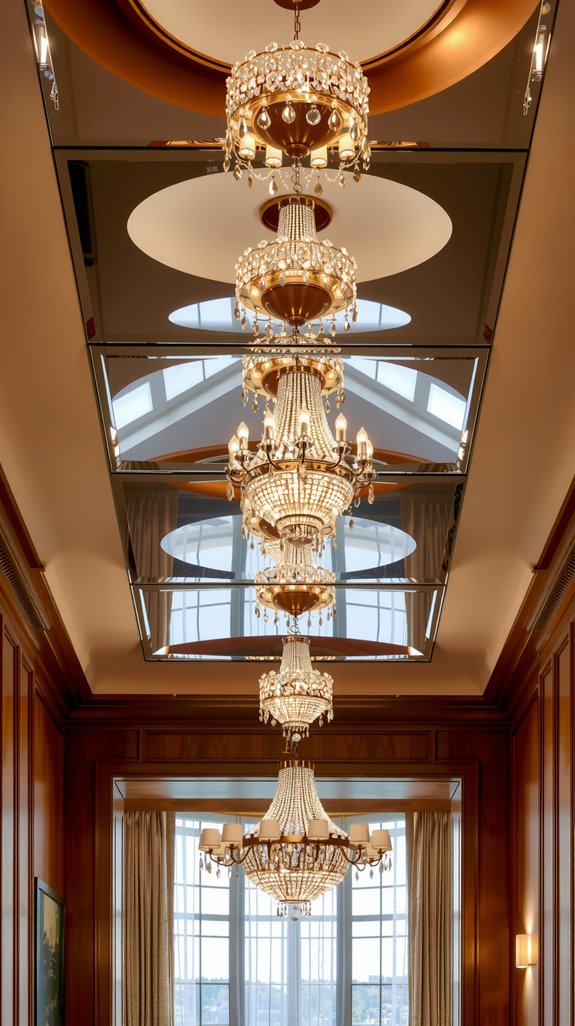
When you replace a standard false ceiling with a full-panel bevelled mirror ceiling in a hall, the room fundamentally lies to your eyes in the best possible way.
The mirror doubles perceived ceiling height instantly. Each panel runs 4mm to 6mm thick, sitting on a reinforced plywood or gypsum substrate that carries the full load safely.
Bevelled edges, cut 1 to 1.5 inches wide, catch light at multiple angles, adding subtle geometry without feeling busy.
Budget about $3.59–$8.38 per sq. ft., including materials and specialized labor.
Larger halls actually lower your per-square-foot cost slightly, which is a rare win. Recessed lights placed alongside the mirrored panels create a warm, inviting atmosphere that further amplifies the reflective luxury of the ceiling.
SEE THIS: 11 Latest Gypsum Board False Ceiling Design Ideas (Budget to Premium).
Single-Layer Square Mirror False Ceiling for Pooja Rooms
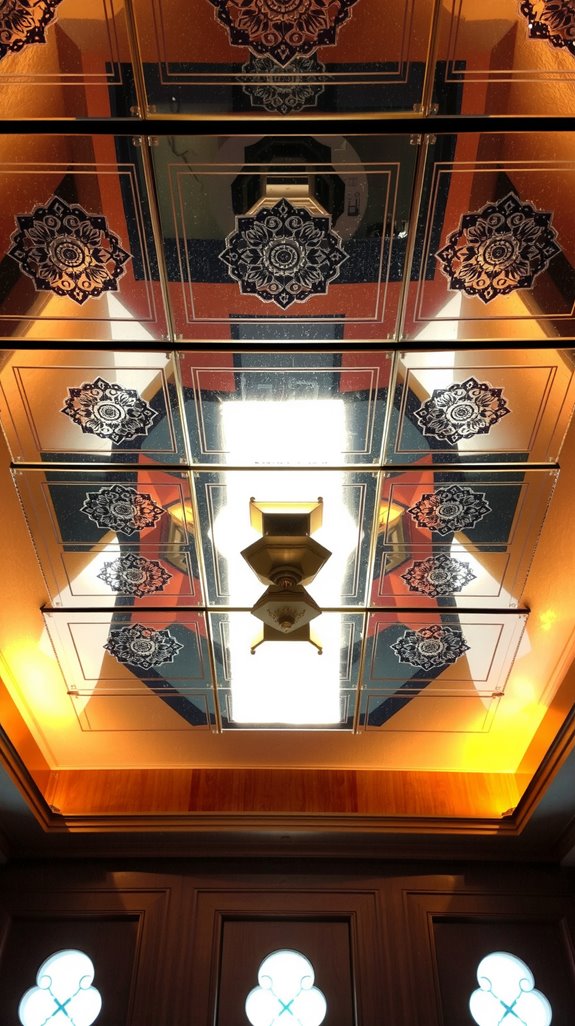
Halls reward mirror ceilings with drama, but pooja rooms ask for something quieter and more deliberate.
A single-layer square false ceiling in gypsum or POP keeps things clean without feeling sterile. You get one flat level, bevelled mirror panels inset at the center, and a white or pastel border around the frame. Simple.
The bevelled edges cut light at an angle, scattering it softly rather than bouncing it aggressively. Add warm LED cove lighting along the inner edges, and the mirror lifts the room’s perceived height without competing with the mandir below.
SEE THIS: 10 Farmhouse Style False Ceiling Designs for Kitchen Spaces!
L-Shaped Mirror False Ceiling With Accent Panels
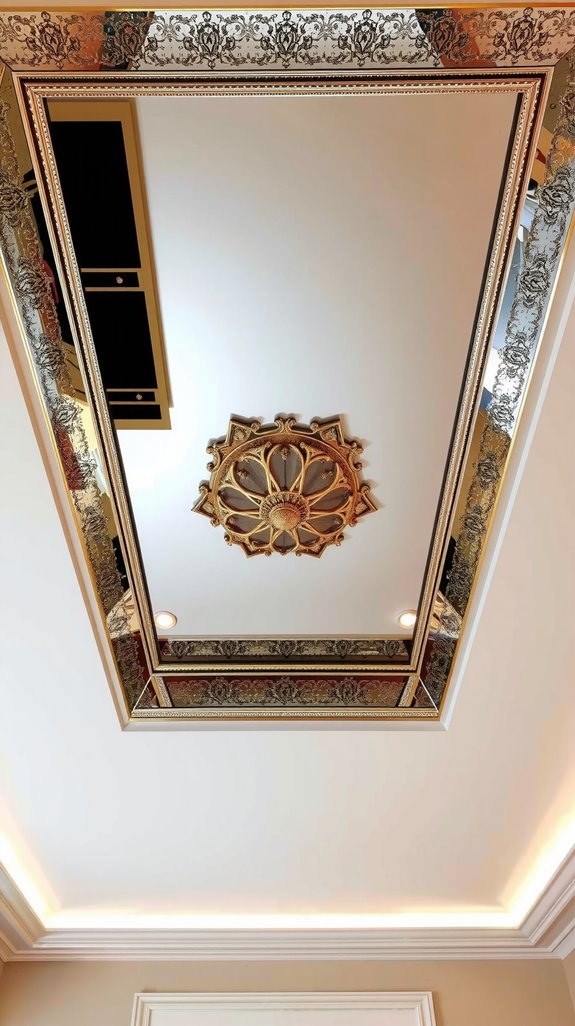
A pooja room keeps things meditative, but an L-shaped mirror false ceiling is built for rooms that want to make a statement.
This layout runs mirror panels along two connecting ceiling planes, doubling light and making narrow halls look wider instantly. You’ll need at least 9-foot ceilings to avoid feeling like you’re inside a disco ball.
The base uses gypsum or POP, with beveled glass or reflective laminates as the mirror surface. Add LED cove lighting along the L-profiles inner edge, and the whole ceiling glows evenly.
MORE IDEAS: 28 Latest False Ceiling Designs That Make Every Room Look Custom-Built (Living Room, Bedroom, Kitchen & More).
Double L-Shaped Mirror Ceiling With Central Chandelier
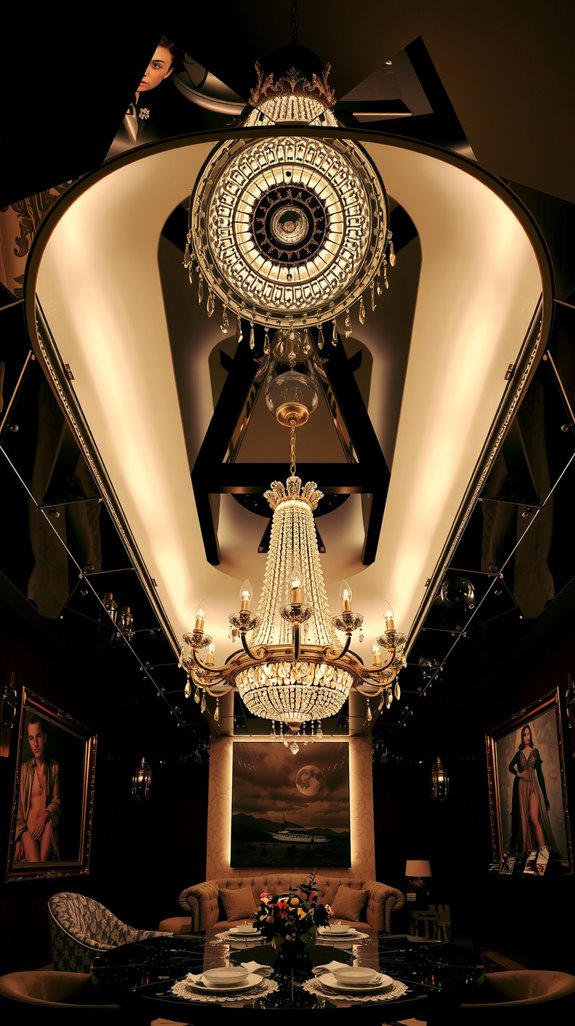
Where the single L-shaped version plays it relatively safe, the double L-shaped mirror ceiling doubles down, literally.
Two descending planes create serious depth, with the inner L sitting higher and holding the mirror panels, usually 3mm acrylic, not glass, while the outer L stays matte white for contrast.
Your chandelier mounts directly into the original slab with the false ceiling built around that electrical box. Mirror surfaces boost perceived brightness by 30–50%, so you’re running fewer downlights.
Stick with 2700K–3000K warm LEDs to avoid harsh glare. You’ll need at least 10-foot ceilings before attempting this, the double drop eats 8–14 inches.
SEE THIS: 13 False Ceiling Designs for Office Cabin (Clean & Professional Look)!
Geometric Patterned Mirror False Ceiling Layouts
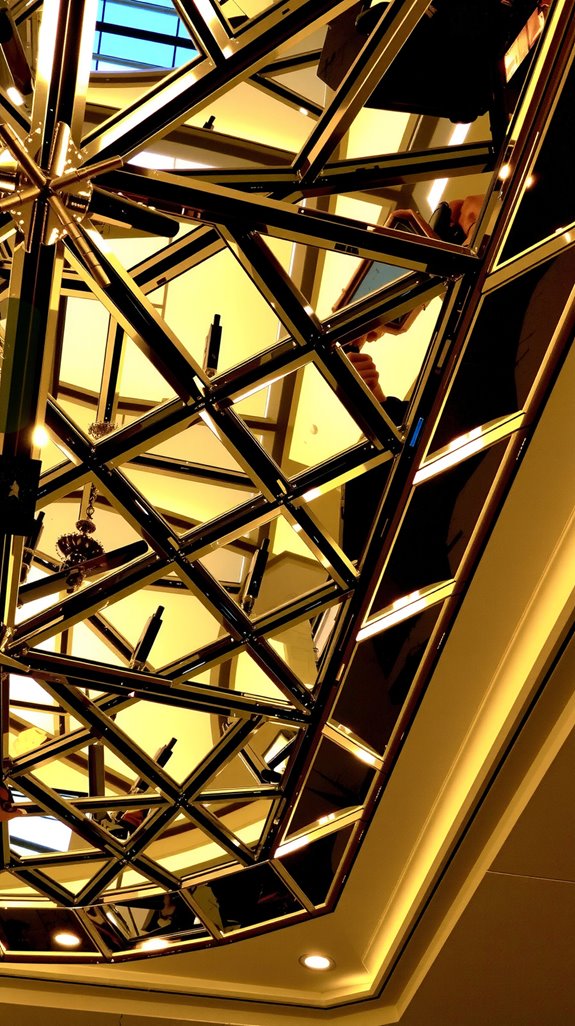
Geometric patterned mirror ceilings trade the soft curves of traditional false ceilings for hard angles, hexagons, triangles, squares, and chevrons cut into a gypsum or POP base with mirror panels inlaid into the recessed sections.
Bevelled edges on the mirrors catch and refract light, adding polish without extra effort. Pair clear or tinted mirrors with white-painted gypsum borders to keep things clean.
Cove lighting along the perimeter creates a floating ceiling effect, while recessed spotlights prevent dark spots on reflective surfaces.
SEE THIS: 10 CNC Cut False Ceiling Designs That Add Pattern & Detail!
Coffered Mirror False Ceiling With Recessed Panels
Coffered ceilings divide your ceiling into a grid of recessed square or rectangular panels, and the mirror version simply fits bevelled glass into each recess instead of leaving them painted and flat.
The bevelled edges catch light cleanly, bouncing it across the room without turning your ceiling into a disco ball. Frames are typically wood, MDF, or metallic trim over a gypsum base.
Add recessed LED downlights or cove lighting inside each coffer and those mirrors actually work for you, amplifying both natural and artificial light noticeably. This design adds significant architectural interest to the space, making the ceiling itself a defining feature of the room’s overall aesthetic.
Vintage Tin Tile Mirror False Ceiling Designs
Pressed tin ceiling panels go back to the 1880s, when manufacturers stamped them from steel and tin-plated the surface to slow rust, giving middle-class homes a cheap shortcut to Victorian plasterwork opulence.
Today, the Victorian Mirror pattern, Pattern 110, replicates that look with a hammered border, leafy inner edge, and flat mirror-like center available in over 25 finishes.
Real 24″×24″ steel tiles weigh about 2 lbs each and they need periodic lacquer to prevent oxidation.
Prefer zero maintenance? PVC faux tiles weigh 6 oz, cut with scissors, and accept custom paint without ever rusting.
Minimalist Mirror False Ceiling Designs for Bedrooms
Where pressed tin tiles lean into ornamentation, minimalist mirror false ceilings strip everything back to clean lines, flat surfaces, and deliberate negative space. The empty area around mirror panels keeps the ceiling from feeling chaotic.
You’re working with a tight material palette: mirror panels, matte POP or gypsum, and maybe a slim aluminum frame. A single rectangular mirror panel centered over your bed creates a focal point without turning the ceiling into a funhouse.
Pair it with 2700K LED strips tucked behind the panel edge and you get a soft halo glow that feels intentional rather than accidental.
Full Mirror Ceilings for Walk-In Closets and Dressing Areas
If minimalist mirror ceilings are the quiet option, full mirror ceilings are the commitment. You’re covering the entire overhead surface, typically with tempered glass or acrylic panels ranging from 3mm to 6mm thick.
Acrylic weighs less, which makes ceiling anchoring considerably easier.
The payoff is real. A mirrored ceiling can visually double your closet’s square footage without touching a single wall. It also bounces light downward, eliminating shadow pockets on shelving and in corners.
Installation requires anchoring into joists or a reinforced grid using French cleat systems or overhead-rated mirror adhesive. Please, hire a professional. Gravity isn’t forgiving.
Cove Lighting Effects for Mirror False Ceilings
Cove lighting does two jobs at once: it hides the light source and bounces illumination off the mirror panels above. The recessed channel sits behind a gypsum or POP border, so you never see the actual LED strip.
Warm LEDs at 2700K, 3000K suit pooja rooms, creating a soft glow without harsh shadows. Cool white at 4000K, 5000K works better for contemporary spaces, making the room feel sharper and bigger.
Bevelled mirror edges refract that cove light into prismatic patterns, which adds depth without adding bulk. One LED profile installed cleanly does a lot of visual heavy lifting.
Mirror False Ceilings With RGB Mood Lighting Effects
Static cove lighting is elegant, but RGB systems let you swap the entire mood of a room without touching a single fixture.
Addressable LEDs, each diode independently programmable, let you run animated patterns across a mirror ceiling like a low-resolution video display.
Semi-transparent metallized PVC membranes need at least 12,15% light transmissivity so the illumination penetrates without showing individual diode hotspots.
Keep RGB arrays more than 50 millimeters from the membrane or heat warps it permanently. DMX controllers sync color shifts to music, smartphone apps handle brightness and presets.
Mirror False Ceiling Costs and Budget Breakdown
A mirror false ceiling‘s final price tag surprises most people, not because it’s outrageous, but because the costs stack up across four distinct layers: materials, labor, framework, and long-term maintenance.
Basic mirrored glass panels run about $2.16–$5.39 per sq. ft. Acrylic sheets cost less at $0.96–$2.40 per sq. ft., but they scratch easily.
Labor adds $0.60–$1.80 per sq. ft., with higher costs for ceilings over 10 feet that need scaffolding. GI metal grid framework adds another $0.24–$0.54 per sq. ft.
Simple designs usually land around $2.99–$5.39 per sq. ft. all-inclusive, while fully custom etched work can cross $11.98 per sq. ft. Annual professional cleaning costs roughly $0.30 per sq. ft.